Confrontation
面质
What is confrontation in counseling?
Confrontation is a counseling skill in which the counselor points out discrepancies in what a client presents, such as between words and actions, words and facial expression, or two statements, and invites the client to examine them.[1][2] The aim is to help the client face the situation, not to argue or blame.[3]
Six common discrepancies
Two ways to raise it
Schematic; the examples and sample lines are made up.
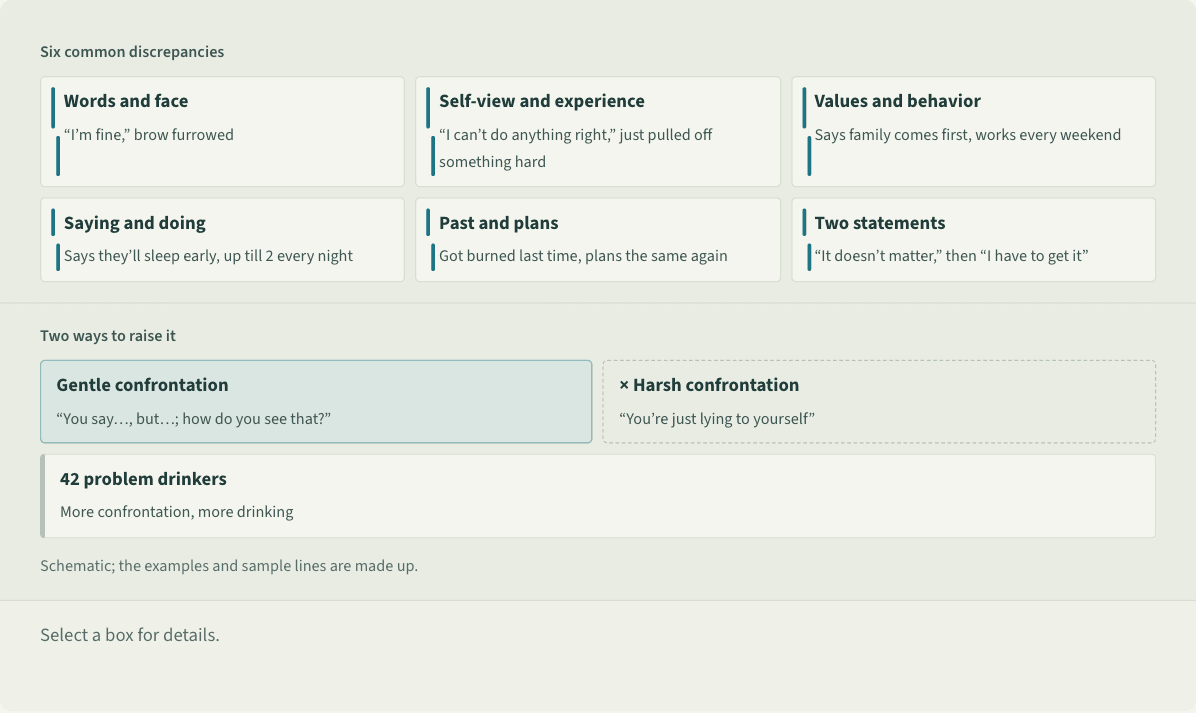
Schematic. At the top, labeled six common discrepancies, six cards: words and face (says “I’m fine,” brow furrowed); self-view and experience (says “I can’t do anything right,” just pulled off something hard); values and behavior (says family comes first, works every weekend); saying and doing (says they’ll sleep early, up till 2 every night); past and plans (got burned last time, plans the same again); two statements (“it doesn’t matter,” then “I have to get it”). Below, labeled two ways to raise it: on the left, a solid box, gentle confrontation, with the line “You say…, but…; how do you see that?”; on the right, a dashed box, harsh confrontation, with the line “You’re just lying to yourself”. At the bottom, a card: 42 problem drinkers, more confrontation, more drinking.
 Save as image (PNG)
This figure image is licensed CC BY 4.0: reuse it with credit and a link back to this page. How to reuse
Key points
- One textbook lists six common discrepancies: verbal versus nonverbal messages, self-beliefs versus experience, values versus behavior, words versus actions, past experience versus future plans, and one statement versus another.[2]
- Early definitions cast it as a counselor-led push for clients to face themselves realistically. The focus later shifted to discrepancies clients may not see, and many texts say “challenging” or “caring confrontation.”[2]
- US addiction treatment once relied on harsh, humiliating confrontation. Four decades of research produced no trial showing it worked, and several found harm, such as more dropout and faster relapse.[3]
- Among 42 problem drinkers randomized to confrontational or client-centered counseling, outcomes did not differ significantly overall, but more counselor confrontation predicted more drinking a year later (r = .65).[4]
An example
Jay says missing the promotion “doesn’t matter,” but he looks at the floor as he says it, and last month he called it a must-win. Lin doesn’t argue, and says only, “You say it doesn’t matter, but you look down when you talk about it, and last month you really wanted it. Put together, how do you see that?”
Misreadings and limits
Confrontation is often taken to mean calling someone out or winning the argument. The APA dictionary notes it can be disruptive as well as constructive,[1] and addiction research shows that confronting tends to raise defensiveness.[3] White and Miller treat facing reality as the goal, best reached in a safe, empathic relationship rather than by force.[3]
Sources
- 1 American Psychological Association (2018). Confrontation. APA Dictionary of Psychology (updated April 19, 2018). View source
- 2 Bakes, A. S. (2012). Helpful strategies for teaching effective confrontation skills. Ideas and research you can use: VISTAS 2012 (Vol. 1, Article 36). American Counseling Association. View source
- 3 White, W. L., & Miller, W. R. (2007). The use of confrontation in addiction treatment: History, science and time for change. Counselor, 8(4), 12–30. View source
- 4 Miller, W. R., Benefield, R. G., & Tonigan, J. S. (1993). Enhancing motivation for change in problem drinking: A controlled comparison of two therapist styles. Journal of Consulting and Clinical Psychology, 61(3), 455–461. doi:10.1037/0022-006X.61.3.455
Last checked against sources: October 28, 2026