ORID focused conversation method
ORID 焦点讨论法
What is the ORID focused conversation method?
The ORID focused conversation method is a way of leading group discussions developed by the Institute of Cultural Affairs (ICA): a facilitator asks questions at four levels in turn, objective, reflective, interpretive and decisional, so the talk moves from facts everyone saw to a concrete decision.[1][4]
Four levels, asked in order
Uses and evidence
Schematic. The order of the levels, the sample questions and the uses come from ICA Associates’ method overview and dispute template; ICA notes the template is not meant to be used as is, so questions should be rewritten for each occasion.
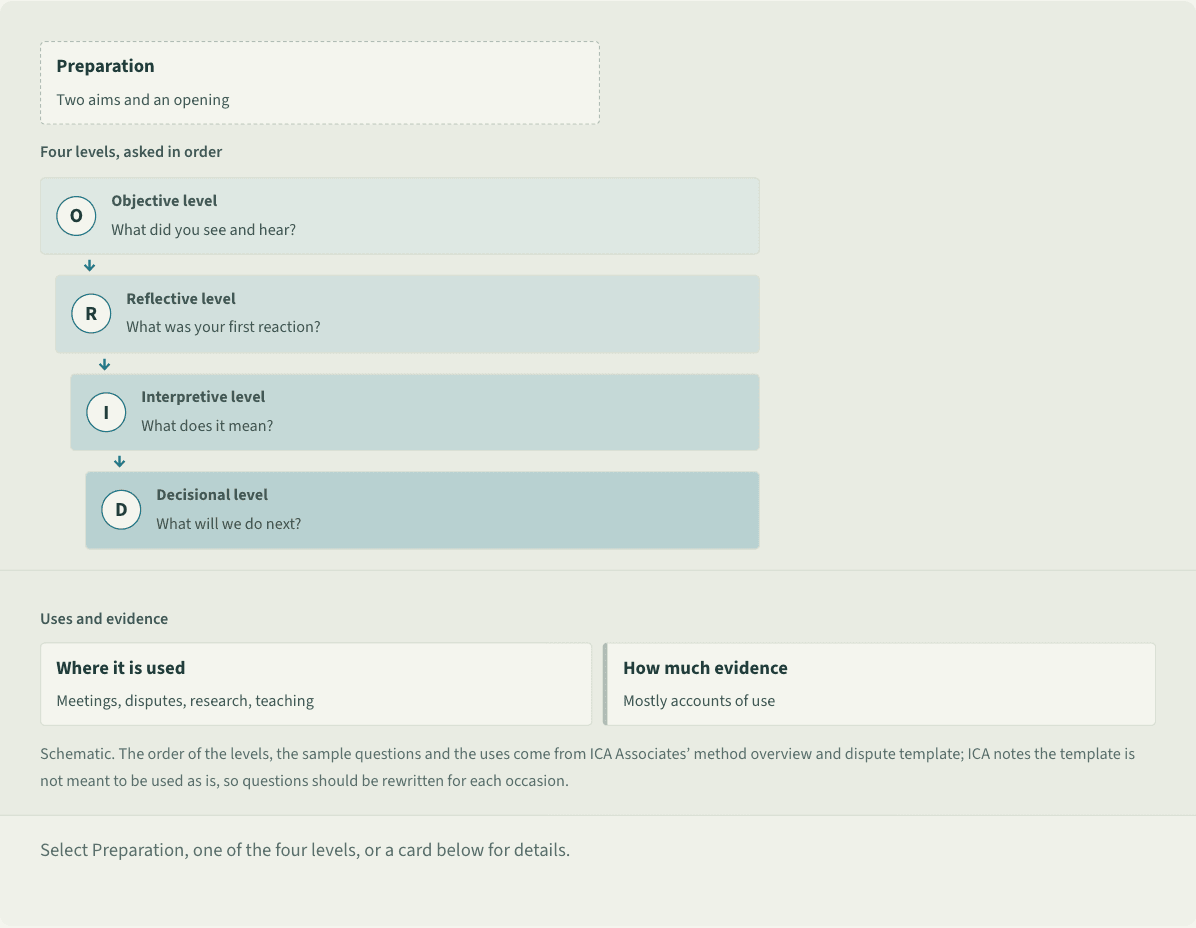
A schematic. One card at the top covers preparation: set a rational aim and an experiential aim, choose the experience or material the group will discuss, prepare two or three questions per level, and write an opening and a closing. Four cards below it are joined by arrows from top to bottom: O, the objective level, asks what people saw and heard; R, the reflective level, asks for first reactions, surprises and worries; I, the interpretive level, asks what it means; D, the decisional level, asks what happens next and who is responsible. Two cards at the bottom: one lists uses, including project reviews, planning, performance conversations, conflict and team relationships, research and teaching; the other covers evidence: the peer-reviewed papers consulted describe how it was used and do not compare its effects with other ways of running a discussion.
 Save as image (PNG)
This figure image is licensed CC BY 4.0: reuse it with credit and a link back to this page. How to reuse
Key points
- Each level asks one kind of question: objective, what did you see and hear; reflective, first reactions and worries; interpretive, what it means; decisional, next steps and who does what.[1]
- To prepare, set a rational and an experiential aim and write two or three specific questions per level. When leading, do not skip levels because someone jumps ahead.[1][2]
- ICA’s dispute template gathers facts from all sides, asks which part upsets people most, explores causes, effects on each person and possible solutions, then records the group’s decision.[2]
- It also appears in research and teaching: a public health team analyzed interview data with it,[3] and a university course used it to structure reflection papers, noting its explicit feelings stage.[4]
An example
Lin and Jay are roommates who keep arguing about cleaning. Ms. Wang sits down with them and asks each to say what actually happened at home this week, then which part annoyed them most, then what it means to each of them. Finally they draw up a chore chart together and agree to check in next week.
Misreadings and limits
It is often said to follow the natural way people think and to be backed by science; that is ICA’s own claim.[1] The peer-reviewed papers consulted describe how it was used and do not compare its effects with other ways of running a discussion; one analyzed reflection papers from just 11 students, and its authors call for validating their revised model.[3][4]
Sources
- 1 ICA Associates (2026). The Art of Focused Conversation: Transform your meetings with the four-level ORID method. ICA Associates (Canada), News. View source ICA Associates is licensed by the Canadian Institute of Cultural Affairs (ICA Canada) to use the Technology of Participation (ToP) methods; the page also promotes its paid course.
- 2 ICA Associates (2023). Focused conversation for resolving a dispute. ICA Associates (Canada), News. View source
- 3 Fritzen-Pedicini, C., Bleasdale, S. C., Brosseau, L. M., Moritz, D., Sikka, M., Stiehl, E., & Jones, R. M. (2019). Utilizing the focused conversation method in qualitative public health research: A team-based approach. BMC Health Services Research, 19, 306. doi:10.1186/s12913-019-4107-0
- 4 Kayan Fadlelmula, F., & Qadhi, S. M. (2024). Beyond the classroom: Integrating the ORID model for in-depth reflection and assessment in service-learning. Education Sciences, 14(9), 987. doi:10.3390/educsci14090987
Last checked against sources: October 28, 2026