Psychoanalysis
精神分析
What is psychoanalysis?
Psychoanalysis is Sigmund Freud’s theory of the mind, personality and psychological disorders, and a method for investigating and treating them.[1][2] It holds that much mental activity is unconscious, and uses free association, dream interpretation and analysis of resistance and transference to bring repressed conflicts into awareness.[1][2]
In the consulting room
Later forms and debates
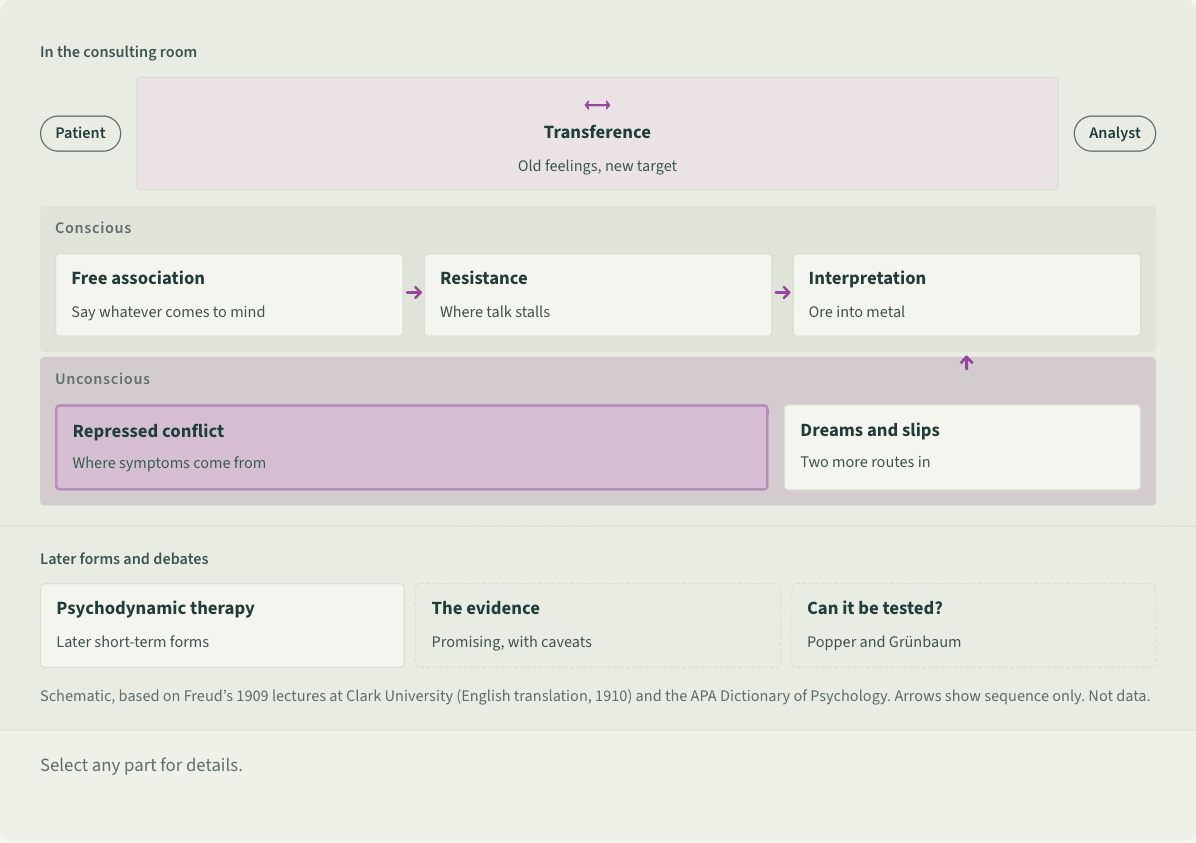
Schematic, based on Freud’s 1909 lectures at Clark University (English translation, 1910) and the APA Dictionary of Psychology. Arrows show sequence only. Not data.
Schematic in two parts. The top part is labeled in the consulting room. Small labels for patient and analyst sit at either end, joined by a two-way arrow labeled transference. In the middle, three cards are linked left to right by arrows: free association (say whatever comes to mind), resistance (where talk stalls) and interpretation (ore into metal). Below the cards is a dark band, repressed conflict, labeled unconscious, set against a light area above labeled conscious; beside the band is a card, dreams and slips, labeled two more routes in. The bottom part, labeled later forms and debates, has three cards: psychodynamic therapy (later short-term forms), the evidence (promising, with caveats) and can it be tested? (Popper and Grünbaum); the last two have dashed borders. A note says the figure is a schematic: arrows show sequence only, not data.
 Save as image (PNG)
This figure image is licensed CC BY 4.0: reuse it with credit and a link back to this page. How to reuse
Key points
- It began with a young woman whom Josef Breuer treated from 1880 and who called it her “talking cure.” Freud later dropped hypnosis and had patients say whatever came to mind.[1]
- Freud named patients’ failure or refusal to recall resistance and inferred repression from it. He also analyzed slips of the tongue and called dream interpretation the royal road to the unconscious.[1]
- Patients redirect old love and hostility onto the physician, which Freud called transference and saw as the main carrier of therapeutic influence.[1] Contemporary psychoanalysis keeps the unconscious but largely sets drives aside.[2]
- Its successor, psychodynamic therapy, also comes in short-term forms.[3] A Cochrane review of 33 randomized trials found these beat wait-list or usual care, though study quality varied.[3]
An example
Ms. Wang freezes whenever she reports to her boss. In psychodynamic counseling, the therapist invites her to say whatever comes to mind. Talking, she recalls her father scolding her in front of others. Later they notice that with the therapist, too, she keeps bracing for disapproval.
Misreadings and limits
“Psychoanalysis has been debunked” and “psychoanalysis is proven” both overreach. Popper held it could not be tested; Grünbaum replied that it can be, but its clinical evidence is contaminated by the analyst’s suggestion.[4] The trials pooled by the Cochrane review tested later short-term psychodynamic therapy, and its authors urge caution.[3]
Sources
- 1 Freud, S. (1910). The origin and development of psychoanalysis (H. W. Chase, Trans.). American Journal of Psychology, 21(2), 181–218. doi:10.2307/1413001
- 2 American Psychological Association (2023). Psychoanalysis. APA dictionary of psychology (updated November 15, 2023). View source
- 3 Abbass, A. A., Kisely, S. R., Town, J. M., Leichsenring, F., Driessen, E., De Maat, S., Gerber, A., Dekker, J., Rabung, S., Rusalovska, S., & Crowe, E. (2014). Short-term psychodynamic psychotherapies for common mental disorders. Cochrane Database of Systematic Reviews, 2014(7), CD004687. doi:10.1002/14651858.CD004687.pub4
- 4 Thornton, S. (2026). Karl Popper. The Stanford Encyclopedia of Philosophy (Fall 2026 ed., E. N. Zalta & U. Nodelman, Eds.). View source
Last checked against sources: October 28, 2026