Transference and countertransference
移情与反移情
What are transference and countertransference?
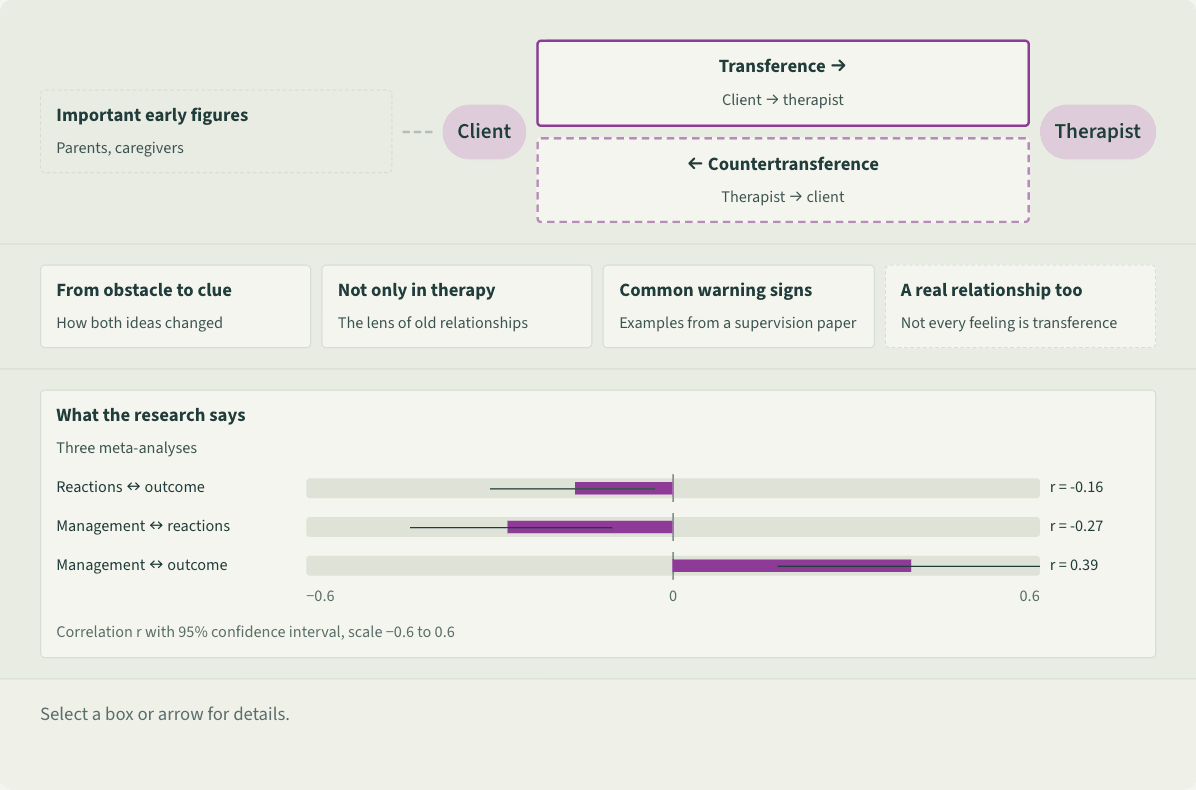
Transference is a client’s unconscious shifting onto the therapist of feelings and wishes once aimed at important early figures such as parents. Countertransference is the therapist’s reaction to the client and that transference, rooted in the therapist’s own needs and conflicts.[1] Both terms come from psychoanalysis but are used in other therapies too.[1]
Schematic. On the left, a dashed box labeled important early figures, such as parents and caregivers, with a dashed line to the client in the middle. Between the client and the therapist on the right are two arrows: the upper one, from client to therapist, is labeled transference; the lower one, from therapist back to client, countertransference. Below are four cards: from obstacle to clue, not only in therapy, common warning signs, and a real relationship too. At the bottom, a bar chart titled what the research says shows three correlations with 95% confidence intervals: countertransference reactions and outcome −0.16 (−0.30 to −0.03, 14 studies); countertransference management and reactions −0.27 (−0.43 to −0.10, 13 studies); management and outcome 0.39 (0.17 to 0.60, 9 studies).
 Save as image (PNG)
This figure image is licensed CC BY 4.0: reuse it with credit and a link back to this page. How to reuse
Key points
- Psychoanalysis first saw transference as resistance that hampered treatment, later as central to it.[2] Countertransference likewise went from a hindrance to a clue about how the client affects other people.[1]
- Transference is not confined to therapy. In social-cognitive models, mental representations of significant others are triggered by similar cues, so people see new acquaintances through those old lenses.[1][2]
- A paper on CBT supervision lists typical countertransference problems: running over time or meeting outside sessions, advising clients who should decide for themselves, and attraction that blurs boundaries.[2]
- Meta-analyses link countertransference reactions modestly to poorer outcomes (r = −.16) and good countertransference management to better ones (r = .39), with wide variation between studies.[3]
An example
Jay is late to every counseling session and says, “You’ll get fed up with me like my dad did.” His counselor, Ms. Wang, notices she is in fact growing impatient. Instead of snapping at him, she takes the feeling to supervision to sort out what comes from Jay’s behavior and what comes from her own history.
Misreadings and limits
In Chinese, 移情 is not only transference: China’s standardized terms also use it for empathy in rhetoric, medical aesthetics and general practice, while counseling psychology uses 共情 for empathy.[4] Nor is everything a client feels toward a therapist transference; part of it is a real relationship.[2]
Sources
- 1 American Psychological Association (2018). Transference; Countertransference. APA Dictionary of Psychology (entries updated April 19, 2018). View source
- 2 Prasko, J., Ociskova, M., Vanek, J., Burkauskas, J., Slepecky, M., Bite, I., Krone, I., Sollar, T., & Juskiene, A. (2022). Managing transference and countertransference in cognitive behavioral supervision: Theoretical framework and clinical application. Psychology Research and Behavior Management, 15, 2129–2155. doi:10.2147/PRBM.S369294
- 3 Hayes, J. A., Gelso, C. J., Goldberg, S., & Kivlighan, D. M. (2018). Countertransference management and effective psychotherapy: Meta-analytic findings. Psychotherapy, 55(4), 496–507. doi:10.1037/pst0000189
- 4 全国科学技术名词审定委员会 (2011–2019). 移情;反向移情;共情(规范术语条目). 术语在线(《心理学名词》2014、《精神医学名词》2019 等). View source
Last checked against sources: October 28, 2026