Freudian dream interpretation
弗洛伊德的释梦理论
How did Freud interpret dreams?
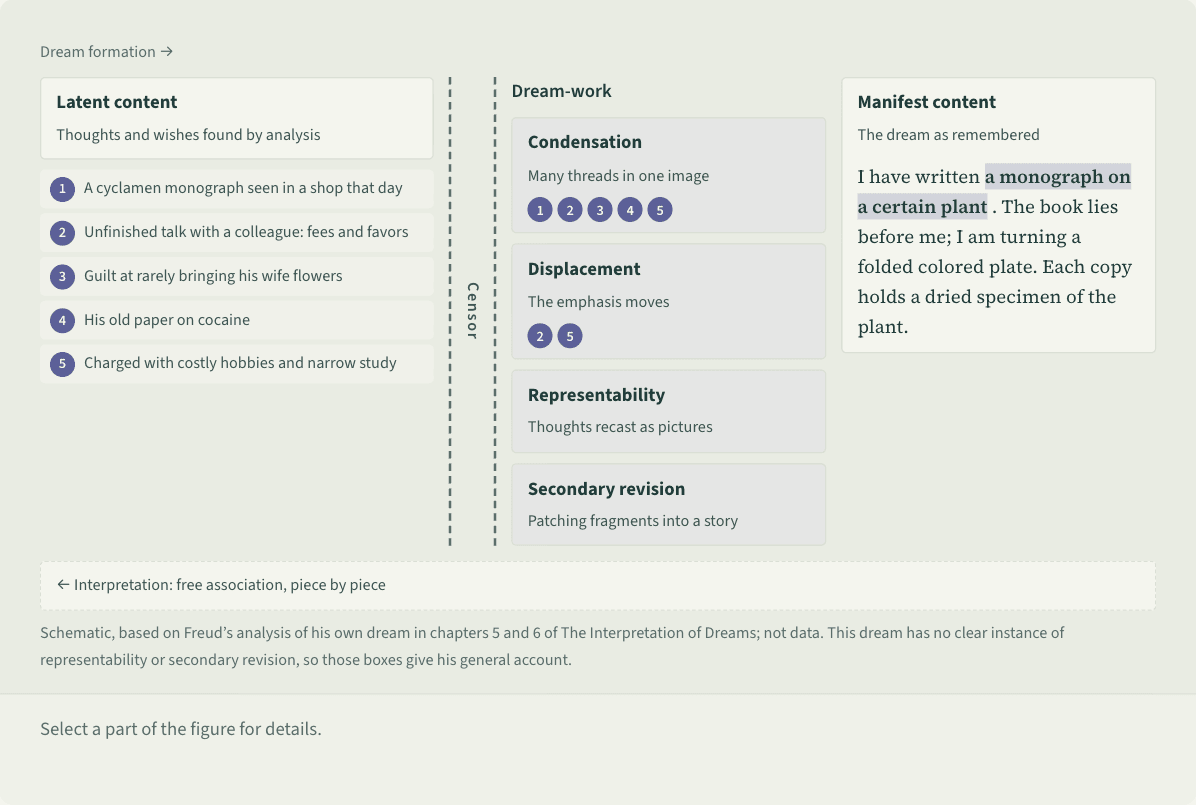
In The Interpretation of Dreams (1900), Sigmund Freud argued that a dream is the disguised fulfillment of a repressed wish. The dream-work turns hidden dream thoughts (the latent content) into the dream as remembered (the manifest content), and interpretation follows the dreamer’s free associations back from one to the other.[1]
- 1 A cyclamen monograph seen in a shop that day
- 2 Unfinished talk with a colleague: fees and favors
- 3 Guilt at rarely bringing his wife flowers
- 4 His old paper on cocaine
- 5 Charged with costly hobbies and narrow study
Dream-work
Schematic, based on Freud’s analysis of his own dream in chapters 5 and 6 of The Interpretation of Dreams; not data. This dream has no clear instance of representability or secondary revision, so those boxes give his general account.
Schematic in three columns, left to right. The left column, latent content, lists five threads Freud found behind his dream of the botanical monograph: a monograph on cyclamens he had seen in a bookshop window that day; an unfinished talk the evening before with an eye-specialist colleague about fees and favors between doctors; self-reproach for rarely bringing his wife the flowers she liked; a paper on cocaine he had once written; and the charge that he indulged his hobbies and studied too narrowly. The threads pass a gate labeled censor into the middle column, the dream-work, with four boxes: condensation, displacement, representability and secondary revision. The condensation box shows all five threads merging into the monograph in the right column, and the displacement box marks the two core threads (fees and favors, hobbies). The right column is the manifest content: he had written a monograph on a certain plant, the book lay before him, he was turning a folded colored plate, and each copy held a dried specimen of the plant. An arrow along the bottom, from right to left, is labeled interpretation: free association, piece by piece.
 Save as image (PNG)
This figure image is licensed CC BY 4.0: reuse it with credit and a link back to this page. How to reuse
Key points
- The manifest content is the dream as remembered; the latent content is the thought that analysis uncovers. Freud held that even painful dreams fulfill wishes, disguised by an inner censor.[1][2]
- He named four dream-work processes: condensation (many thoughts packed into one image), displacement (emphasis moved to minor details), representability (thoughts recast as pictures) and secondary revision (fragments patched into a story).[1]
- He split a dream into pieces and asked the dreamer to report every idea each piece brought up, holding nothing back. He rejected dream books that assign images fixed meanings.[1]
- Laboratory studies find most dreams coherent and tied to the dreamer’s waking concerns.[2][3] Domhoff argues that this kind of evidence is why most dream researchers no longer accept Freud’s theory.[3]
An example
Lin dreams she cannot find a pen during an exam and wakes with her heart pounding. Following Freud, an analyst would not tell her what the pen stands for. Lin would instead say whatever comes to mind about each piece, the exam room, the pen, and the analyst would look in those associations for the wish behind the dream.
Misreadings and limits
Online “Freudian dream dictionaries” give each image a fixed meaning. Freud did list common sexual symbols, but warned they are not shorthand signs: some must be read literally, and meanings vary by dreamer.[1] As a general law the wish theory fares poorly: young children’s dreams are mostly bland, and nightmares that keep returning after trauma are hard to call wish fulfillments.[3]
Sources
- 1 Freud, S. (1913). The interpretation of dreams (A. A. Brill, Trans.; original work published 1900). Macmillan. Project Gutenberg eBook #66048. View source
- 2 Spielman, R. M., Jenkins, W. J., & Lovett, M. D. (2020). 4.3 Stages of sleep. Psychology 2e. OpenStax. View source
- 3 Domhoff, G. W. (2004). Why did empirical dream researchers reject Freud? A critique of historical claims by Mark Solms. Dreaming, 14(1), 3–17. doi:10.1037/1053-0797.14.1.3
Last checked against sources: October 27, 2026