Comfort zone
舒适区
What is the comfort zone?
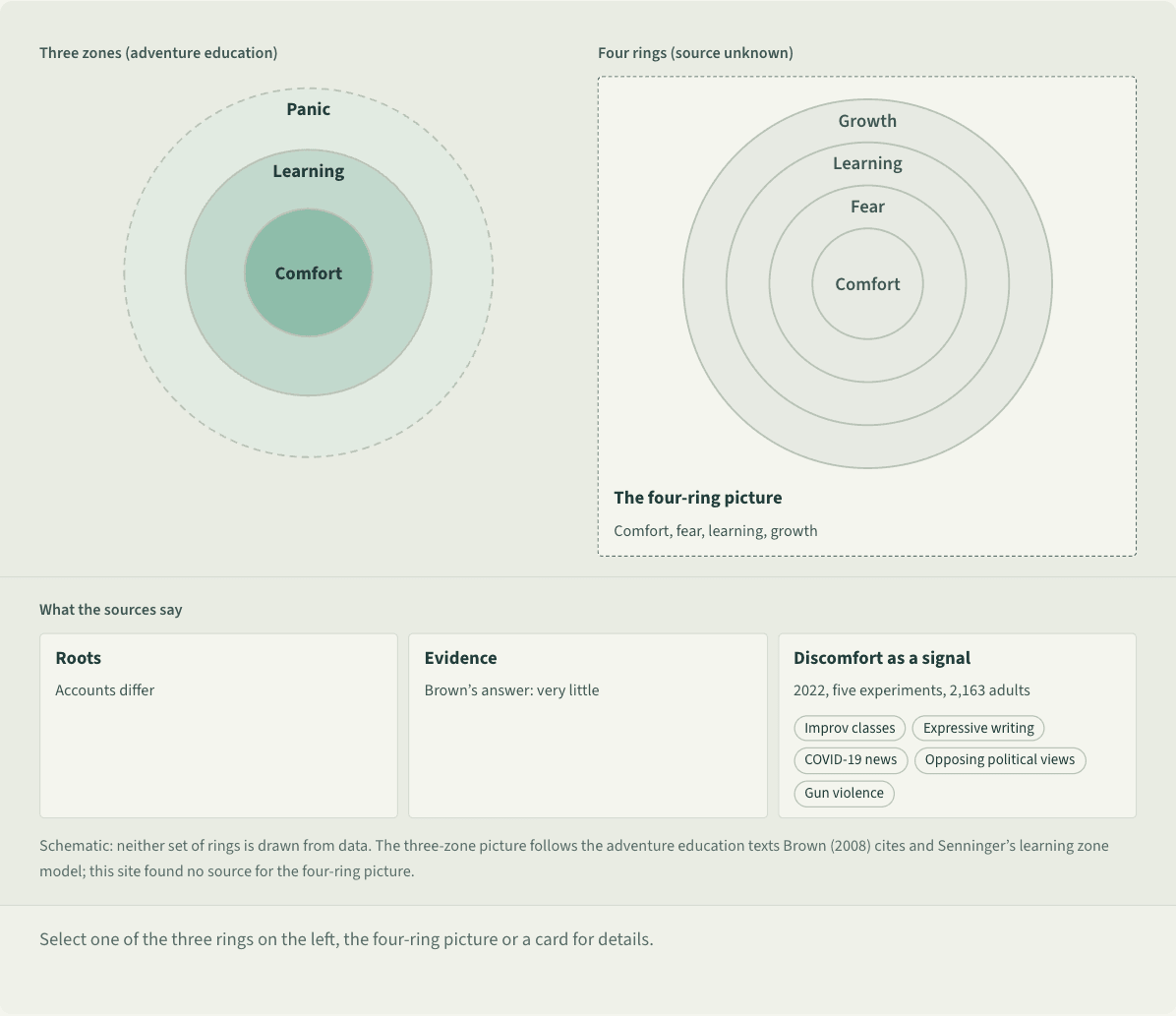
The comfort zone is the range of familiar situations in which a person feels safe and need not take risks.[2] The popular model holds that growth comes from stepping into a challenging learning zone, while going too far lands people in a panic zone; it spread through adventure education with little research behind it.[1][2]
Three zones (adventure education)
Four rings (source unknown)
What the sources say
Schematic: neither set of rings is drawn from data. The three-zone picture follows the adventure education texts Brown (2008) cites and Senninger’s learning zone model; this site found no source for the four-ring picture.
Left, three nested circles: the comfort zone at the center, the learning zone (also called the growth or stretch zone) in the middle ring, and the panic zone in the outer ring. Right, four nested circles labeled from the inside out comfort, fear, learning and growth, marked source unknown. Three cards below. The first, roots: Brown traces the comfort zone model to Piaget’s idea of disequilibrium and to cognitive dissonance theory, while Palethorpe and Wilson see the Yerkes–Dodson law as the basis of the comfort–stretch–panic models. The second, evidence: Brown found no comfort zone theory in the main education and psychology databases, cites a study in which the activities that pushed students out of their comfort zone were not necessarily those they learned most from, and suggests using it only as a metaphor after an activity. The third, discomfort as a signal: five experiments in 2022 with 2,163 adults, covering improv classes, expressive writing, COVID-19 news, opposing political views and gun violence; people told to treat discomfort as a sign of growth engaged more and felt they achieved more, but only in areas that bring immediate discomfort.
 Save as image (PNG)
This figure image is licensed CC BY 4.0: reuse it with credit and a link back to this page. How to reuse
Key points
- Adventure education texts often draw three rings, comfort, growth or learning, and panic, and present them before rock climbing or ropes courses to urge students to stretch themselves.[1]
- German adventure educator Tom Senninger’s learning zone model has the same three zones. A training group that teaches it stresses that the borders differ by person and situation: invite, never push.[2]
- Accounts of its roots differ. Brown traces it to Piaget’s disequilibrium and Festinger’s cognitive dissonance;[1] others see the Yerkes–Dodson law as its basis and hold that moderate stress spurs learning.[3]
- In five experiments with 2,163 adults, people told to treat awkwardness as a sign of growth engaged more and felt they achieved more than controls, but only where growth brings immediate discomfort.[4]
An example
Lin has just joined her company’s English speaking club. Before her first talk her palms sweat and she wants to quit. She reminds herself that the awkwardness means she is learning a new skill, speaks for two minutes in the club first and signs up for a department talk next month, rather than offering to host the company’s year-end party.
Misreadings and limits
A common misreading is that the more uncomfortable you feel, the more you grow. Brown notes that stressful situations do not guarantee learning, and experiences too far from what people know may be dismissed; he suggests treating the comfort zone as a metaphor to discuss after an activity, not a basis for program design.[1] Seeking discomfort helped only in some areas.[4]
Sources
- 1 Brown, M. (2008). Comfort zone: Model or metaphor?. Australian Journal of Outdoor Education, 12(1), 3–12. doi:10.1007/BF03401019
- 2 ThemPra Social Pedagogy (n.d.). The learning zone model. ThemPra Social Pedagogy: Social pedagogy concepts. View source
- 3 Palethorpe, R., & Wilson, J. P. (2011). Learning in the panic zone: Strategies for managing learner anxiety. Journal of European Industrial Training, 35(5), 420–438. doi:10.1108/03090591111138008
- 4 Woolley, K., & Fishbach, A. (2022). Motivating personal growth by seeking discomfort. Psychological Science, 33(4), 510–523. doi:10.1177/09567976211044685
Last checked against sources: October 28, 2026