Feelings wheel (Willcox)
情绪词汇轮
What is the feelings wheel?
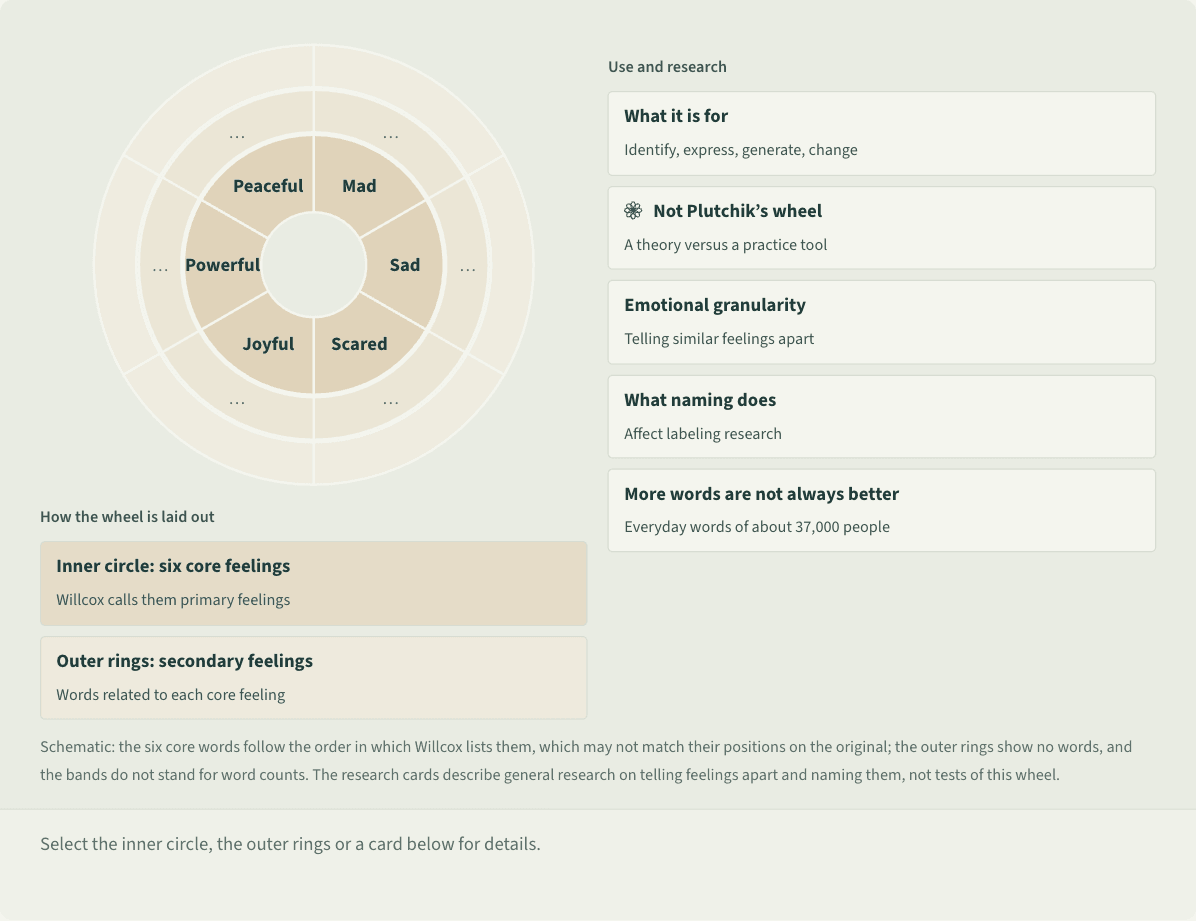
The feelings wheel is a tool Gloria Willcox published in a transactional analysis journal in 1982. An inner circle names six core feelings (mad, sad, scared, joyful, powerful and peaceful), and two outer rings list related secondary feelings, to help people learn to recognize and express what they feel.[1]
How the wheel is laid out
Use and research
Schematic: the six core words follow the order in which Willcox lists them, which may not match their positions on the original; the outer rings show no words, and the bands do not stand for word counts. The research cards describe general research on telling feelings apart and naming them, not tests of this wheel.
Schematic. A disc of three rings divided into six sectors. Clockwise, the inner ring reads: mad, sad, scared, joyful, powerful, peaceful. In each sector the two outer rings are blank bands, standing for the related secondary feeling words on the original, which are not shown. Below the disc are five cards: what it is for (identifying, expressing, generating and changing feelings); how it differs from Plutchik’s wheel (a theory versus a practice tool); emotional granularity (telling similar feelings apart); the effect of naming feelings (affect labeling research); and why more words are not always better (a study of everyday language from about 37,000 people).
 Save as image (PNG)
This figure image is licensed CC BY 4.0: reuse it with credit and a link back to this page. How to reuse
Key points
- Willcox reports that it helps clients learn to identify, express, generate and change feelings. The article ran as a technique and cites Plutchik’s book on emotion theory.[1]
- Emotional granularity is the ability to tell similar feelings apart. People high in it for negative feelings rely less on rumination and avoidance; emotion-word training raises it short-term.[2]
- Naming a feeling has a regulating effect: choosing an emotion word for an unpleasant picture lowers self-rated distress and amygdala response, though participants predicted it would make them feel worse.[3]
- In essays and blogs by about 37,000 people, a wider range of negative emotion words went with more distress and poorer physical health; the authors stress this is correlational.[4]
An example
After an argument with her teenage son, Ms. Wang can only say she is fed up. That evening she takes out a feelings wheel, finds “scared” in the inner circle, looks outward for a closer word, and writes: “I’m afraid he’ll stop telling me what’s on his mind.” The next day she says it to him.
Misreadings and limits
A common misreading is that more emotion words are always better, or that the wheel is proven to work. The studies above test telling feelings apart and naming them, not this wheel.[2][3] Finding your own words can feel worse at first, and too many labels may not help;[3] people with varied negative emotion words report more distress.[4]
Sources
- 1 Willcox, G. (1982). The Feeling Wheel: A tool for expanding awareness of emotions and increasing spontaneity and intimacy. Transactional Analysis Journal, 12(4), 274–276. doi:10.1177/036215378201200411
- 2 叶伟豪, 于美琪, 张利会, 高琪, 傅明珠, & 卢家楣 (2023). 精准的意义:负性情绪粒度的作用机制与干预. 心理科学进展, 31(6), 1030–1043. doi:10.3724/SP.J.1042.2023.01030
- 3 Torre, J. B., & Lieberman, M. D. (2018). Putting feelings into words: Affect labeling as implicit emotion regulation. Emotion Review, 10(2), 116–124. doi:10.1177/1754073917742706
- 4 Vine, V., Boyd, R. L., & Pennebaker, J. W. (2020). Natural emotion vocabularies as windows on distress and well-being. Nature Communications, 11, 4525. doi:10.1038/s41467-020-18349-0
Last checked against sources: October 28, 2026