Primary and secondary emotions
初级情绪与次级情绪
What are primary and secondary emotions?
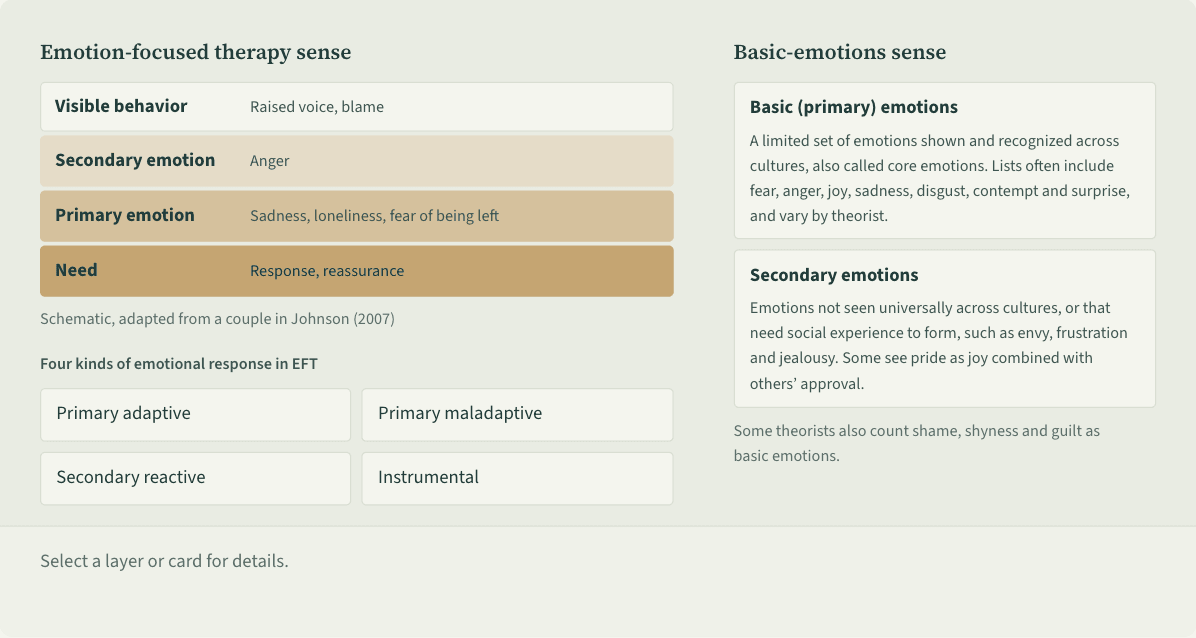
In emotion-focused therapy, primary emotions are a person’s first, direct reactions to a situation; secondary emotions are reactions to them that take their place, as when someone who feels afraid gets angry about the fear.[1] The terms also name a different contrast: universal basic emotions versus socially constructed ones.[3][4]
Emotion-focused therapy sense
Schematic, adapted from a couple in Johnson (2007)
Four kinds of emotional response in EFT
Basic-emotions sense
Some theorists also count shame, shyness and guilt as basic emotions.
Schematic with two views. In the first, four bands run top to bottom on the left: visible behavior (raising her voice, accusing him of never listening), secondary emotion (anger), primary emotion (sadness, loneliness, fear of being left) and need (to be responded to and reassured). Four cards on the right list emotion-focused therapy’s four kinds of emotional response: primary adaptive, primary maladaptive, secondary reactive and instrumental. The second view has two columns: basic emotions (fear, anger, joy, sadness, disgust, contempt, surprise) and secondary emotions (pride, envy, frustration, jealousy), with a note that some theorists also count shame, shyness and guilt as basic.
 Save as image (PNG)
This figure image is licensed CC BY 4.0: reuse it with credit and a link back to this page. How to reuse
Key points
- Emotion-focused therapy distinguishes four kinds of emotional response: primary adaptive, primary maladaptive, secondary reactive, and instrumental emotions displayed to influence others.[1]
- The labels describe an emotion’s place in a sequence, not its name. Anger at being violated is primary; anger at one’s own fear is secondary.[1]
- In emotionally focused couple therapy, Susan Johnson helps partners move from reactive irritation and anger to the fear and sadness beneath them, and to voice their need for connection.[2]
- The aim is not to vent secondary emotions but to reach and express primary ones that were held back. When secondary distress overwhelms, therapists first offer a safe, calm, empathic presence.[1]
An example
As Jay glances at his phone mid-sentence, Lin raises her voice: “You never listen.” The counselor asks what she feels right now, and she chokes up: “I can’t seem to reach him.” The anger was secondary; beneath it lay loneliness and fear of being left, and a need for him to respond.[2]
Misreadings and limits
Lists that file guilt, jealousy or resentment under secondary emotions mix up two uses. In the basic-emotions sense jealousy is secondary, yet some theorists count guilt as basic;[3][4] in emotion-focused therapy, whether an emotion is secondary depends on its place in that person’s reaction at that moment.[1]
Sources
- 1 Elliott, R., & Greenberg, L. S. (2016). Humanistic-experiential psychotherapy in practice: Emotion-focused therapy. In A. J. Consoli, L. E. Beutler, & B. Bongar (Eds.), Comprehensive textbook of psychotherapy: Theory and practice (2nd ed., pp. 106–120). Oxford University Press. View source
- 2 Johnson, S. M. (2007). The contribution of emotionally focused couples therapy. Journal of Contemporary Psychotherapy, 37(1), 47–52. doi:10.1007/s10879-006-9034-9
- 3 American Psychological Association (2018). Primary emotion. APA dictionary of psychology (updated April 19, 2018). View source
- 4 American Psychological Association (2018). Secondary emotion. APA dictionary of psychology (updated April 19, 2018). View source
Last checked against sources: October 27, 2026