Rumination
反刍思维
What is rumination?
Rumination is repetitively and passively focusing on one’s distress and its possible causes and consequences, without taking steps to solve the problems behind it.[1] ICD-11 lists it among symptoms involving mood: mental preoccupation with negative events, personal characteristics or failures.[2]
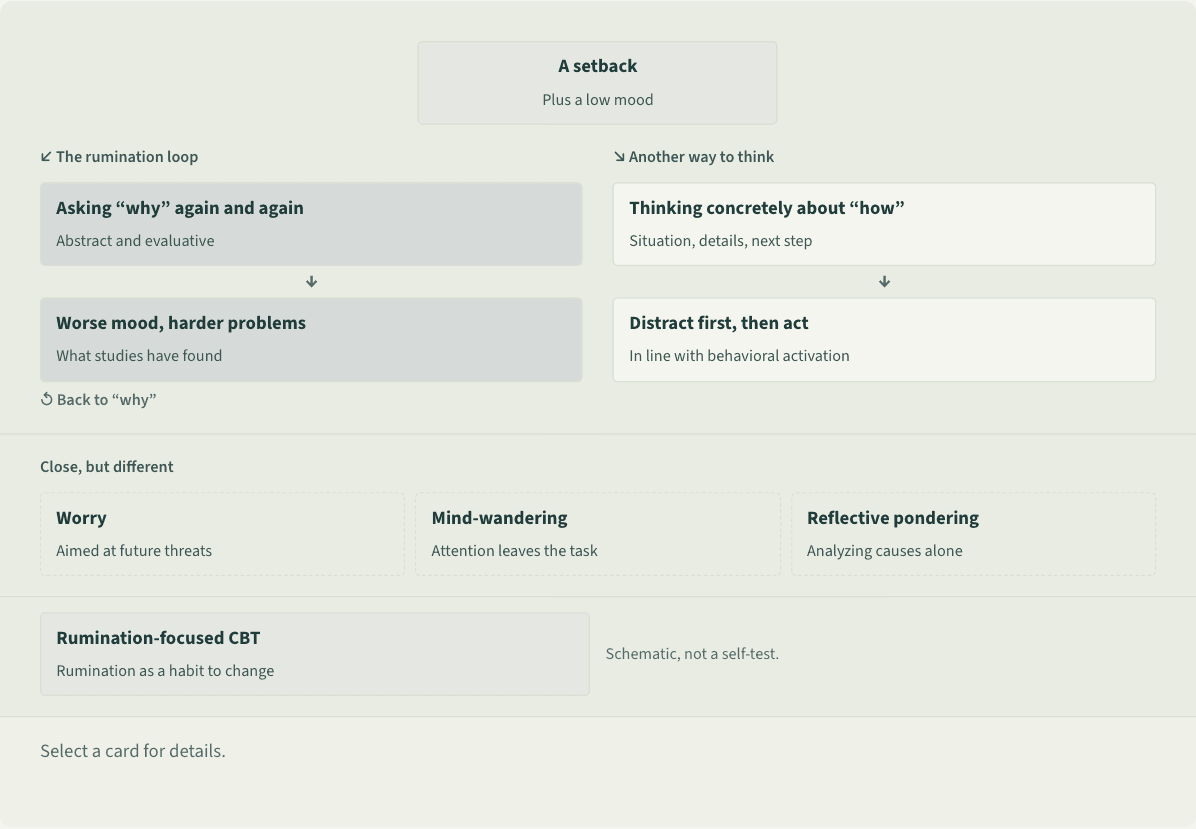
The rumination loop
Back to “why”
Another way to think
Close, but different
Schematic, not a self-test.
Schematic. At the top: a setback plus a low mood. On the left, a loop: asking “why” over and over (abstract and evaluative) leads to worse mood and harder problem-solving, and an arrow leads back to asking “why.” On the right, another route: thinking concretely about “how” leads to first distracting oneself, then tackling the problem. Below, three dashed cards labeled “close, but different”: worry (aimed at future threats), mind-wandering (attention leaving the task at hand) and reflective pondering (analyzing causes alone). At the bottom, a card for rumination-focused CBT. A note says the figure is a schematic, not a self-test.
 Save as image (PNG)
This figure image is licensed CC BY 4.0: reuse it with credit and a link back to this page. How to reuse
Key points
- Among about 1,300 community adults, higher rumination scores predicted a new depressive episode within a year; overall, rumination predicts onset more consistently than duration.[1]
- Brooding (“Why can’t I handle things better?”) goes with more depression now and a year later; reflective pondering, analyzing causes alone, goes with less depression a year on.[1]
- Worry and rumination are both repetitive negative thinking, but worry looks ahead to possible threats and is central to GAD; rumination looks back, often at loss.[1][2]
- Abstract “why” thinking turns out worse than concrete “how” thinking.[3] Among 42 patients with residual depression, 62% remitted with added rumination-focused CBT, against 21% with usual care alone.[4]
An example
Lin and a close friend fall out over a joke. For days, whenever she is idle, she thinks, “Why do I always say the wrong thing? Can anyone stand me?” She feels worse and still hasn’t replied to the message. Asking “How will I apologize tomorrow?” would bring her closer to solving it.[3]
Misreadings and limits
Going over things is often mistaken for careful reflection, yet in experiments people who ruminated while low saw problems as harder to solve and acted less on their solutions.[1] Repetitive thought is universal and not always harmful.[3] This page is not for self-diagnosis; if it won’t stop, comes with lasting low mood, or brings thoughts of self-harm, seek help soon; targeted therapies exist.[4]
If you need help now
If you’re struggling to cope or having thoughts of harming yourself:
- US and Canada: call or text 988 (24/7)
- UK and Ireland: Samaritans, 116 123 (free, 24/7)
- Australia: Lifeline, 13 11 14 (24/7)
- Elsewhere: findahelpline.com
If you’re in immediate danger, call your local emergency number.
Psyfield is not a crisis service. Numbers checked October 2026.
Sources
- 1 Nolen-Hoeksema, S., Wisco, B. E., & Lyubomirsky, S. (2008). Rethinking rumination. Perspectives on Psychological Science, 3(5), 400–424. doi:10.1111/j.1745-6924.2008.00088.x
- 2 World Health Organization (2025). MB24.E Mental rumination; MB24.H Worry. ICD-11 for mortality and morbidity statistics (2025-01 release). View source
- 3 Watkins, E. R. (2008). Constructive and unconstructive repetitive thought. Psychological Bulletin, 134(2), 163–206. doi:10.1037/0033-2909.134.2.163
- 4 Watkins, E. R., & Roberts, H. (2020). Reflecting on rumination: Consequences, causes, mechanisms and treatment of rumination. Behaviour Research and Therapy, 127, 103573. doi:10.1016/j.brat.2020.103573
Last checked against sources: October 28, 2026