Panksepp’s primary emotional systems
潘克塞普基本情绪系统
What are Panksepp’s primary emotional systems?
Panksepp’s primary emotional systems are seven emotional networks proposed by affective neuroscientist Jaak Panksepp. They lie in the subcortical brain, are homologous across mammals, and each generates a class of instinctual emotional behavior and raw feeling.[1]
The most pervasive system
Three ancient systems
Three social systems, well developed in mammals
Levels, measurement and debate
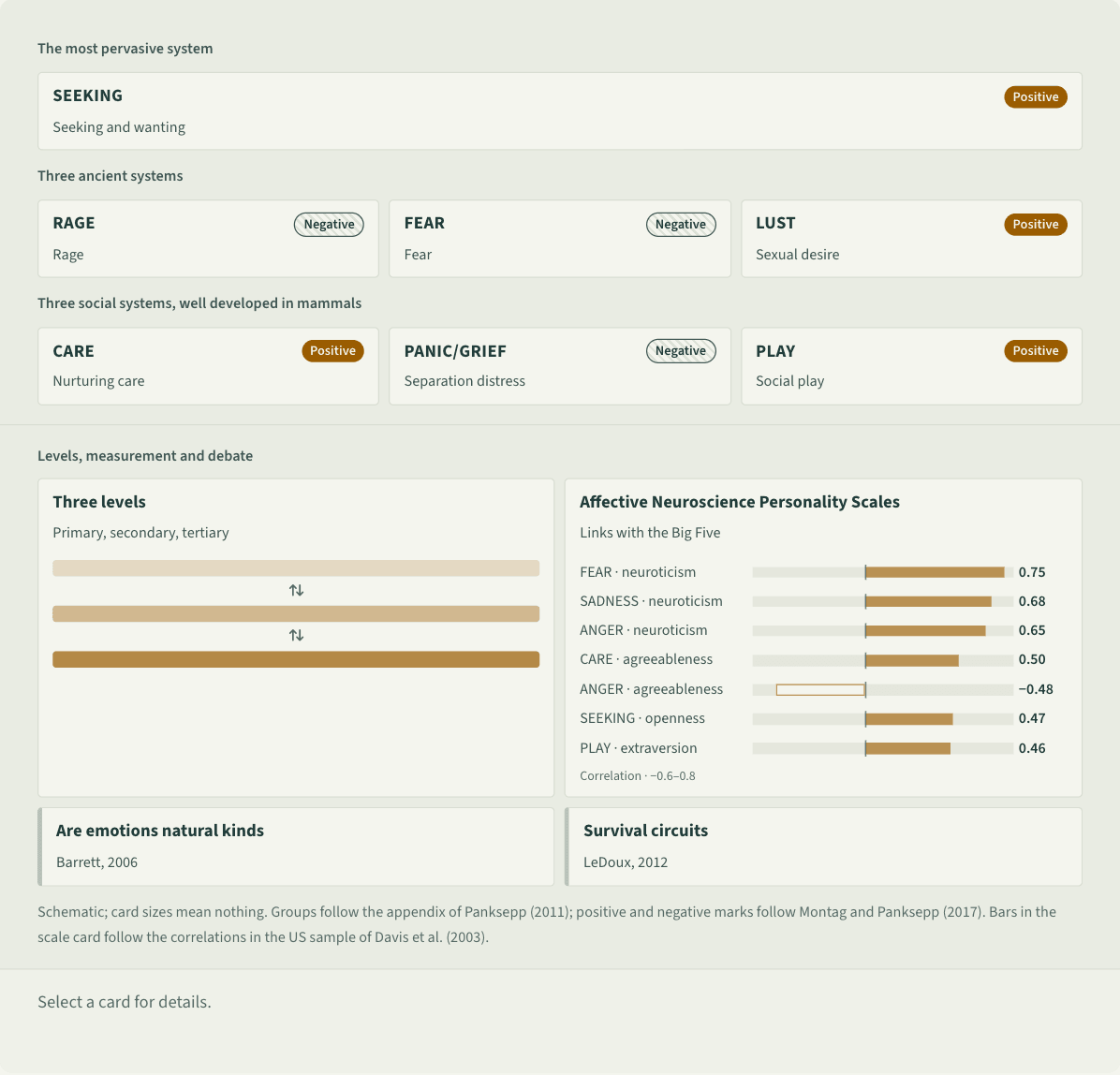
Schematic; card sizes mean nothing. Groups follow the appendix of Panksepp (2011); positive and negative marks follow Montag and Panksepp (2017). Bars in the scale card follow the correlations in the US sample of Davis et al. (2003).
Seven system cards in three groups. The first holds only SEEKING, which Panksepp calls the most pervasive system, marked positive. The second holds three ancient systems: RAGE, negative; FEAR, negative; LUST, positive. The third holds the social systems well developed in mammals: CARE, positive; PANIC/GRIEF, negative; PLAY, positive. Four are positive and three negative. Four cards below: three levels of processing, with raw affect at the primary level, learning at the secondary and thought at the tertiary; the Affective Neuroscience Personality Scales, with bars for correlations with the Big Five among 171 US students: FEAR with neuroticism 0.75, SADNESS with neuroticism 0.68, ANGER with neuroticism 0.65, CARE with agreeableness 0.50, ANGER with agreeableness minus 0.48, SEEKING with openness 0.47, and PLAY with extraversion 0.46; Barrett’s critique that categories such as anger, sadness and fear lack consistent markers; and LeDoux’s critique that these are survival circuits and what animals feel cannot be objectively verified.
 Save as image (PNG)
This figure image is licensed CC BY 4.0: reuse it with credit and a link back to this page. How to reuse
Key points
- Panksepp’s order: SEEKING, the most pervasive; three ancient systems, RAGE, FEAR and LUST; and three social systems well developed in mammals, CARE, PANIC/GRIEF and PLAY.[1]
- The core evidence comes from animals: stimulating specific subcortical sites evokes these behaviors, animals work to turn the stimulation on or off, and play survives early removal of the neocortex.[1]
- He calls them primary processes, beneath secondary processes of learning and tertiary processes of thought. Words such as anger or loneliness already name tertiary concepts, hence the capitals.[1]
- Montag and Panksepp class SEEKING, LUST, CARE and PLAY as positive, and FEAR, RAGE and PANIC/SADNESS as negative. On a scale built on the theory, FEAR and SADNESS track neuroticism closely.[2]
An example
On his three-year-old daughter’s first day at preschool, Jay turns to leave and she bursts into tears, calling for him. Half an hour later the teacher sends a photo of her chasing other children and laughing. In Panksepp’s terms, the first scene is the separation distress of PANIC/GRIEF; the second is PLAY.
Misreadings and limits
The seven are often taken as a proven list of human emotions. Barrett found that anger, sadness and fear show no consistent markers in feelings, faces, bodies or behavior, and that finding a freezing circuit is not finding fear.[3] LeDoux calls such circuits survival circuits and argues that what animals feel cannot be objectively verified.[4]
Sources
- 1 Panksepp, J. (2011). Cross-species affective neuroscience decoding of the primal affective experiences of humans and related animals. PLoS ONE, 6(9), e21236. doi:10.1371/journal.pone.0021236
- 2 Montag, C., & Panksepp, J. (2017). Primary emotional systems and personality: An evolutionary perspective. Frontiers in Psychology, 8, 464. doi:10.3389/fpsyg.2017.00464
- 3 Barrett, L. F. (2006). Are emotions natural kinds?. Perspectives on Psychological Science, 1(1), 28–58. doi:10.1111/j.1745-6916.2006.00003.x
- 4 LeDoux, J. (2012). Rethinking the emotional brain. Neuron, 73(4), 653–676. doi:10.1016/j.neuron.2012.02.004
Last checked against sources: October 28, 2026