Suicidal ideation
自杀意念
If you need help now
If you’re struggling to cope or having thoughts of harming yourself:
- US and Canada: call or text 988 (24/7)
- UK and Ireland: Samaritans, 116 123 (free, 24/7)
- Australia: Lifeline, 13 11 14 (24/7)
- Elsewhere: findahelpline.com
If you’re in immediate danger, call your local emergency number.
Psyfield is not a crisis service. Numbers checked October 2026.
What is suicidal ideation?
Suicidal ideation means thoughts of ending one’s own life, ranging from feeling one would be better off dead to making detailed plans.[1] Such thoughts are not rare,[2] and talking about them does not make them worse; it may even ease them.[3]
From milder to more serious
What research shows
What helps
Schematic, not a self-test.
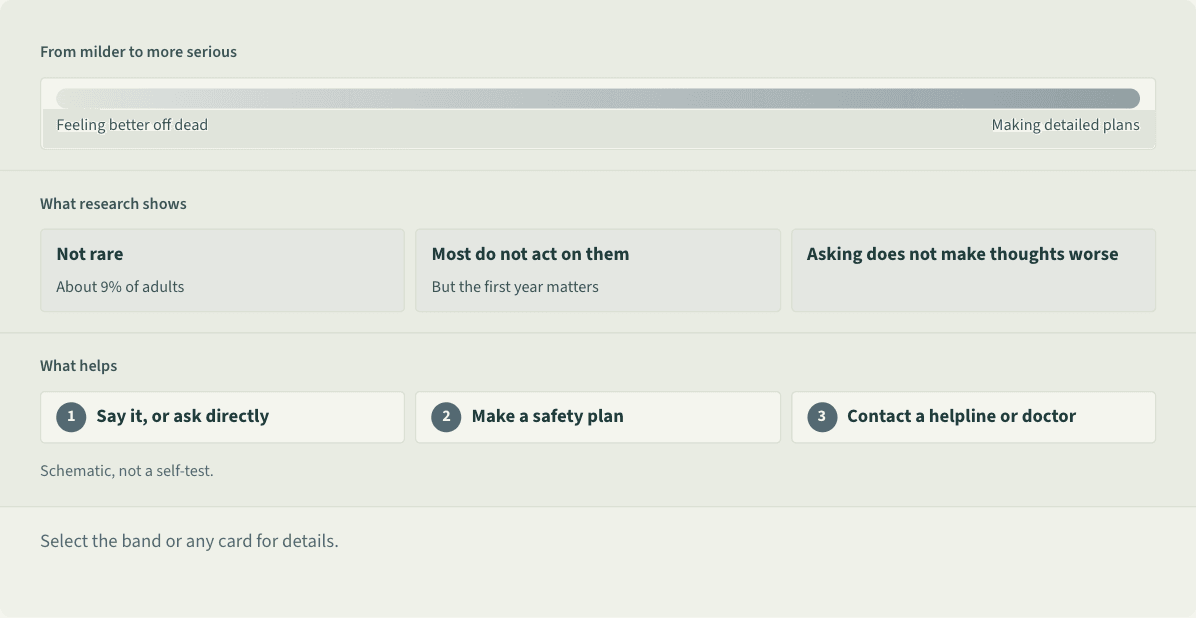
Schematic. At the top, a band shading from light to dark, labeled “feeling one would be better off dead” at the left and “making detailed plans” at the right, shows that suicidal ideation ranges from milder to more serious. Three cards in the middle: not rare, about 9% of adults in 17 countries have had such thoughts; most people do not act on them, about seven in ten never make an attempt, but the first year after the thoughts start needs the most attention; asking directly does not increase the thoughts. Three steps below, in order: say it, or ask directly; make a safety plan with a professional; contact a helpline or doctor, and call emergency services if there is immediate danger.
 Save as image (PNG)
This figure image is licensed CC BY 4.0: reuse it with credit and a link back to this page. How to reuse
Key points
- WHO World Mental Health surveys of about 85,000 adults in 17 countries found that 9.2% had had suicidal thoughts at some point, ranging from 3% to 16% by country.[2]
- About seven in ten people who have had suicidal thoughts have never made an attempt; of those who do, 60% do so within a year of onset, so early help matters.[2]
- A review of 13 studies in adolescents and adults found none where being asked about suicidal thoughts significantly increased them; talking about suicide may even reduce such thoughts.[3]
- A safety plan made with a clinician lists warning signs, coping strategies and people to contact; a meta-analysis found about 40% less suicidal behavior, but no clear effect on the thoughts.[4]
An example
Jay has been saying life feels pointless. His friend Lin doesn’t change the subject; she calmly asks, “Are you thinking about suicide?” Jay says sometimes. Lin thanks him for telling her, stays with him while he calls a helpline, and they plan a doctor’s visit together.[3]
Misreadings and limits
Milder thoughts, such as feeling one would be better off dead, still count as suicidal ideation,[1] and they are worth saying out loud. Having these thoughts does not mean someone will act, but risk is much higher once there is a plan.[2] Reach out promptly to a doctor, mental health professional or helpline.
Sources
- 1 World Health Organization (2025). MB26.A Suicidal ideation. ICD-11 for mortality and morbidity statistics (2025-01 release). View source
- 2 Nock, M. K., Borges, G., Bromet, E. J., Alonso, J., Angermeyer, M., Beautrais, A., Bruffaerts, R., Chiu, W. T., de Girolamo, G., Gluzman, S., de Graaf, R., Gureje, O., Haro, J. M., Huang, Y., Karam, E., Kessler, R. C., Lepine, J. P., Levinson, D., Medina-Mora, M. E., … Williams, D. R. (2008). Cross-national prevalence and risk factors for suicidal ideation, plans and attempts. British Journal of Psychiatry, 192(2), 98–105. doi:10.1192/bjp.bp.107.040113
- 3 Dazzi, T., Gribble, R., Wessely, S., & Fear, N. T. (2014). Does asking about suicide and related behaviours induce suicidal ideation? What is the evidence?. Psychological Medicine, 44(16), 3361–3363. doi:10.1017/S0033291714001299
- 4 Nuij, C., van Ballegooijen, W., de Beurs, D., Juniar, D., Erlangsen, A., Portzky, G., O’Connor, R. C., Smit, J. H., Kerkhof, A., & Riper, H. (2021). Safety planning-type interventions for suicide prevention: Meta-analysis. British Journal of Psychiatry, 219(2), 419–426. doi:10.1192/bjp.2021.50
Last checked against sources: October 28, 2026