Bipolar disorder
双相障碍
How is bipolar disorder different from ordinary mood swings?
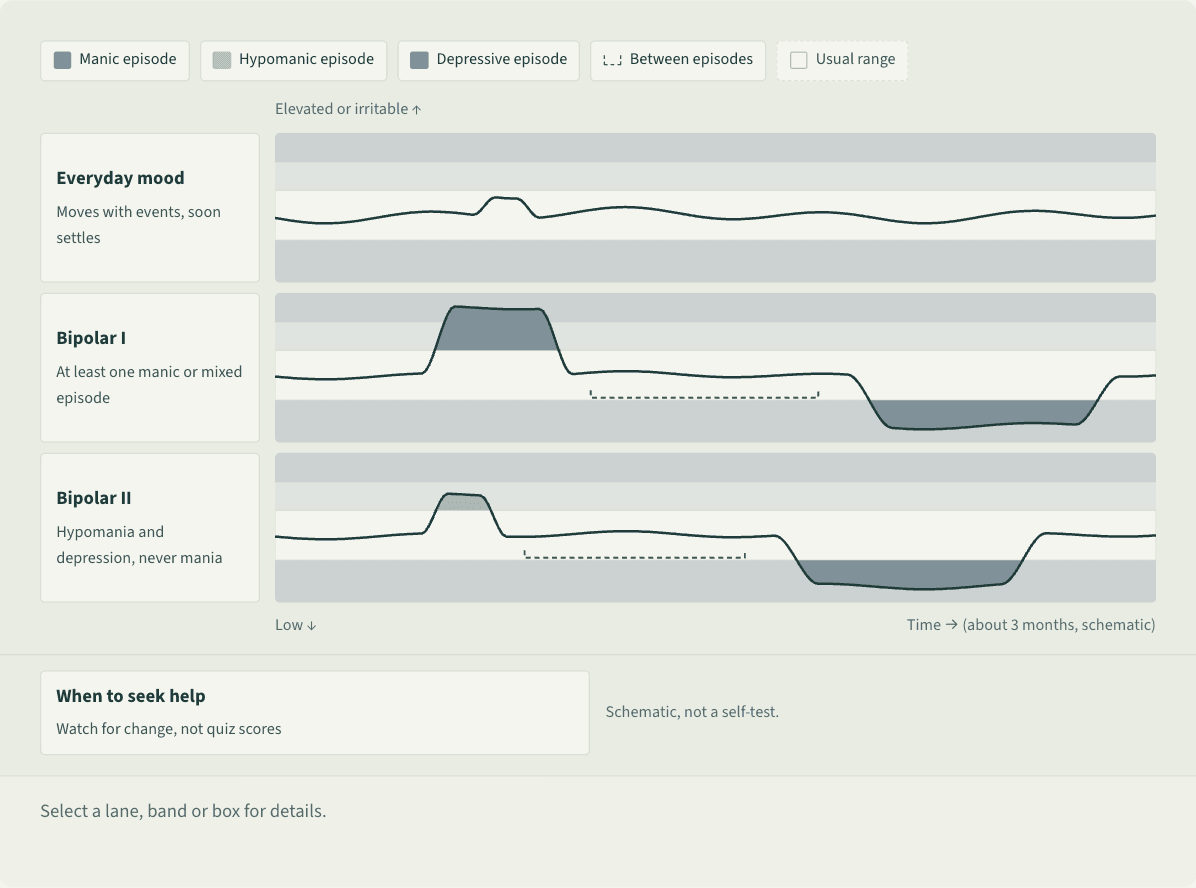
Bipolar disorder is an episodic mood disorder with manic or hypomanic episodes, and in most people depressive episodes too, each lasting days to weeks for most of every day.[1][2] Mood, energy and activity shift clearly from the person’s usual self, in ways others notice, unlike everyday ups and downs.[1][2]
Elevated or irritable ↑
Low ↓ Time → (about 3 months, schematic)
Schematic, not a self-test.
Schematic with three horizontal lanes stacked vertically. Each lane has four horizontal bands, top to bottom: mania, hypomania, usual range and depression; the time axis spans about three months. The first lane, everyday mood, wobbles within the usual range and rises briefly after good news before settling. The second, bipolar I, climbs into the mania band for more than a week, returns to the usual range for a while, then drops into the depression band for more than two weeks. The third, bipolar II, rises into the hypomania band for a few days, returns, then drops into depression for more than two weeks. The usual-range stretches between episodes are labeled as intervals. Below is a box on when to seek help, and a note that this is a schematic, not a self-test.
 Save as image (PNG)
This figure image is licensed CC BY 4.0: reuse it with credit and a link back to this page. How to reuse
Key points
- Bipolar I requires a manic or mixed episode: mania lasting a week or more that disrupts life, needs hospital care or brings delusions. Bipolar II has hypomania and depression but never mania.[1][2]
- In mania people need little sleep, feeling fine on two or three hours, unlike insomnia, where they want sleep but cannot get it.[1] Hypomania often feels productive, so few seek help.[1][2]
- Among 61,392 adults in 11 countries, lifetime prevalence was about 0.6% for bipolar I and 0.4% for bipolar II (0.3% and 0.2% in Shenzhen). Half of bipolar I began before 25.[3]
- Episodes tend to recur, so care is long term: NICE advises long-term medication plus a structured psychological intervention designed for bipolar disorder to prevent relapse; CBT can help in depressive phases.[4]
An example
For a week Jay has slept three hours a night without feeling tired. He talks nonstop, comes up with several business plans a day and charges two new cameras to his card; coworkers say he seems like a different person. A change this marked, lasting days, calls for a prompt psychiatric assessment, not a checklist.[4]
Misreadings and limits
Being moody, happy one moment and sad the next, is not bipolar disorder; elation at good news and gloom after a setback are normal.[1] Diagnosis takes a psychiatrist weighing the course over time and family history; online tests cannot diagnose.[2][4] Suspected mania or severe depression, or any risk of harm to self or others, needs prompt medical help.[4]
If you need help now
If you’re struggling to cope or having thoughts of harming yourself:
- US and Canada: call or text 988 (24/7)
- UK and Ireland: Samaritans, 116 123 (free, 24/7)
- Australia: Lifeline, 13 11 14 (24/7)
- Elsewhere: findahelpline.com
If you’re in immediate danger, call your local emergency number.
Psyfield is not a crisis service. Numbers checked October 2026.
Sources
- 1 World Health Organization (2025). Mood disorders: Manic episode; Hypomanic episode; 6A60 Bipolar type I disorder; 6A61 Bipolar type II disorder. ICD-11 for mortality and morbidity statistics (2025-01 release). View source
- 2 National Institute of Mental Health (2025). Bipolar disorder. National Institute of Mental Health (NIH Publication No. 25-MH-8088, revised 2025). View source
- 3 Merikangas, K. R., Jin, R., He, J.-P., Kessler, R. C., Lee, S., Sampson, N. A., Viana, M. C., Andrade, L. H., Hu, C., Karam, E. G., Ladea, M., Medina-Mora, M. E., Ono, Y., Posada-Villa, J., Sagar, R., Wells, J. E., & Zarkov, Z. (2011). Prevalence and correlates of bipolar spectrum disorder in the World Mental Health Survey Initiative. Archives of General Psychiatry, 68(3), 241–251. doi:10.1001/archgenpsychiatry.2011.12
- 4 National Institute for Health and Care Excellence (2014). Bipolar disorder: Assessment and management (CG185). National Institute for Health and Care Excellence (last updated 2 September 2025). View source
Last checked against sources: October 28, 2026