Insomnia disorder
失眠症
When does poor sleep become insomnia disorder?
Insomnia disorder is frequent difficulty falling or staying asleep despite enough time and a suitable setting for sleep, with effects on daytime energy, mood or concentration.[1] At least three nights a week for three months or more makes it chronic; shorter spells are short-term insomnia.[1][2]
10,778 adults in Beijing: how many remain as each criterion is applied
Short-term insomnia and treatment
Data: Shang et al. (2026), Figure 1 and Table 1. Bar lengths use unweighted counts; percentages are the paper’s weighted prevalence. Not a self-test.
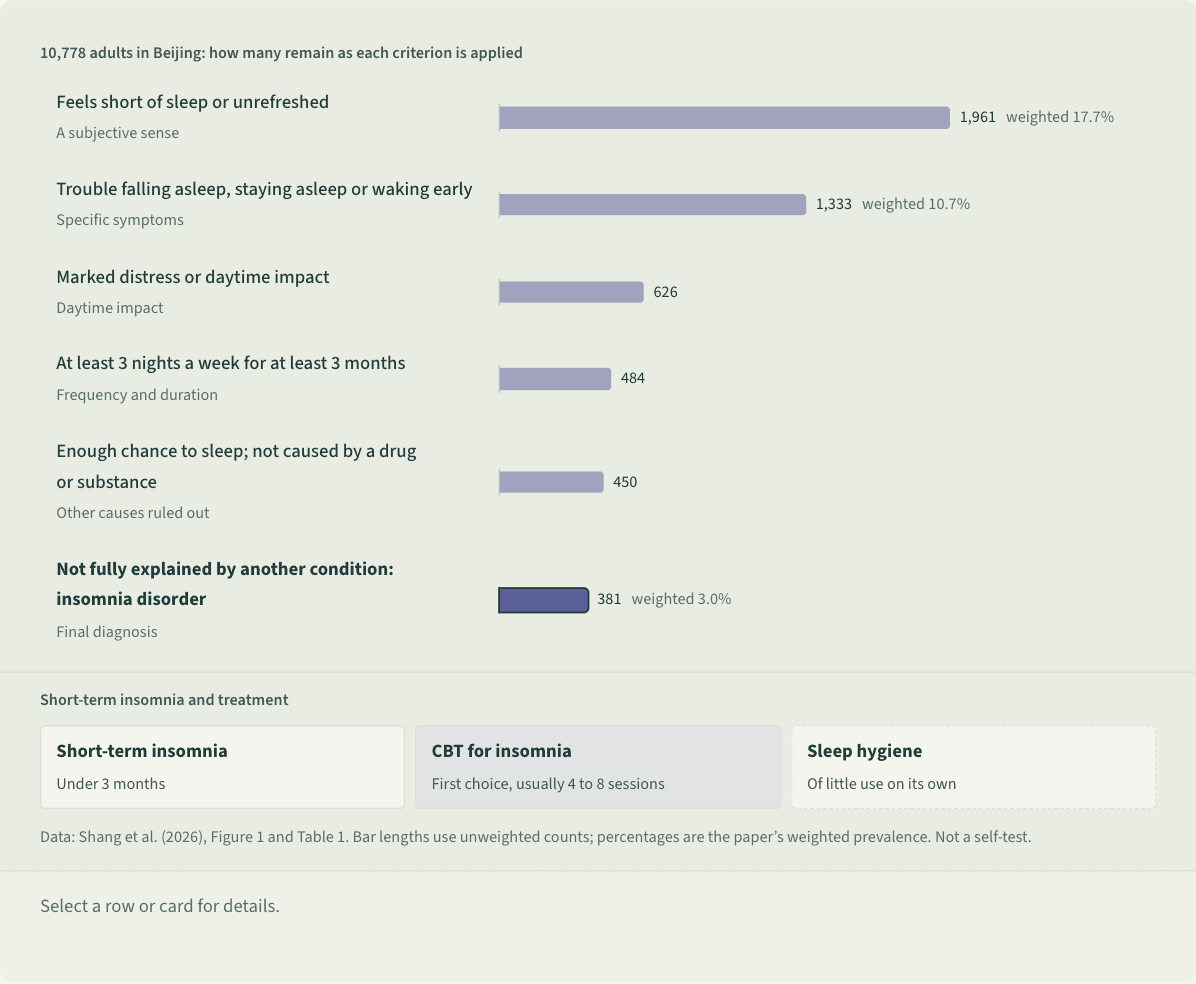
Horizontal bar chart with six rows that shorten from top to bottom, drawn to scale by number of people. Row 1, felt short of sleep or unrefreshed: 1,961 people, about 17.7% after weighting. Row 2, trouble falling asleep, staying asleep or waking early: 1,333, about 10.7%. Row 3, marked distress or daytime impact: 626. Row 4, at least 3 nights a week for at least 3 months: 484. Row 5, enough opportunity to sleep and not caused by a drug or substance: 450. Row 6, not fully explained by another condition: 381, the insomnia disorder group, about 3.0% after weighting. Data from a 2021 survey of 10,778 adults in Beijing. Below the chart are three cards: short-term insomnia (under 3 months), cognitive behavioral therapy for insomnia (the first-choice treatment) and sleep hygiene (of little use on its own).
 Save as image (PNG)
This figure image is licensed CC BY 4.0: reuse it with credit and a link back to this page. How to reuse
Key points
- Psychiatrists interviewed 10,778 adults in Beijing in 2021: 17.7% reported poor sleep, 10.7% had insomnia symptoms, and only 3.0% met full DSM-5 criteria for insomnia disorder.[2]
- Short sleep is not insomnia disorder. Too little time set aside for sleep or a noisy bedroom does not count, and poor sleep without daytime effects is not diagnosed as insomnia disorder.[1][4]
- In 2021 the AASM gave a strong recommendation only to cognitive behavioral therapy for insomnia (CBT-I). The 2023 European guideline also puts it first, including alongside other conditions.[3][4]
- Sleep hygiene advice, like less coffee or a quiet bedroom, helps little by itself; neither guideline advises it alone.[3][4] Sleep restriction brings early sleepiness and may not suit people prone to mania.[3]
An example
Since changing jobs, Ms. Wang has lain awake over an hour on four or five nights a week for two months. She drifts off in meetings and snaps easily. Putting her phone away at bedtime has not helped. Her doctor asks her to keep a sleep diary for two weeks before they decide whether CBT-I fits.[4]
Misreadings and limits
An occasional bad night, or needing less sleep than others, is not insomnia disorder. Diagnosis takes a clinician weighing sleep history, a sleep diary and other conditions; online scales cannot diagnose.[1][4] Persistent insomnia that affects the day, or snoring and pauses in breathing, warrant a visit: German data suggest no more than 30% of people with insomnia have ever sought help.[4]
If you need help now
If you’re struggling to cope or having thoughts of harming yourself:
- US and Canada: call or text 988 (24/7)
- UK and Ireland: Samaritans, 116 123 (free, 24/7)
- Australia: Lifeline, 13 11 14 (24/7)
- Elsewhere: findahelpline.com
If you’re in immediate danger, call your local emergency number.
Psyfield is not a crisis service. Numbers checked October 2026.
Sources
- 1 World Health Organization (2025). Insomnia disorders: 7A00 Chronic insomnia; 7A01 Short-term insomnia. ICD-11 for mortality and morbidity statistics (2025-01 release). View source
- 2 Shang, L., Zhao, Y., Cong, A., Lv, P., Ding, H., Zhu, X., & Zhang, L. (2026). Prevalence, subtypes, and comorbidity of DSM-5 insomnia disorder among adults in Beijing, China: A large-scale cross-sectional study. BMC Public Health, 26, 827. doi:10.1186/s12889-026-26453-x
- 3 Edinger, J. D., Arnedt, J. T., Bertisch, S. M., Carney, C. E., Harrington, J. J., Lichstein, K. L., Sateia, M. J., Troxel, W. M., Zhou, E. S., Kazmi, U., Heald, J. L., & Martin, J. L. (2021). Behavioral and psychological treatments for chronic insomnia disorder in adults: An American Academy of Sleep Medicine clinical practice guideline. Journal of Clinical Sleep Medicine, 17(2), 255–262. doi:10.5664/jcsm.8986
- 4 Riemann, D., Espie, C. A., Altena, E., Arnardottir, E. S., Baglioni, C., Bassetti, C. L. A., Bastien, C., Berzina, N., Bjorvatn, B., Dikeos, D., Dolenc Groselj, L., Ellis, J. G., Garcia-Borreguero, D., Geoffroy, P. A., Gjerstad, M., Gonçalves, M., Hertenstein, E., Hoedlmoser, K., Hion, T., … Spiegelhalder, K. (2023). The European Insomnia Guideline: An update on the diagnosis and treatment of insomnia 2023. Journal of Sleep Research, 32(6), e14035. doi:10.1111/jsr.14035
Last checked against sources: October 28, 2026