Generalized anxiety disorder
广泛性焦虑障碍
What is generalized anxiety disorder?
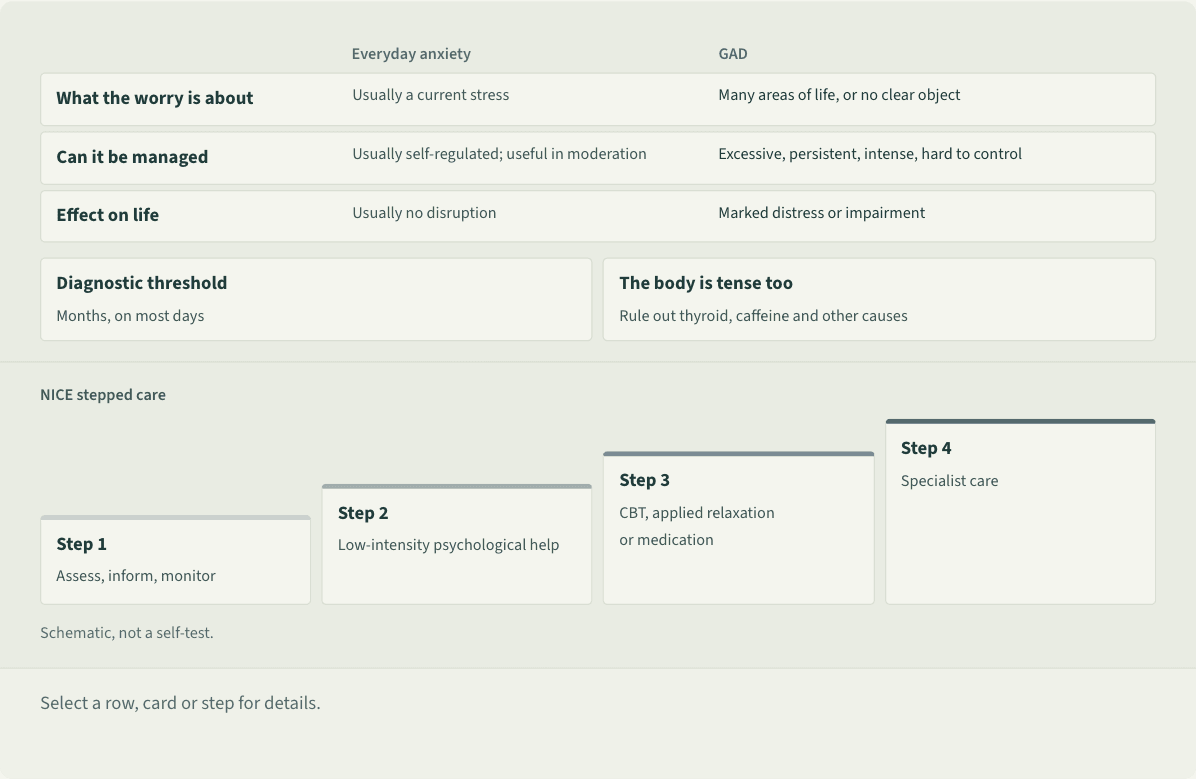
In generalized anxiety disorder, on most days for at least several months, a person worries excessively about many everyday matters such as work, health, family or money, or feels dread with no clear object. Muscle tension, a racing heart, poor concentration or poor sleep come with it, causing marked distress or impairment.[1]
NICE stepped care
Schematic, not a self-test.
Schematic. At the top, a two-column table compares everyday anxiety (left) with generalized anxiety disorder (right) in three rows. What the worry is about: usually tied to a current stress, versus many areas such as work, money, health and family, or no clear object. Whether it can be managed: usually self-regulated and, in moderation, helpful for solving problems, versus excessive, persistent, intense and hard to control. Effect on life: usually no disruption, versus marked distress or impairment. Below the table, two cards: the diagnostic threshold (ICD-11: most days for at least several months; DSM: at least 6 months with at least 3 of 6 associated symptoms) and physical symptoms (muscle tension or restlessness; sympathetic overactivity such as palpitations, sweating, trembling and stomach upset; poor concentration; irritability; sleep problems). At the bottom, four steps rising from left to right: assessment, information and monitoring; CBT-based self-help or psychoeducational groups; a choice of CBT, applied relaxation or medication; specialist care. A note says the figure is a schematic, not a self-test.
 Save as image (PNG)
This figure image is licensed CC BY 4.0: reuse it with credit and a link back to this page. How to reuse
Key points
- DSM criteria require hard-to-control worry for at least 6 months plus 3 of 6 symptoms, such as restlessness, fatigue, irritability or muscle tension;[3] ICD-11 says “at least several months.”[1]
- Everyday worry stays manageable and, in moderation, aids problem-solving; GAD worry is excessive, persistent and intense. Anxiety felt only amid real danger, such as war, does not count.[1]
- Surveys of about 147,000 adults in 26 countries found a lifetime prevalence of 3.7%: about 1.0% in Beijing and Shanghai, 7.8% in the US. Over half had also had depression.[2]
- NICE uses stepped care: information and monitoring first, then CBT-based self-help or groups; with marked impairment, a choice of CBT, applied relaxation or medication, by preference.[3]
An example
As soon as Ms. Wang leaves home she worries the gas is on, then about her parents’ checkup results, next month’s mortgage and her child’s exams. She knows it will probably be fine but cannot stop. For months her neck and shoulders have been tight, she lies awake after waking at night, and colleagues say little things fluster her.
Misreadings and limits
GAD is often brushed off as overthinking, yet in the surveys half of those affected reported severe impairment in at least one area of life.[2] Worry that lasts for months, feels uncontrollable and disrupts life calls for a professional assessment, not a checklist; medical conditions such as an overactive thyroid can cause similar symptoms.[1]
If you need help now
If you’re struggling to cope or having thoughts of harming yourself:
- US and Canada: call or text 988 (24/7)
- UK and Ireland: Samaritans, 116 123 (free, 24/7)
- Australia: Lifeline, 13 11 14 (24/7)
- Elsewhere: findahelpline.com
If you’re in immediate danger, call your local emergency number.
Psyfield is not a crisis service. Numbers checked October 2026.
Sources
- 1 World Health Organization (2025). 6B00 Generalised anxiety disorder. ICD-11 for mortality and morbidity statistics (2025-01 release). View source
- 2 Ruscio, A. M., Hallion, L. S., Lim, C. C. W., Aguilar-Gaxiola, S., Al-Hamzawi, A., Alonso, J., Andrade, L. H., Borges, G., Bromet, E. J., Bunting, B., Caldas de Almeida, J. M., Demyttenaere, K., Florescu, S., de Girolamo, G., Gureje, O., Haro, J. M., He, Y., Hinkov, H., Hu, C., … Scott, K. M. (2017). Cross-sectional comparison of the epidemiology of DSM-5 generalized anxiety disorder across the globe. JAMA Psychiatry, 74(5), 465–475. doi:10.1001/jamapsychiatry.2017.0056
- 3 National Institute for Health and Care Excellence (2011). Generalised anxiety disorder and panic disorder in adults: Management (CG113). NICE clinical guideline (published January 26, 2011; last updated June 15, 2020). View source
Last checked against sources: October 28, 2026