Panic attacks and panic disorder
惊恐发作与惊恐障碍
How is a panic attack different from panic disorder?
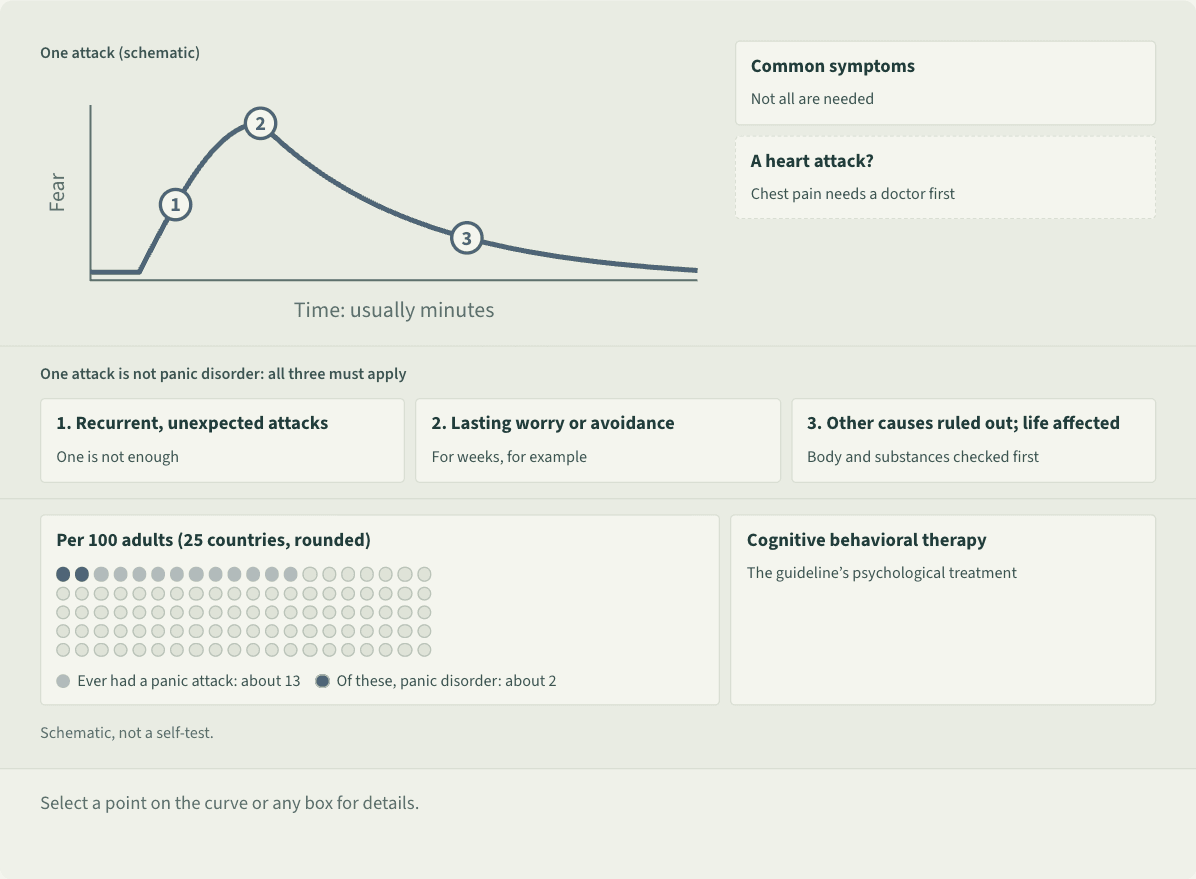
A panic attack is a sudden surge of intense fear that peaks quickly, with symptoms such as a pounding heart, sweating, trembling, breathlessness, chest pain or fear of dying; it usually lasts only minutes.[1] Panic disorder applies only when unexpected attacks recur and are followed by lasting worry or avoidance that disrupts daily life.[1]
One attack (schematic)
One attack is not panic disorder: all three must apply
Schematic, not a self-test.
Schematic. At the top, a curve shows fear intensity rising suddenly, peaking within minutes and then easing, with three points marked: sudden onset, peak within minutes, gradual fading. Beside it are two boxes: common symptoms (pounding heart, sweating, trembling, breathlessness, chest pain, dizziness, fear of losing control or dying) and “A heart attack?”, noting that chest pain needs a doctor to rule out physical causes. In the middle, the words “One attack is not panic disorder” sit above three conditions: recurrent, unexpected attacks; lasting worry about more attacks or avoidance; physical illness and substances ruled out, with clear impact on daily life. Below, a grid of 100 dots has 13 colored for adults who have had a panic attack, 2 of them darker for panic disorder. At the bottom is a box for cognitive behavioral therapy. A note says the figure is schematic and not a self-test.
 Save as image (PNG)
This figure image is licensed CC BY 4.0: reuse it with credit and a link back to this page. How to reuse
Key points
- Across 25 countries (142,949 adults), 13.2% had ever had a panic attack; only one in eight of them, 1.7% overall, had panic disorder. Beijing and Shanghai: 2.1% and 0.4%.[2]
- People may fear a heart attack, and many return to emergency care for unneeded tests.[1] NICE advises the minimum tests to rule out acute physical problems, then referral to primary care.[3]
- Attacks often become tied to particular places, which people then fear. Many start avoiding them or go out only with a trusted companion; agoraphobia may then be diagnosed as well.[1]
- NICE recommends 7 to 14 hours of CBT for moderate to severe panic disorder.[3] In a review of 72 trials, programs with interoceptive exposure did better; breathing retraining did little for outcomes.[4]
An example
On the subway, Jay’s heart suddenly races, he can’t catch his breath, his hands tingle and he feels he is dying; it eases after ten minutes or so. The emergency room finds no heart problem. Now he dreads another attack and avoids the subway. Whether to seek more help depends on whether attacks recur and the worry and avoidance persist.[1]
Misreadings and limits
This page is not a tool for self-diagnosis. Chest pain and breathlessness can also come from heart or other physical illness and need a medical check,[1][3] and one panic attack is not panic disorder.[3] If attacks keep returning, or fear of them starts to restrict daily life, a doctor or mental health professional can help; proven treatments exist.[3]
If you need help now
If you’re struggling to cope or having thoughts of harming yourself:
- US and Canada: call or text 988 (24/7)
- UK and Ireland: Samaritans, 116 123 (free, 24/7)
- Australia: Lifeline, 13 11 14 (24/7)
- Elsewhere: findahelpline.com
If you’re in immediate danger, call your local emergency number.
Psyfield is not a crisis service. Numbers checked October 2026.
Sources
- 1 World Health Organization (2025). 6B01 Panic disorder. ICD-11 for mortality and morbidity statistics (2025-01 release). View source
- 2 de Jonge, P., Roest, A. M., Lim, C. C. W., Florescu, S. E., Bromet, E. J., Stein, D. J., Harris, M., Nakov, V., Caldas-de-Almeida, J. M., Levinson, D., Al-Hamzawi, A. O., Haro, J. M., Viana, M. C., Borges, G., O’Neill, S., de Girolamo, G., Demyttenaere, K., Gureje, O., Iwata, N., … Scott, K. M. (2016). Cross-national epidemiology of panic disorder and panic attacks in the world mental health surveys. Depression and Anxiety, 33(12), 1155–1177. doi:10.1002/da.22572
- 3 National Institute for Health and Care Excellence (2011). Generalised anxiety disorder and panic disorder in adults: Management (CG113). NICE clinical guideline (last updated June 2020). View source
- 4 Pompoli, A., Furukawa, T. A., Efthimiou, O., Imai, H., Tajika, A., & Salanti, G. (2018). Dismantling cognitive-behaviour therapy for panic disorder: A systematic review and component network meta-analysis. Psychological Medicine, 48(12), 1945–1953. doi:10.1017/S0033291717003919
Last checked against sources: October 28, 2026