Decisional balance
决策平衡
What is decisional balance?
Decisional balance is the relative weighing of the pros and cons of a change. It comes from Janis and Mann’s 1977 theory of decision making, became a core construct of the transtheoretical model, and is also used as a counseling exercise that lists pros and cons cell by cell.[1][2]
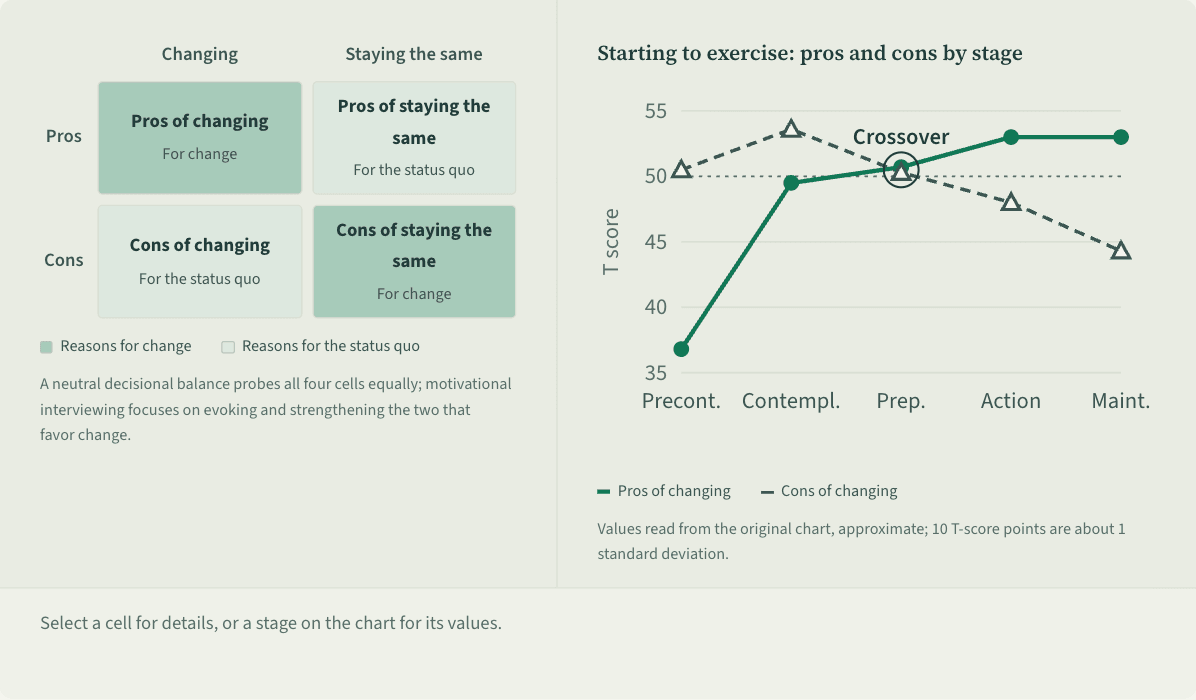
A neutral decisional balance probes all four cells equally; motivational interviewing focuses on evoking and strengthening the two that favor change.
Starting to exercise: pros and cons by stage
Values read from the original chart, approximate; 10 T-score points are about 1 standard deviation.
On the left, a two-by-two grid: the top row is pros, the bottom row cons; the left column is changing, the right column staying the same. Pros of changing and cons of staying share one color, labeled reasons for change; cons of changing and pros of staying share another, labeled reasons for the status quo. On the right, a line chart with five stages along the horizontal axis, precontemplation, contemplation, preparation, action and maintenance, and T scores from 35 to 55 on the vertical axis. The pros of changing are about 37, 49.5, 50.7, 53 and 53; the cons about 50.5, 53.6, 50.3, 48 and 44.3. The lines cross at preparation, after which the pros are higher.
 Save as image (PNG)
This figure image is licensed CC BY 4.0: reuse it with credit and a link back to this page. How to reuse
Key points
- Janis’s original balance sheet had 16 cells, recording practical gains and losses and approval or disapproval, for self and for others. Factor analysis left just pros and cons: the familiar 2×2 grid.[1][2]
- In transtheoretical research, contemplators see the pros of changing but are acutely aware of the cons and can stay stuck; in action, the pros exceeded the cons in 11 of 12 studies.[2]
- A meta-analysis of 48 health behaviors (nearly 50,000 people) found that from precontemplation to action, the pros of changing rise by 1 standard deviation on average, the cons fall by only 0.56.[3]
- It began as a neutral tool that helps people think a choice through and reduces later regret without steering them, as in deciding whether to have children or donate an organ.[1]
An example
Ms. Wang has a job offer in another city and cannot decide. Her counselor asks her to fill a four-cell grid with the pros and cons of moving and of staying, probes each cell equally, and offers no opinion. With no right direction, this is the neutral use of decisional balance.[1]
Misreadings and limits
It is often used to push hesitant people toward change. Reviewing the research, Miller and Rose found that exploring pros and cons equally with people who have not yet decided tends to lower commitment; in one trial, adding it cancelled out the benefit of motivational interviewing. For people who have already decided, it may strengthen commitment.[1]
Sources
- 1 Miller, W. R., & Rose, G. S. (2015). Motivational interviewing and decisional balance: Contrasting responses to client ambivalence. Behavioural and Cognitive Psychotherapy, 43(2), 129–141. doi:10.1017/S1352465813000878
- 2 Prochaska, J. O., & Velicer, W. F. (1997). The transtheoretical model of health behavior change. American Journal of Health Promotion, 12(1), 38–48. doi:10.4278/0890-1171-12.1.38
- 3 Hall, K. L., & Rossi, J. S. (2008). Meta-analytic examination of the strong and weak principles across 48 health behaviors. Preventive Medicine, 46(3), 266–274. doi:10.1016/j.ypmed.2007.11.006
Last checked against sources: October 27, 2026