Emotional cycle of change
改变的情绪周期
What is the emotional cycle of change?
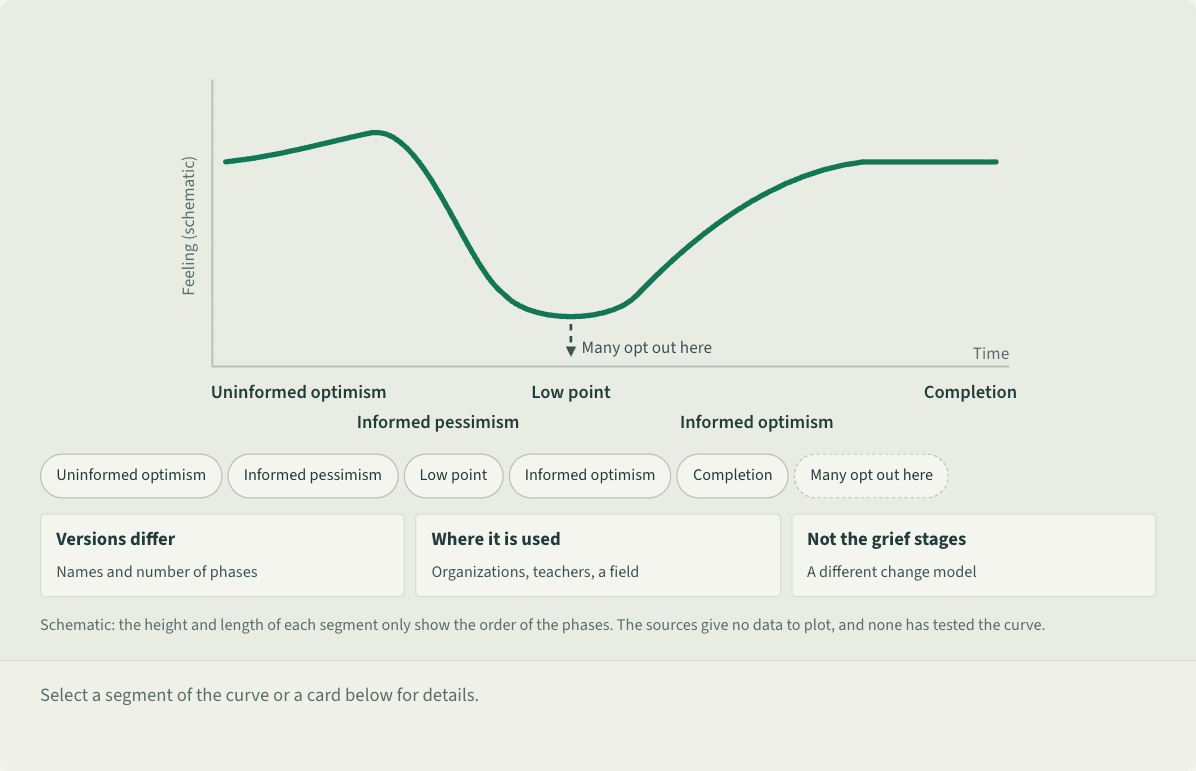
The emotional cycle of change is a model published by Kelley and Conner in 1979 that describes five emotional phases in a major change: uninformed optimism, informed pessimism, a low point, informed optimism and, finally, completion.[1][2]
Schematic: the height and length of each segment only show the order of the phases. The sources give no data to plot, and none has tested the curve.
Schematic, not data. Time runs along the horizontal axis and feeling up the vertical one. The curve starts fairly high, labeled uninformed optimism, then falls, labeled informed pessimism, to its lowest point, labeled low point, where a dashed arrow leaves the curve with the note “many opt out here.” It then rises, labeled informed optimism, and levels off, labeled completion. Three cards below the curve say that versions name the third phase differently, that the model has been used for organizational change, teacher development and a research field, and that it is separate from the model adapted from Kübler-Ross’s stages of loss.
 Save as image (PNG)
This figure image is licensed CC BY 4.0: reuse it with credit and a link back to this page. How to reuse
Key points
- Early optimism is not yet informed by the facts; meeting difficulties turns it into pessimism and doubt; past the low point, optimism rests on evidence and confidence returns.[2][4]
- The low point is where many opt out.[2] An organizational change paper sums up the model: well-informed pessimists can still engage with and support a change, and the aim is informed optimism.[3]
- It has also been used to describe a whole field: research on blood glucose control in intensive care went from early optimism through pessimism after failed replications to informed optimism by 2017.[2]
- Versions name the third phase differently: one calls it the “valley of despair,”[2] while a teacher-development paper lists “realism (hope).”[4]
An example
Lin signs up for guitar lessons and is keen for two weeks. By the second month her fingers hurt and chord changes keep tripping her up; she doubts she can learn and barely plays for a while. Then she gets through a whole chorus and her confidence returns. In the model’s terms, she has passed the first four phases.
Misreadings and limits
It is often said that most people quit in the valley of despair, but the source says only that many opt out, with no figure.[2] The sources use it to describe experience; none tests whether feelings follow this order.[2][3][4] It is also separate from the adaptation of Kübler-Ross’s stages of loss used for organizational change.[3]
Sources
- 1 Kelley, D., & Conner, D. R. (1979). The emotional cycle of change. In J. E. Jones & J. W. Pfeiffer (Eds.), The 1979 annual handbook for group facilitators (pp. 117–122). University Associates. View source No openly available copy; only the bibliographic record was checked. Page numbers follow Chase and Dickson (2017), and the content is described from other sources.
- 2 Chase, J. G., & Dickson, J. L. (2017). Traversing the valley of glycemic control despair. Critical Care, 21, 237 (editorial). doi:10.1186/s13054-017-1824-9
- 3 Lomas, E., & McLeod, J. (2020). Engaging with change: Information and communication technology professionals’ perspectives on change at the mid-point in the UK/EU Brexit process. PLOS ONE, 15(1), e0227089. doi:10.1371/journal.pone.0227089
- 4 Kiliańska-Przybyło, G., Bedir, H., & Can, C. (2012). “When a foreign language learner becomes a foreign language teacher…” – A cross-cultural study into the affective domain of teaching. Glottodidactica, 39(2), 61–74. doi:10.14746/gl.2012.39.2.5
Last checked against sources: October 28, 2026