Satir change model
萨提亚改变过程
What is the Satir change model?
The Satir change model is family therapist Virginia Satir’s account of how people go through change: a foreign element disrupts a familiar status quo, chaos follows, and a transforming idea, practice and integration lead to a new status quo.[1][2]
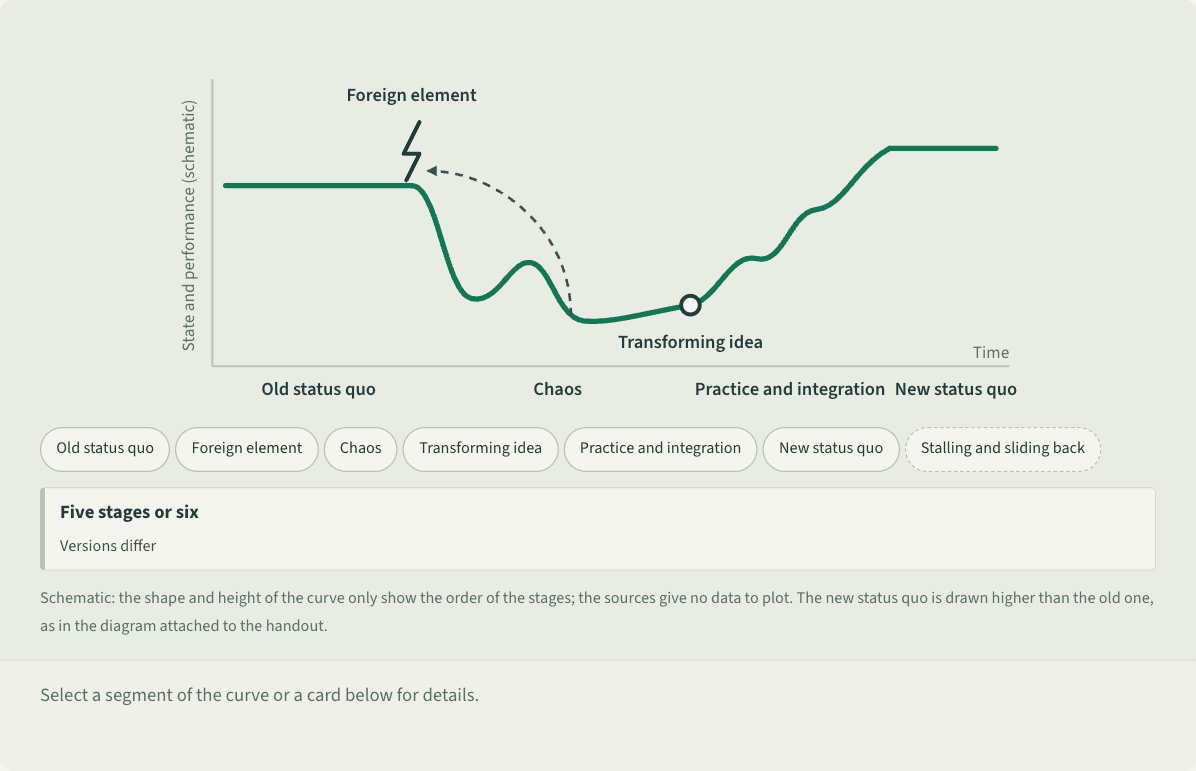
Schematic: the shape and height of the curve only show the order of the stages; the sources give no data to plot. The new status quo is drawn higher than the old one, as in the diagram attached to the handout.
Schematic, not data. The horizontal axis is time and the vertical axis is state and performance. The curve runs flat at the old status quo, drops after a marker for the foreign element into chaos, where it wavers low and makes one brief rise that falls back, then after a marker for the transforming idea it climbs unevenly through practice and integration and levels off at a new status quo above the starting point. A dashed line turns back from chaos to the old status quo level, showing that change can stall and retreat. A card below the curve notes that versions differ: six stages in the 1991 book, five in the handout, and one version that adds relapse.
 Save as image (PNG)
This figure image is licensed CC BY 4.0: reuse it with credit and a link back to this page. How to reuse
Key points
- The 1991 book on the Satir model lists six stages: old status quo, foreign element, chaos, practice, integration and new status quo, which may later become the next old status quo.[2]
- Chaos brings fear, pain and stress but also creativity that can spark a transforming idea. The pull is back to the familiar status quo; support helps people move on.[2]
- A handout on the Satir network’s site applies it to groups and organizations and warns change can stall: people deny the foreign element and retreat, or slip back into chaos without support.[1]
- A 2016 narrative review found that the four studies it included gave equivocal support for Satir’s methods;[3] the Satir network’s bibliography summarizes it as finding a dearth of empirical support.[4]
An example
After Ms. Wang becomes team lead, her familiar ways stop working; for two months she keeps slipping up and thinks of asking for her old post back. Her predecessor suggests a weekly meeting, she practices it for months, and the team finds a new rhythm. In Satir’s terms, the promotion was a foreign element and those months were chaos.[2]
Misreadings and limits
A common misreading is that every change runs through the same fixed steps. The handout warns that change can stall or slide back,[1] and versions differ: five stages in the handout,[1] six in the 1991 book,[2] and one adds relapse.[4] It is also a different model from the Stages of change.
Sources
- 1 Strider, W., & Strider, E. (2019). The Satir change process: A model for individuals, groups & organizations during a change process. Virginia Satir Global Network. View source
- 2 Christie-Seely, J. (2017). Workshop on climate change based on the work of Macy, and informed by the Satir Model. Satir International Journal, 5(1), 19–35. View source
- 3 Wretman, C. J. (2016). Saving Satir: Contemporary perspectives on the change process model. Social Work, 61(1), 61–68. doi:10.1093/sw/swv056
- 4 Virginia Satir Global Network (2024). Annotated bibliography (version 51). Virginia Satir Global Network. View source
Last checked against sources: October 28, 2026