Growth mindset
成长型思维
What is a growth mindset?
A growth mindset is the belief that basic qualities can be cultivated through effort; believing they are fixed is a fixed mindset.[2] It grew out of Dweck and Leggett’s 1988 work on implicit theories of intelligence, which some see as a quality that can grow and others as a fixed entity.[1]
Meta-analysis of 63 studies (Macnamara & Burgoyne, 2023)
Subgroups in the same meta-analysis
The differences between subgroups were not significant; the authors say this does not show the intervention matters more for some students.
US national experiment, first-year high school students (Yeager et al., 2019)
Effect (standard deviations; GPA points for the national experiment)
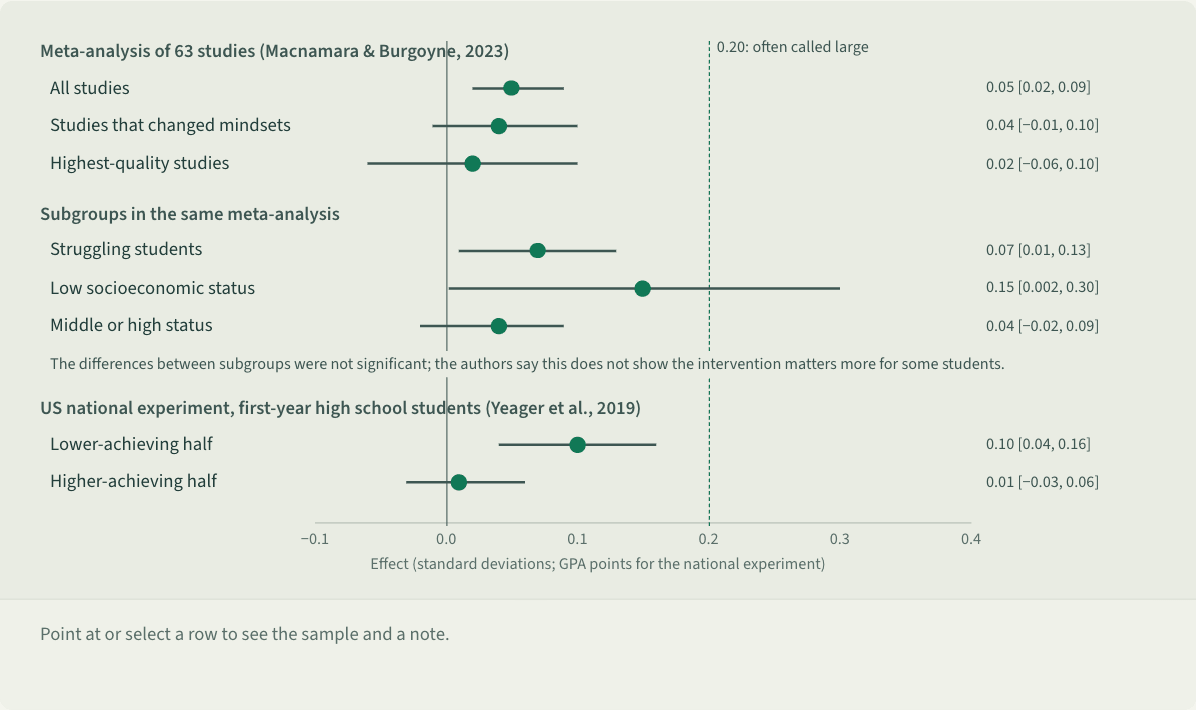
A horizontal effect-size chart from −0.1 to 0.4, with lines at 0 and at 0.20, what education research often calls a large effect. Meta-analysis: all studies 0.05, interval 0.02 to 0.09; studies where the intervention changed mindsets 0.04, −0.01 to 0.10; highest-quality studies 0.02, −0.06 to 0.10. Subgroups in the same meta-analysis: academically struggling students 0.07, 0.01 to 0.13; low socioeconomic status 0.15, 0.002 to 0.30; middle or high status 0.04, −0.02 to 0.09; the subgroups do not differ significantly. US national experiment: the lower-achieving half gained 0.10 GPA points, 0.04 to 0.16; the higher-achieving half 0.01, −0.03 to 0.06. Every estimate falls below 0.20.
 Save as image (PNG)
This figure image is licensed CC BY 4.0: reuse it with credit and a link back to this page. How to reuse
Key points
- Children of similar ability react differently to failure: some withdraw, others try harder. Dweck’s model traces this to goals, proving versus improving ability, which follow from beliefs about intelligence.[1]
- In a US national experiment, first-year high school students completed two online sessions of about 25 minutes. The lower-achieving half raised their GPAs by 0.10 points; the other half barely changed.[3]
- Effects depended on the school. In lower- and middle-achieving schools where peers readily took on challenges, GPAs rose by 0.14 to 0.18 points; the authors argue beliefs need a supportive setting.[3]
- A meta-analysis of 63 studies with nearly 98,000 students found an average effect on achievement of d = 0.05, not significant after correcting for publication bias or in the highest-quality studies.[4]
An example
After failing a math test, Lin thinks, “I’m just not a math person,” and sticks to easy problems. Later she thinks, “I haven’t mastered this kind of problem yet; let me try another way,” then asks her teacher for help and changes how she practices. A growth mindset is the second view; it does not by itself guarantee better grades.
Misreadings and limits
A popular claim is that training lets people of ordinary talent catch up with or overtake the gifted. Dweck does write that trained people sometimes outdo those who need no training, but she also says people differ in initial talents and not everyone can become an Einstein.[2] Effects on grades are small overall; in the large trial, only lower achievers’ grades rose.[3][4]
Sources
- 1 Dweck, C. S., & Leggett, E. L. (1988). A social-cognitive approach to motivation and personality. Psychological Review, 95(2), 256–273. doi:10.1037/0033-295X.95.2.256
- 2 Dweck, C. S. (2006). Mindset: The new psychology of success. Random House. View source
- 3 Yeager, D. S., Hanselman, P., Walton, G. M., Murray, J. S., Crosnoe, R., Muller, C., Tipton, E., Schneider, B., Hulleman, C. S., Hinojosa, C. P., Paunesku, D., Romero, C., Flint, K., Roberts, A., Trott, J., Iachan, R., Buontempo, J., Yang, S. M., Carvalho, C. M., … Dweck, C. S. (2019). A national experiment reveals where a growth mindset improves achievement. Nature, 573(7774), 364–369. doi:10.1038/s41586-019-1466-y
- 4 Macnamara, B. N., & Burgoyne, A. P. (2023). Do growth mindset interventions impact students’ academic achievement? A systematic review and meta-analysis with recommendations for best practices. Psychological Bulletin, 149(3–4), 133–173. doi:10.1037/bul0000352
Last checked against sources: October 27, 2026