Schwartz’s theory of basic human values
施瓦茨基本价值观理论
What is Schwartz’s theory of basic human values?
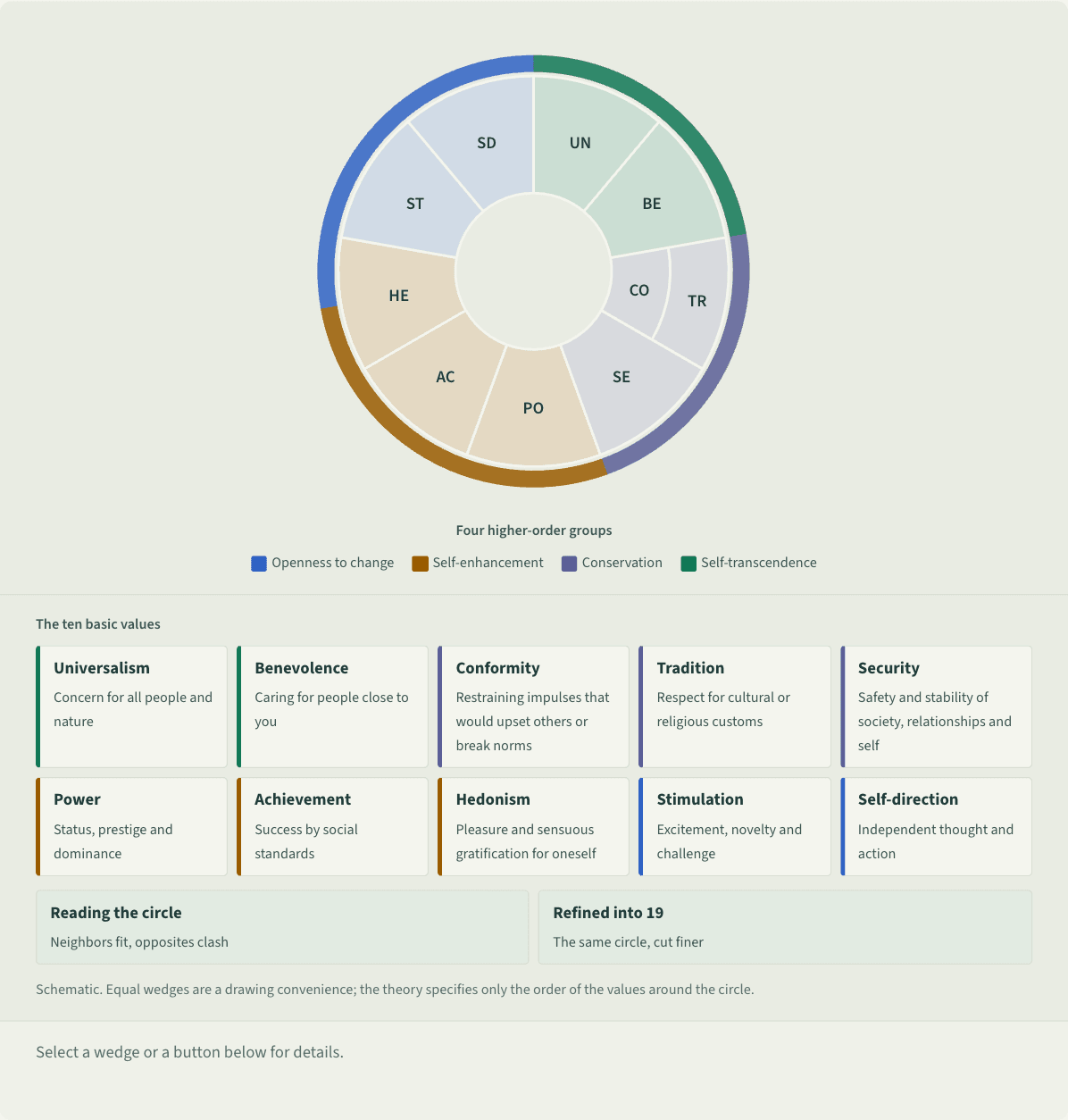
Shalom Schwartz’s theory, set out in 1992, sorts the basic values that people in all cultures recognize into 10 types, each defined by the motivational goal it expresses.[1] They form a circle: neighbors can be pursued in the same action, while opposites conflict.[1][2]
Four higher-order groups
- Openness to change
- Self-enhancement
- Conservation
- Self-transcendence
The ten basic values
Schematic. Equal wedges are a drawing convenience; the theory specifies only the order of the values around the circle.
Schematic. A ring divided into 9 wedges. Clockwise from the top: universalism, benevolence, conformity and tradition (one wedge, conformity inner and tradition outer), security, power, achievement, hedonism, stimulation, self-direction, then back to universalism. An outer band groups them: universalism and benevolence are self-transcendence; conformity, tradition and security are conservation; power and achievement are self-enhancement; stimulation and self-direction are openness to change. The stretch around hedonism is half self-enhancement, half openness to change. Openness faces conservation across the center, and self-enhancement faces self-transcendence. Below the ring are 10 value buttons and two cards: how to read the circle, and the refinement into 19 values.
 Save as image (PNG)
This figure image is licensed CC BY 4.0: reuse it with credit and a link back to this page. How to reuse
Key points
- Two axes summarize the circle: openness to change (self-direction, stimulation) versus conservation (security, conformity, tradition), and self-enhancement (power, achievement) versus self-transcendence (universalism, benevolence).[1]
- An early survey rates 57 values as guiding principles; the Portrait Values Questionnaire asks how much described people are like you.[1][2] The European Social Survey’s 21-item version distinguishes just 7 of 10.[2]
- Across samples from 82 countries, both oppositions nearly always appear.[1] Average rankings are similar too: benevolence, universalism and self-direction highest, power and stimulation lowest.[1]
- A 2012 refinement splits the circle into 19 values, such as power over people versus resources, plus face and humility.[2] Data from 49 cultural groups reproduced the predicted order.[2]
An example
Lin has two job offers: a long-established company that is stable and close to home, and a start-up where the work is new and she could make her own calls. The longer she compares, the harder it gets. On Schwartz’s circle she is pulled between opposite sides, security versus stimulation and self-direction, and one decision cannot fully serve both.
Misreadings and limits
A common misreading equates values with personality or character strengths. Values are what people consider important; traits describe how they actually behave, so valuing creativity does not make someone creative.[1] A meta-analysis of 60 studies found consistent but generally modest links between the Big Five and values,[3] while VIA defines character strengths as morally valued traits.[4]
Sources
- 1 Schwartz, S. H. (2012). An overview of the Schwartz theory of basic values. Online Readings in Psychology and Culture, 2(1). doi:10.9707/2307-0919.1116
- 2 Schwartz, S. H., & Cieciuch, J. (2022). Measuring the refined theory of individual values in 49 cultural groups: Psychometrics of the revised Portrait Value Questionnaire. Assessment, 29(5), 1005–1019. doi:10.1177/1073191121998760
- 3 Parks-Leduc, L., Feldman, G., & Bardi, A. (2015). Personality traits and personal values: A meta-analysis. Personality and Social Psychology Review, 19(1), 3–29. doi:10.1177/1088868314538548
- 4 VIA Institute on Character (n.d.). Character strengths. VIA Institute on Character. View source
Last checked against sources: October 28, 2026