Tree of Life (narrative approach)
叙事生命树
What is the Tree of Life narrative approach?
The Tree of Life is a narrative therapy group exercise: people draw their origins, present life, skills, hopes, important people and gifts received as parts of a tree, share these first, and only then talk about hardships together.[1] It was first used with children affected by HIV/AIDS in southern Africa.[1][2]
The full four-part process
- ① Draw your own tree (above)
History, name and evidence
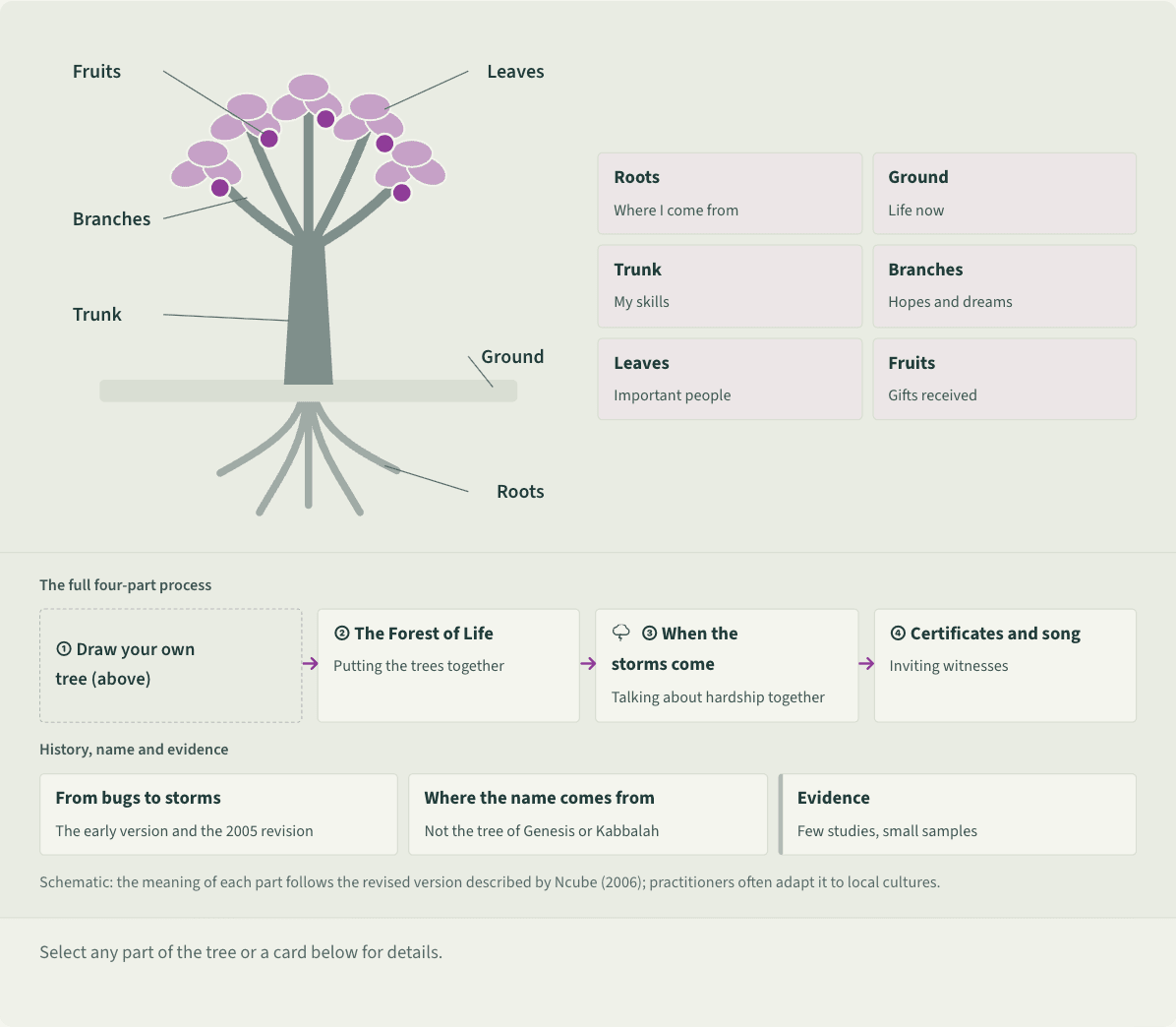
Schematic: the meaning of each part follows the revised version described by Ncube (2006); practitioners often adapt it to local cultures.
Schematic. A simple drawing of a tree: roots below a ground line, a trunk above it, branches spreading from the trunk, clusters of leaves at the branch tips and a few fruits among the leaves. Each part is labeled: roots for where you come from, ground for present life, trunk for skills, branches for hopes and dreams, leaves for important people, fruits for gifts received. No storms or bugs are drawn on the tree. Below the tree, a row of four steps: one, draw your own tree; two, the Forest of Life; three, when the storms come; four, certificates and song. At the bottom, three cards: from bugs to storms (the early version and the 2005 revision), where the name comes from, and the evidence.
 Save as image (PNG)
This figure image is licensed CC BY 4.0: reuse it with credit and a link back to this page. How to reuse
Key points
- An early version used bugs for problems and fallen leaves for the dead, often upsetting children; the 2005 revision moved problems off the tree and kept the dead on it.[1][2]
- There are four parts: draw your tree; join the trees into a Forest of Life; discuss the storms trees and people face; hand out certificates naming each person’s skills and hopes.[1]
- The storms are discussed only as dangers the group shares, with no one asked for personal stories; everyone first agrees that children are not to blame, then swaps ways children respond.[2]
- Evidence is thin: studies with refugee and immigrant youth had 1 to 29 participants;[3] a Hong Kong trial randomizing 157 older adults reported higher self-rated wisdom against a waitlist.[4]
An example
A community center runs a Tree of Life group for mothers new to the city. On the roots Lin writes her hometown and the grandmother who taught her to cook; on the trunk, “good at looking after people”; as a fruit, the neighbor who picks up her kids. In the storms part, the group talks about raising children without help.
Misreadings and limits
A common misreading treats the storms as part of the tree, so people draw their troubles on it. The revision did the opposite: it took the problem bugs off the tree, and hardships are discussed only collectively in the storms part, so problems do not sit too close to identity.[2]
Sources
- 1 Ncube, N. (2006). The Tree of Life Project: Using narrative ideas in work with vulnerable children in Southern Africa. International Journal of Narrative Therapy and Community Work, 2006(1), 3–16. View source
- 2 Denborough, D. (2018). Tracing the roots of the Tree of Life narrative approach. In Do you want to hear a story? Adventures in collective narrative practice (pp. 57–75). Dulwich Centre Publications. View source
- 3 Stiles, D. A., Alaraudanjoki, E., Wilkinson, L. R., Ritchie, K. L., & Brown, K. A. (2021). Researching the effectiveness of Tree of Life: An Imbeleko approach to counseling refugee youth. Journal of Child & Adolescent Trauma, 14(1), 123–139. doi:10.1007/s40653-019-00286-w
- 4 Chow, E. O. W., & Fung, S. F. (2021). Narrative group intervention to rediscover life wisdom among Hong Kong Chinese older adults: A single-blind randomized waitlist-controlled trial. Innovation in Aging, 5(3), igab027. doi:10.1093/geroni/igab027
Last checked against sources: October 28, 2026