Theories of dream function
梦的功能理论
Why do we dream?
Theories of dream function ask why we dream: to rehearse responses to threats,[1] to process new memories,[2] to regulate emotion,[3] or for no adaptive reason at all, as a by-product of sleep and consciousness.[4]
Evidence markers
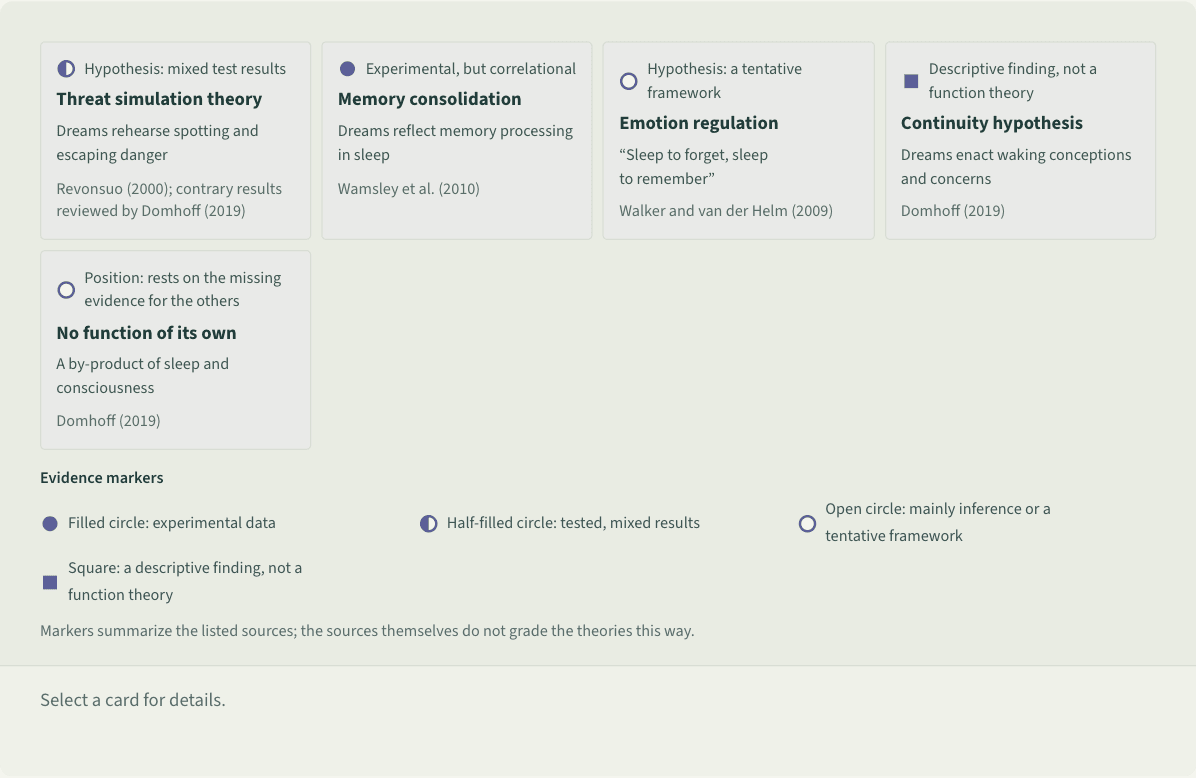
- Filled circle: experimental data
- Half-filled circle: tested, mixed results
- Open circle: mainly inference or a tentative framework
- Square: a descriptive finding, not a function theory
Markers summarize the listed sources; the sources themselves do not grade the theories this way.
Five cards side by side, each with an evidence marker. First, threat simulation theory, half-filled circle, a hypothesis with mixed test results: Revonsuo proposed in 2000 that dreams rehearse spotting and escaping threats; contrary results include life threats in 8.7% of Cape Town students’ dream reports versus 18.6% in Bangor. Second, memory consolidation, filled circle, experimental but correlational: of 99 students who learned a virtual maze, the 4 nappers who dreamed of it improved about ten times more than other nappers. Third, emotion regulation, open circle, a tentative framework: REM sleep is proposed to dull the emotional tone of memories while keeping their content; 25 to 30% of REM dream reports contain no emotion. Fourth, continuity hypothesis, square, a descriptive finding rather than a function theory: dreams mostly enact the dreamer’s waking conceptions and concerns. Fifth, no function of its own, open circle, a theoretical position: Domhoff argues dreaming is a by-product of sleep and consciousness.
 Save as image (PNG)
This figure image is licensed CC BY 4.0: reuse it with credit and a link back to this page. How to reuse
Key points
- Threat simulation theory says dreams rehearse escaping danger.[1] Yet dream reports from students in high-crime Cape Town held life threats less often than reports from Bangor, Wales (8.7% vs. 18.6%).[4]
- After 99 people learned a virtual maze, the 4 nappers who dreamed of it improved about ten times more than other nappers; thinking of the maze while awake did not help.[2]
- The emotion-regulation view holds REM sleep dulls the emotional tone of memories but keeps their content. Its authors call it a tentative framework, built mainly on sleep rather than dream data.[3]
- The continuity hypothesis observes that dreams mostly enact waking conceptions and concerns. Domhoff argues that dreaming itself has no adaptive function, being a by-product of sleep and consciousness.[4]
An example
Jay spends the morning learning a complicated transit map. Napping, he dreams of hunting for the exit of a maze-like mall, and afterward the map feels easier. On the memory view, the dream may reflect his brain reworking what he learned; such studies show the two go together, not that the dream caused the gain.
Misreadings and limits
Evidence that sleep helps memory and mood is often read as proof that dreams are useful. The maze study’s authors say plainly that they do not claim dreams cause consolidation.[2] Domhoff notes that none of these theories has been taken up beyond its own proponents, and that denying dreams a function does not make their content random.[4]
Sources
- 1 Revonsuo, A. (2000). The reinterpretation of dreams: An evolutionary hypothesis of the function of dreaming. Behavioral and Brain Sciences, 23(6), 877–901. doi:10.1017/S0140525X00004015
- 2 Wamsley, E. J., Tucker, M., Payne, J. D., Benavides, J. A., & Stickgold, R. (2010). Dreaming of a learning task is associated with enhanced sleep-dependent memory consolidation. Current Biology, 20(9), 850–855. doi:10.1016/j.cub.2010.03.027
- 3 Walker, M. P., & van der Helm, E. (2009). Overnight therapy? The role of sleep in emotional brain processing. Psychological Bulletin, 135(5), 731–748. doi:10.1037/a0016570
- 4 Domhoff, G. W. (2019). The neurocognitive theory of dreams at age 20: An assessment and a comparison with four other theories of dreaming. Dreaming, 29(4), 265–302. doi:10.1037/drm0000119
Last checked against sources: October 27, 2026