Dream content research
梦的内容研究
What do people dream about most?
Dream content research codes dream reports with fixed rules, counts how often characters, interactions, emotions and misfortunes appear, and compares the results with norms.[1][3] The most used system is Hall and Van de Castle’s (1966), normed on 1,000 dream reports from 200 American college students.[1]
Questionnaire: people who say they have ever had the dream
Ever had it (% of people)
Short bar: share of dream reports with that theme
Long bars: Nielsen et al. (2003), Table 1; 1,181 Canadian students ticked which of 55 themes they had ever dreamed. Short bars: 1,612 dream reports from German students (Mathes et al., 2014, cited in Domhoff, 2022). The samples differ, so compare orders of magnitude only.
Norms: dreams with at least one
% of dreams
Data: Hall and Van de Castle norms, 500 dreams from 100 men and 491 from 100 women, 991 in all (DreamResearch.net normative tables).
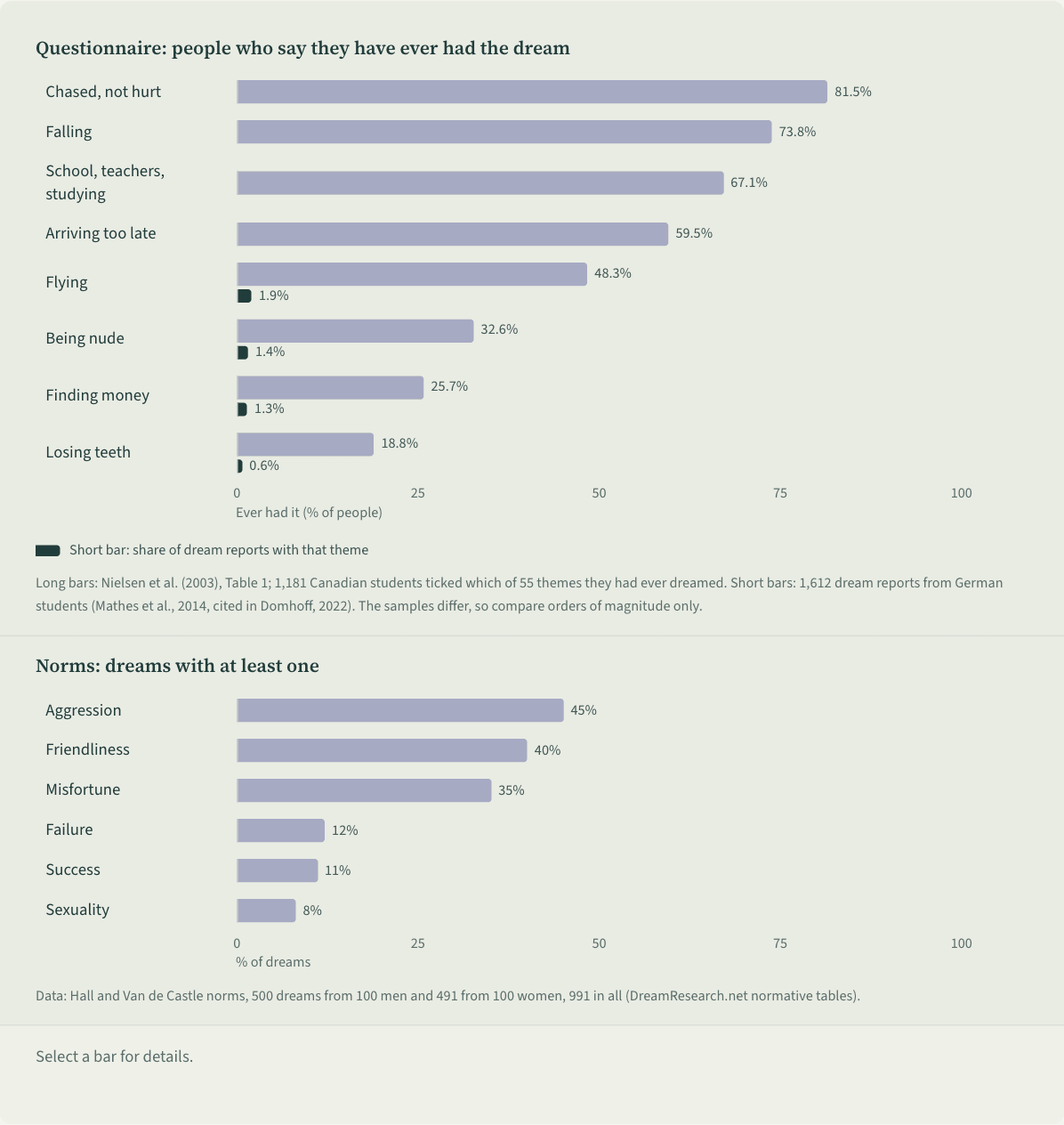
Two sets of horizontal bars. The top set, “Questionnaire: people who have ever had the dream,” shows 1,181 Canadian students: chased but not hurt 81.5%, falling 73.8%, school, teachers or studying 67.1%, arriving too late 59.5%, flying 48.3%, being nude 32.6%, finding money 25.7%, losing teeth 18.8%. Flying, nudity, finding money and losing teeth each have a very short comparison bar for their share of 1,612 German students’ dream reports: 1.9%, 1.4%, 1.3% and 0.6%. The bottom set, “Norms: dreams with at least one,” covers 991 dreams: aggression 45%, friendliness 40%, misfortune 35%, failure 12%, success 11%, sexuality 8%.
 Save as image (PNG)
This figure image is licensed CC BY 4.0: reuse it with credit and a link back to this page. How to reuse
Key points
- In these norms, 45% of dreams contain at least one aggressive interaction, 40% a friendly one and 35% a misfortune; 80% of the emotions coded are negative.[1]
- Asked about 55 themes, 1,181 Canadian students said they had ever dreamed of being chased (81.5%), falling (73.8%), flying (48.3%) or losing teeth (18.8%).[2]
- Having a dream once is not having it often: in 1,612 dream reports from German students, flying, nudity, finding money and losing teeth made up 1.9%, 1.4%, 1.3% and 0.6%.[3]
- Most dream reports are reasonable simulations of waking life. In a person’s dream series, the more often someone or some pastime appears, the more it tends to matter to them awake.[3]
An example
Lin fills in an online typical-dreams quiz and ticks being chased, falling and running late. Then she looks back over two months of her dream diary: none of those scenes appears. Most entries are chats with her roommate, calls with her mother and ordinary classes.
Misreadings and limits
Looking up dream symbols is ancient: Artemidorus compiled a dream book in the second century,[3] and in Han China Wang Fu sorted dreams into ten kinds.[4] Content studies, though, find seemingly symbolic elements rare, and no solid way to tell whether an image is literal or figurative.[3]
Sources
- 1 Schneider, A., & Domhoff, G. W. (n.d.). Normative tables for the Hall/Van de Castle coding system. DreamResearch.net, University of California, Santa Cruz. View source
- 2 Nielsen, T. A., Zadra, A. L., Simard, V., Saucier, S., Stenstrom, P., Smith, C., & Kuiken, D. (2003). The typical dreams of Canadian university students. Dreaming, 13(4), 211–235. doi:10.1023/B:DREM.0000003144.40929.0b
- 3 Domhoff, G. W. (2022). The neurocognitive theory of dreaming: The where, how, when, what, and why of dreams. MIT Press (open access, CC BY-ND). doi:10.7551/mitpress/14679.001.0001
- 4 姚海涛 (2024). 数术批判视域下的王符与荀子之比较研究——兼论王符并非无神论者. 中华经典研究(第五辑). 商务印书馆(爱思想网转载). View source
Last checked against sources: October 27, 2026