Nightmares and nightmare disorder
噩梦与噩梦障碍
When do nightmares become nightmare disorder?
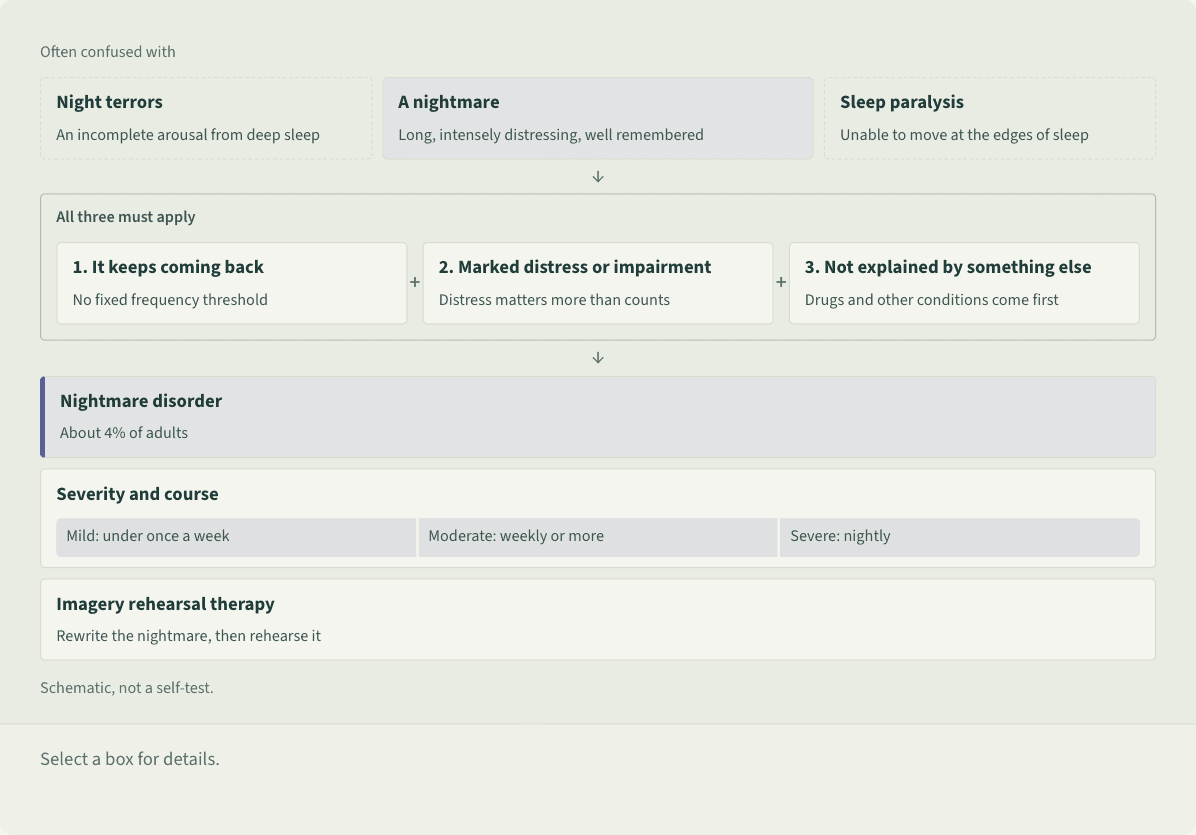
A nightmare is an extended, deeply distressing dream, well remembered on waking, that usually involves threats to survival, safety or the body.[1] Nightmare disorder applies only when nightmares keep recurring, cause marked distress or disrupt daily life, and are not better explained by a drug or another condition.[1][2]
Often confused with
All three must apply
Schematic, not a self-test.
Schematic. At the top, a box labeled nightmare: long, intensely distressing, well remembered, with quick alertness on waking. Dashed boxes on either side are labeled night terrors and sleep paralysis, two things often confused with nightmares. Below, the nightmare box passes through three conditions in a row: it keeps recurring; it causes marked distress or disrupts life; it is not explained by a drug or another condition. They lead to a box labeled nightmare disorder, about 4% of adults. A three-part bar shows severity: under once a week on average is mild, weekly but not nightly is moderate, nightly is severe. At the bottom, a box for imagery rehearsal: rewrite the nightmare while awake and rehearse the new version in imagination for 10 to 20 minutes a day.
 Save as image (PNG)
This figure image is licensed CC BY 4.0: reuse it with credit and a link back to this page. How to reuse
Key points
- A person waking from a nightmare is soon fully alert and remembers it; someone in a night terror is hard to rouse and recalls little. Nightmares are often mistaken for sleep paralysis.[1][2]
- Among 8,558 Hong Kong adults, 5.1% had nightmares at least weekly, women more often than men.[3] The American Academy of Sleep Medicine (AASM) puts nightmare disorder at about 4% of adults.[4]
- In 2018 the AASM recommended only imagery rehearsal: rewriting the nightmare while awake and rehearsing it 10 to 20 minutes a day. Others, such as lucid dreaming therapy, “may be used.”[4]
- A meta-analysis of imagery rehearsal and related therapies found large pre–post drops in nightmares (g = 1.04).[1] In a trial of 124 Vietnam veterans, imagery rehearsal did no better than a control.[4]
An example
After starting a new job, Ms. Wang dreams on several nights that she is trapped in a burning building. She wakes with her heart racing but knows at once where she is and recalls every detail. Whether to seek help depends on whether the nightmares persist and leave her low, tired by day or afraid to sleep.[4]
Misreadings and limits
An occasional nightmare, or even a spell of frequent ones, is not nightmare disorder. A diagnosis takes a professional weighing distress, daytime effects and other conditions, not a checklist.[1][2] The opposite mistake is common too: recurring nightmares are often dismissed as a side symptom of something else, though they can be treated in their own right.[1]
If you need help now
If you’re struggling to cope or having thoughts of harming yourself:
- US and Canada: call or text 988 (24/7)
- UK and Ireland: Samaritans, 116 123 (free, 24/7)
- Australia: Lifeline, 13 11 14 (24/7)
- Elsewhere: findahelpline.com
If you’re in immediate danger, call your local emergency number.
Psyfield is not a crisis service. Numbers checked October 2026.
Sources
- 1 Gieselmann, A., Ait Aoudia, M., Carr, M., Germain, A., Gorzka, R., Holzinger, B., Kleim, B., Krakow, B., Kunze, A. E., Lancee, J., Nadorff, M. R., Nielsen, T., Riemann, D., Sandahl, H., Schlarb, A. A., Schmid, C., Schredl, M., Spoormaker, V. I., Steil, R., … Pietrowsky, R. (2019). Aetiology and treatment of nightmare disorder: State of the art and future perspectives. Journal of Sleep Research, 28(4), e12820. doi:10.1111/jsr.12820
- 2 World Health Organization (2025). 7B01.2 Nightmare disorder. ICD-11 for mortality and morbidity statistics (2025-01 release). View source
- 3 Li, S. X., Zhang, B., Li, A. M., & Wing, Y. K. (2010). Prevalence and correlates of frequent nightmares: A community-based 2-phase study. Sleep, 33(6), 774–780. doi:10.1093/sleep/33.6.774
- 4 Morgenthaler, T. I., Auerbach, S., Casey, K. R., Kristo, D., Maganti, R., Ramar, K., Zak, R., & Kartje, R. (2018). Position paper for the treatment of nightmare disorder in adults: An American Academy of Sleep Medicine position paper. Journal of Clinical Sleep Medicine, 14(6), 1041–1055. doi:10.5664/jcsm.7178
Last checked against sources: October 27, 2026