Adjustment disorder
适应障碍
What is adjustment disorder?
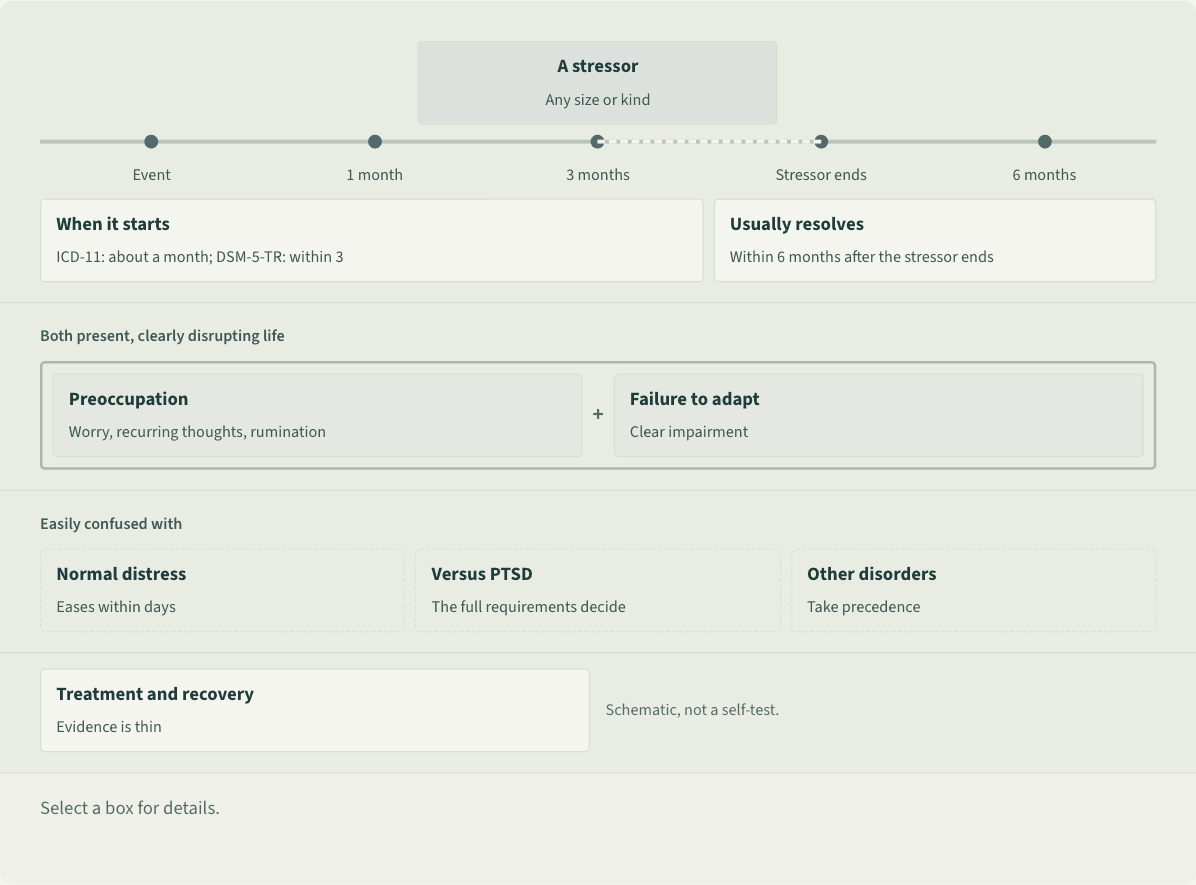
Adjustment disorder is a maladaptive reaction to an identifiable stressor such as divorce, illness, job loss or conflict at home or work, usually within a month: the person is preoccupied with it and its consequences and fails to adapt, with clear impairment.[1] Once the stressor and its consequences end, symptoms usually resolve within six months.[1]
Both present, clearly disrupting life
Easily confused with
Schematic, not a self-test.
Schematic. At the top, a box labeled a stressor, of any size or kind. Below it, a timeline marks the event, one month, three months, the end of the stressor and its consequences, and six months after that. At one month a label says ICD-11 onset usually comes before this point; at three months, that DSM-5-TR requires onset before it; at six months, that symptoms have usually resolved. The timeline is not to scale. In the middle, two cards labeled both present and clearly disrupting life: preoccupation (worry, recurring thoughts, rumination) and failure to adapt (clear impairment at home, socially or at work). The next row shows three things it can be confused with: normal distress, PTSD, and depression or other disorders. At the bottom, a card on treatment and recovery notes that the evidence is thin.
 Save as image (PNG)
This figure image is licensed CC BY 4.0: reuse it with credit and a link back to this page. How to reuse
Key points
- DSM-5-TR requires onset within 3 months and either distress out of proportion to the stressor or impaired functioning.[2] ICD-11 expects onset usually within a month and centers on preoccupation.[1][3]
- The stressor can be of any severity, unlike the extreme threat PTSD requires. If depression or another disorder explains the symptoms, adjustment disorder is generally not diagnosed.[1]
- Prevalence is little studied: about 1–2% in the general population,[4] but about 27% among the recently unemployed and 12% of psychiatric consultations in general hospitals.[3]
- Most people recover with time and support from family and friends.[2] A systematic review of 29 studies rated the evidence for every psychological and drug treatment as low or very low.[3]
An example
Three months after her divorce, Ms. Wang keeps replaying old arguments and worrying about the house and the children’s future. She makes mistakes at work, skips weekends with friends and walks away whenever someone mentions her ex. Whether this goes beyond normal sadness and calls for help depends on whether it persists and clearly disrupts her life.[1]
Misreadings and limits
Adjustment disorder is often treated as a minor problem, yet it brings real distress and impairment and a higher risk of suicide.[2] Sadness that eases within days does not count.[1] This page is not for self-diagnosis. If you cannot let go and work or daily life suffers, or thoughts of self-harm appear, see a doctor or mental health professional soon.
If you need help now
If you’re struggling to cope or having thoughts of harming yourself:
- US and Canada: call or text 988 (24/7)
- UK and Ireland: Samaritans, 116 123 (free, 24/7)
- Australia: Lifeline, 13 11 14 (24/7)
- Elsewhere: findahelpline.com
If you’re in immediate danger, call your local emergency number.
Psyfield is not a crisis service. Numbers checked October 2026.
Sources
- 1 World Health Organization (2025). 6B43 Adjustment disorder. ICD-11 for mortality and morbidity statistics (2025-01 release). View source
- 2 Barnhill, J. W. (2026). Adjustment disorders. MSD Manual Professional Version (full review April 2026). View source
- 3 O’Donnell, M. L., Agathos, J. A., Metcalf, O., Gibson, K., & Lau, W. (2019). Adjustment disorder: Current developments and future directions. International Journal of Environmental Research and Public Health, 16(14), 2537. doi:10.3390/ijerph16142537
- 4 Zelviene, P., & Kazlauskas, E. (2018). Adjustment disorder: Current perspectives. Neuropsychiatric Disease and Treatment, 14, 375–381. doi:10.2147/NDT.S121072
Last checked against sources: October 28, 2026