Psychological trauma
心理创伤
What is psychological trauma?
Psychological trauma is the lasting harm to functioning and well-being left by an event or series of events that a person experiences as physically or emotionally harmful or life-threatening.[1] Clinical definitions are narrower: DSM-5-TR counts only actual or threatened death, serious injury or sexual violence.[2]
Common distinctions
Afterward
Schematic, not a self-test. Bars drawn to scale.
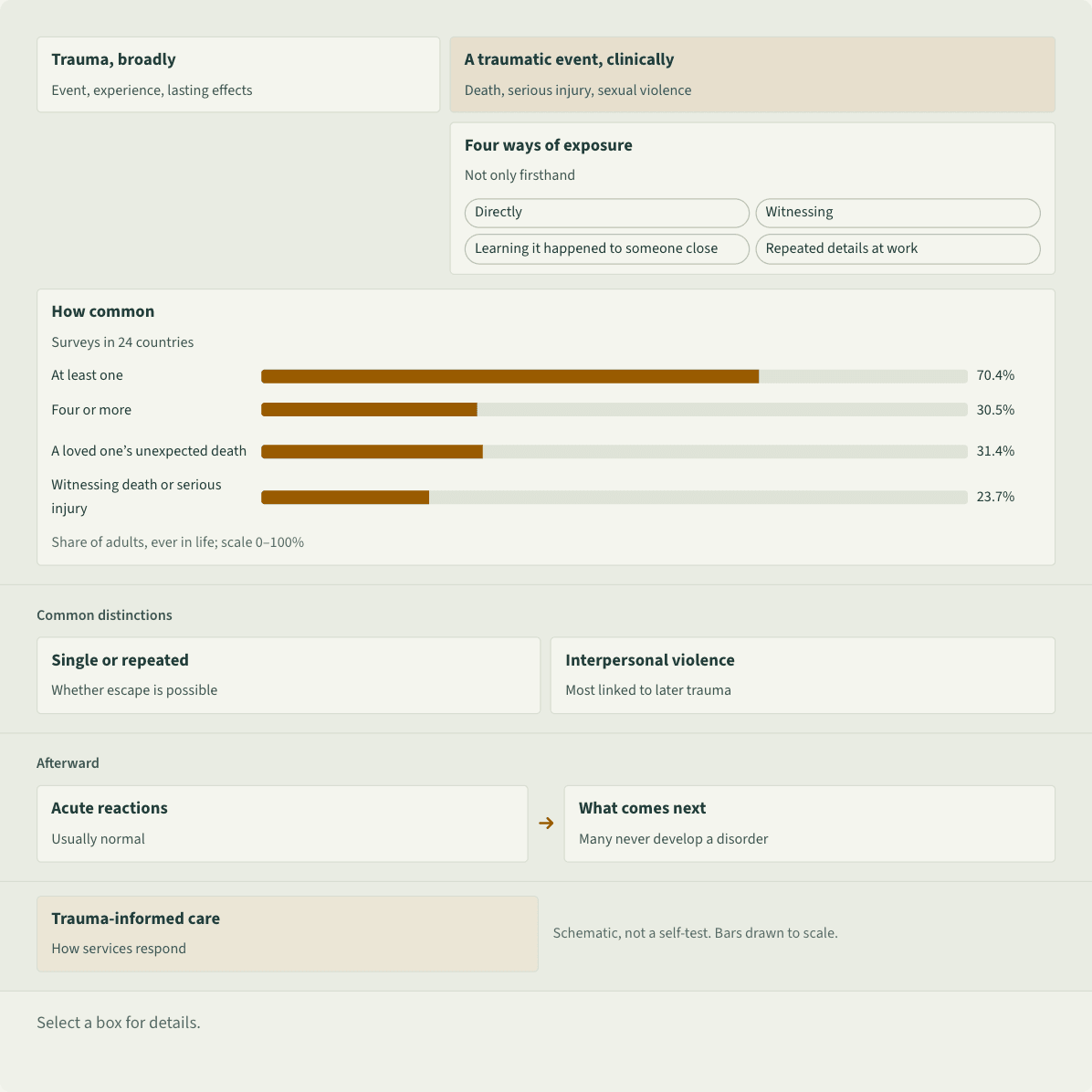
Schematic. At the top, two cards side by side: trauma in the broad sense, noting event, experience and lasting effects; and a traumatic event in the clinical sense, noting death, serious injury and sexual violence, with a button below listing four ways of exposure: directly, witnessing, learning it happened to someone close, and repeated details at work. In the middle, a card on how common it is holds four bars drawn to scale from 0 to 100 percent: among adults in 24 countries, 70.4 percent had faced at least one traumatic event, 30.5 percent four or more, 31.4 percent a loved one’s unexpected death and 23.7 percent witnessing death or serious injury. The next row, labeled common distinctions, has two cards: single versus repeated, and interpersonal violence. Below that, labeled afterward, a card on acute reactions points by an arrow to a card on what comes next. At the bottom, a card on trauma-informed care.
 Save as image (PNG)
This figure image is licensed CC BY 4.0: reuse it with credit and a link back to this page. How to reuse
Key points
- DSM-5-TR accepts four routes: experiencing it, witnessing it, learning it happened to someone close, or repeated exposure to details at work.[2] ICD-11 speaks of extremely threatening or horrific events.[3]
- Across 24 countries, 70.4% of 68,894 adults had faced at least one traumatic event and 30.5% four or more; a loved one’s unexpected death was the most common.[4]
- Single events are often set apart from prolonged, repeated trauma that is hard to escape, which raises the risk of complex PTSD.[3] Interpersonal violence is most strongly linked to later trauma.[4]
- Shock, anxiety or a daze in the following days are usually normal and start to ease within days.[3] Many people have no lasting effects;[1] some develop PTSD or adjustment disorder.[3]
An example
After a public dressing-down from her boss, Lin calls it “traumatic.” Her coworker Jay recently saw a crash at an intersection that left someone badly hurt, and still avoids that corner. Both are shaken, but in DSM-5-TR only Jay’s experience, witnessing serious injury, counts as a traumatic event;[2] lasting effects vary from person to person.[1]
Misreadings and limits
Going through trauma does not mean something is wrong with you: acute reactions usually start to ease within days, and many people have no lasting effects.[1][3] This page is not for self-diagnosis. If flashbacks, nightmares, avoidance or feeling on edge last over a month or disrupt life, or thoughts of self-harm appear, see a doctor or mental health professional soon.[2][3]
If you need help now
If you’re struggling to cope or having thoughts of harming yourself:
- US and Canada: call or text 988 (24/7)
- UK and Ireland: Samaritans, 116 123 (free, 24/7)
- Australia: Lifeline, 13 11 14 (24/7)
- Elsewhere: findahelpline.com
If you’re in immediate danger, call your local emergency number.
Psyfield is not a crisis service. Numbers checked October 2026.
Sources
- 1 Substance Abuse and Mental Health Services Administration (2026). Trauma and violence: What is trauma and its effects?; Trauma-informed approaches and programs. SAMHSA (last updated March 16 and February 8, 2026). View source
- 2 U.S. Department of Veterans Affairs, National Center for PTSD (2026). PTSD and DSM-5. PTSD: National Center for PTSD (last updated September 2026). View source
- 3 World Health Organization (2025). 6B40 Post traumatic stress disorder; 6B41 Complex post traumatic stress disorder; QE84 Acute stress reaction. ICD-11 for mortality and morbidity statistics (2025-01 release). View source
- 4 Benjet, C., Bromet, E., Karam, E. G., Kessler, R. C., McLaughlin, K. A., Ruscio, A. M., Shahly, V., Stein, D. J., Petukhova, M., Hill, E., Alonso, J., Atwoli, L., Bunting, B., Bruffaerts, R., Caldas-de-Almeida, J. M., de Girolamo, G., Florescu, S., Gureje, O., Huang, Y., … Koenen, K. C. (2016). The epidemiology of traumatic event exposure worldwide: Results from the World Mental Health Survey Consortium. Psychological Medicine, 46(2), 327–343. doi:10.1017/S0033291715001981
Last checked against sources: October 28, 2026