Post-traumatic stress disorder (PTSD)
创伤后应激障碍(PTSD)
What is post-traumatic stress disorder?
Post-traumatic stress disorder (PTSD) can develop after an extremely threatening or horrific event. Its core is threefold: reliving the trauma as if it were happening now, deliberately avoiding reminders, and a persistent sense of current threat.[1] The symptoms last at least several weeks and clearly impair daily life.[1]
Afterward
ICD-11’s three core elements: all required, lasting at least several weeks
Schematic, not a self-test.
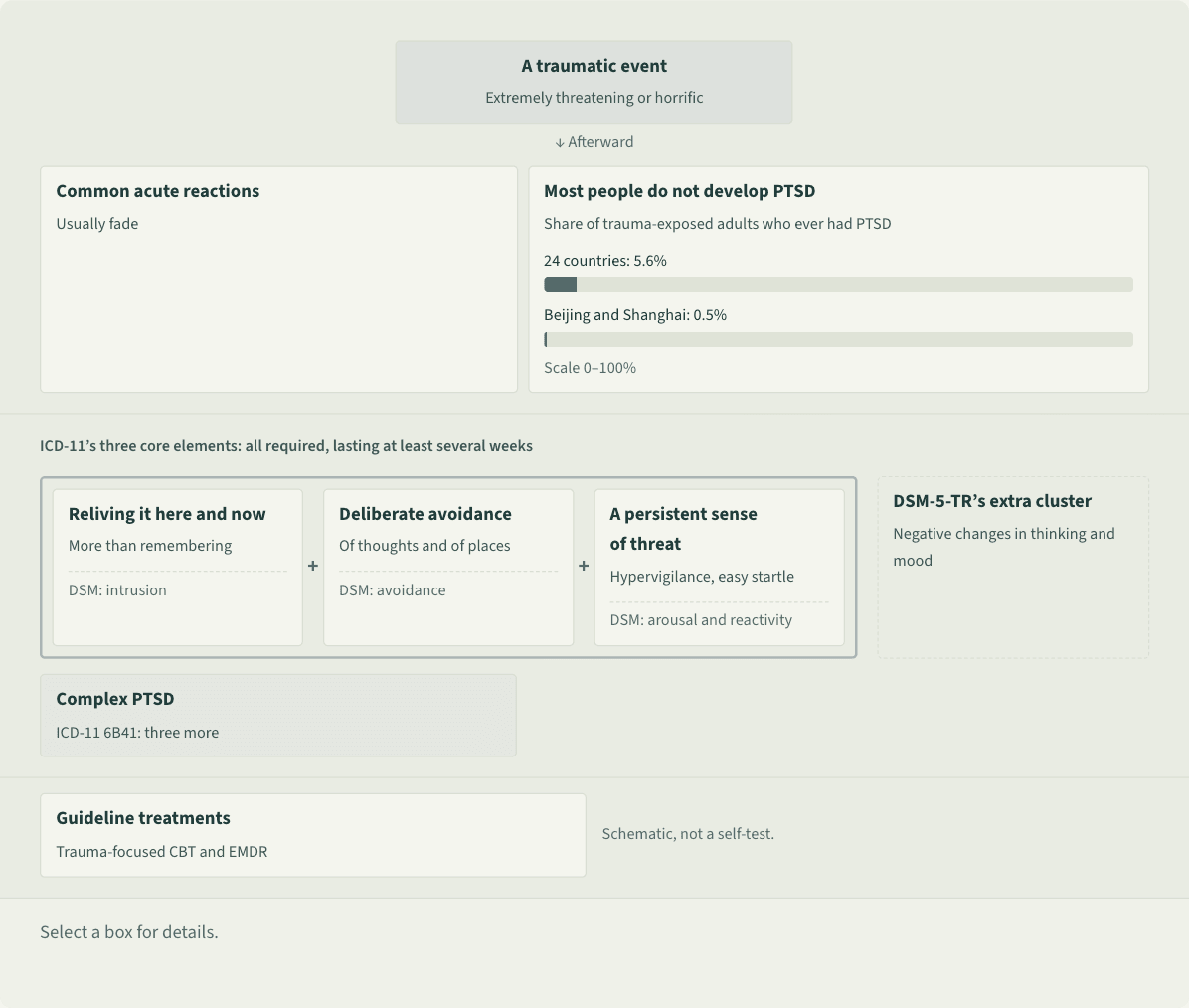
Schematic. At the top, a box labeled traumatic event. Below it, two panels: on the left, common acute reactions, marked as usually fading; on the right, a bar drawn to scale showing that among adults in 24 countries who had faced a trauma, about 5.6% ever developed PTSD, and 0.5% in the Beijing and Shanghai sample. Next, a group of three cards labeled ICD-11’s three core elements, all required and lasting at least several weeks: reliving the trauma in the here and now, deliberate avoidance, and a persistent sense of current threat. Small labels under them name the matching DSM-5-TR clusters: intrusion, avoidance, and changes in arousal and reactivity. Beside them, a dashed card shows DSM-5-TR’s extra cluster, negative changes in thinking and mood. Below is a card for complex PTSD, which adds three further difficulties, and at the bottom a card for guideline treatments: trauma-focused CBT and EMDR.
 Save as image (PNG)
This figure image is licensed CC BY 4.0: reuse it with credit and a link back to this page. How to reuse
Key points
- DSM-5-TR uses four clusters: intrusion, avoidance, negative changes in thinking and mood, and altered arousal and reactivity, lasting over a month.[2] ICD-11 keeps only the three core elements above.[1]
- Of adults in 24 countries who had faced trauma, 5.6% ever had PTSD, 0.5% in Beijing and Shanghai.[3] Severe or repeated trauma, little support afterward and childhood adversity raise the risk.[2]
- ICD-11’s complex PTSD usually follows prolonged or repeated trauma that is hard to escape: on top of PTSD, emotion regulation, self-worth and relationships are severely affected.[1][4]
- NICE advises individual trauma-focused CBT for adults, usually 8 to 12 sessions; three months after trauma not related to combat, EMDR is also offered.[4]
An example
Six months ago Jay lived through a strong earthquake; his family is safe. Now, when a heavy truck rattles the windows, he feels back in the swaying building, heart racing, body shaking. He avoids all quake news and wakes at the slightest sound. Whether he needs help depends on whether this persists and disrupts his life.[1]
Misreadings and limits
In the first days or weeks after a trauma, intrusive images, poor sleep and jumpiness are common and usually ease; this alone is not PTSD.[1][2] This page is not for self-diagnosis. If reactions last over a month or disrupt life, or thoughts of self-harm appear, see a doctor or mental health professional soon; PTSD is treatable.[2][4]
If you need help now
If you’re struggling to cope or having thoughts of harming yourself:
- US and Canada: call or text 988 (24/7)
- UK and Ireland: Samaritans, 116 123 (free, 24/7)
- Australia: Lifeline, 13 11 14 (24/7)
- Elsewhere: findahelpline.com
If you’re in immediate danger, call your local emergency number.
Psyfield is not a crisis service. Numbers checked October 2026.
Sources
- 1 World Health Organization (2025). 6B40 Post traumatic stress disorder. ICD-11 for mortality and morbidity statistics (2025-01 release). View source
- 2 American Psychiatric Association (2025). What is posttraumatic stress disorder (PTSD)?. Psychiatry.org (physician review March 2025). View source
- 3 Koenen, K. C., Ratanatharathorn, A., Ng, L., McLaughlin, K. A., Bromet, E. J., Stein, D. J., Karam, E. G., Meron Ruscio, A., Benjet, C., Scott, K., Atwoli, L., Petukhova, M., Lim, C. C. W., Aguilar-Gaxiola, S., Al-Hamzawi, A., Alonso, J., Bunting, B., Ciutan, M., de Girolamo, G., … Kessler, R. C. (2017). Posttraumatic stress disorder in the World Mental Health Surveys. Psychological Medicine, 47(13), 2260–2274. doi:10.1017/S0033291717000708
- 4 National Institute for Health and Care Excellence (2018). Post-traumatic stress disorder (NG116). NICE guideline (published December 5, 2018). View source
Last checked against sources: October 28, 2026