Burnout
职业倦怠
What is burnout?
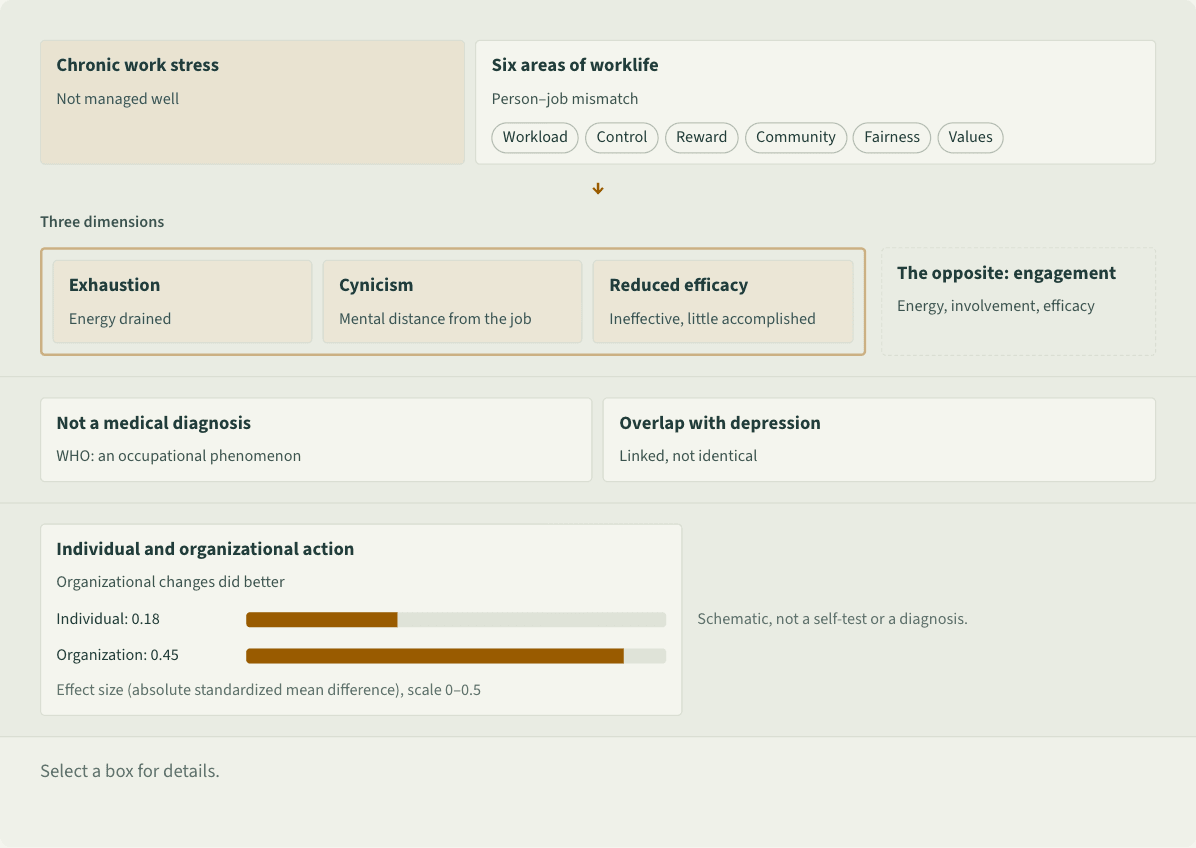
Burnout is a syndrome that develops when chronic work stress is not managed well. It has three dimensions: exhaustion; growing mental distance from the job, or negativity and cynicism about it; and reduced professional efficacy.[1] WHO classes it as an occupational phenomenon, not a medical condition.[1]
Three dimensions
Schematic, not a self-test or a diagnosis.
Schematic. At the top, a box labeled chronic work stress that has not been managed well, beside six small tags: workload, control, reward, community, fairness and values, the six areas where person and job can mismatch. Below, three cards labeled the three dimensions: exhaustion, cynicism and reduced efficacy, with a dashed card beside them for the opposite, engagement. Next, two cards side by side: not a medical diagnosis, noting WHO’s term occupational phenomenon, and overlap with depression, noting that the two are linked but not identical. At the bottom, a card on individual and organizational action holds two bars drawn to scale: in a meta-analysis of studies with physicians, the effect size was about 0.18 for individual-directed and 0.45 for organization-directed interventions.
 Save as image (PNG)
This figure image is licensed CC BY 4.0: reuse it with credit and a link back to this page. How to reuse
Key points
- The concept emerged in the 1970s in people-oriented work such as health care and teaching. The Maslach Burnout Inventory (MBI), which scores each dimension, is the field’s standard research tool.[2]
- Maslach and Leiter name six areas of worklife: workload, control, reward, community, fairness and values. The greater the mismatch between person and job, the greater the risk.[2]
- Its link with depression is debated: some argue that severe burnout and depression are indistinguishable.[2] A meta-analysis of 69 studies found them correlated (r = 0.52) but not the same.[3]
- Most interventions target individuals, for example less overtime, coping skills or relaxation.[2] In a meta-analysis of studies with physicians, organization-directed interventions worked better than individual ones.[4]
An example
In her fifth year as an emergency nurse, Lin comes home from long overtime wanting only to lie down. She grows short with patients and feels nothing she does matters. A week’s family holiday lifts her energy and mood; back at work, it sinks again. Whether such fatigue tracks the job is something researchers weigh in telling burnout from depression.[2]
Misreadings and limits
WHO says burnout is not a medical condition and describes work experiences only, so “parental burnout” or “school burnout” falls outside its definition.[1] This page is not for self-diagnosis. Burnout and depression are linked.[2][3] If low mood and lost interest spread beyond work, or thoughts of self-harm appear, see a doctor or mental health professional soon.
Sources
- 1 World Health Organization (2019). Burn-out an “occupational phenomenon”: International Classification of Diseases. WHO departmental update (May 28, 2019). View source
- 2 Maslach, C., & Leiter, M. P. (2016). Understanding the burnout experience: Recent research and its implications for psychiatry. World Psychiatry, 15(2), 103–111. doi:10.1002/wps.20311
- 3 Koutsimani, P., Montgomery, A., & Georganta, K. (2019). The relationship between burnout, depression, and anxiety: A systematic review and meta-analysis. Frontiers in Psychology, 10, 284. doi:10.3389/fpsyg.2019.00284
- 4 Panagioti, M., Panagopoulou, E., Bower, P., Lewith, G., Kontopantelis, E., Chew-Graham, C., Dawson, S., van Marwijk, H., Geraghty, K., & Esmail, A. (2017). Controlled interventions to reduce burnout in physicians: A systematic review and meta-analysis. JAMA Internal Medicine, 177(2), 195–205. doi:10.1001/jamainternmed.2016.7674
Last checked against sources: October 28, 2026