Responsibility pie
责任饼图
What is a responsibility pie?
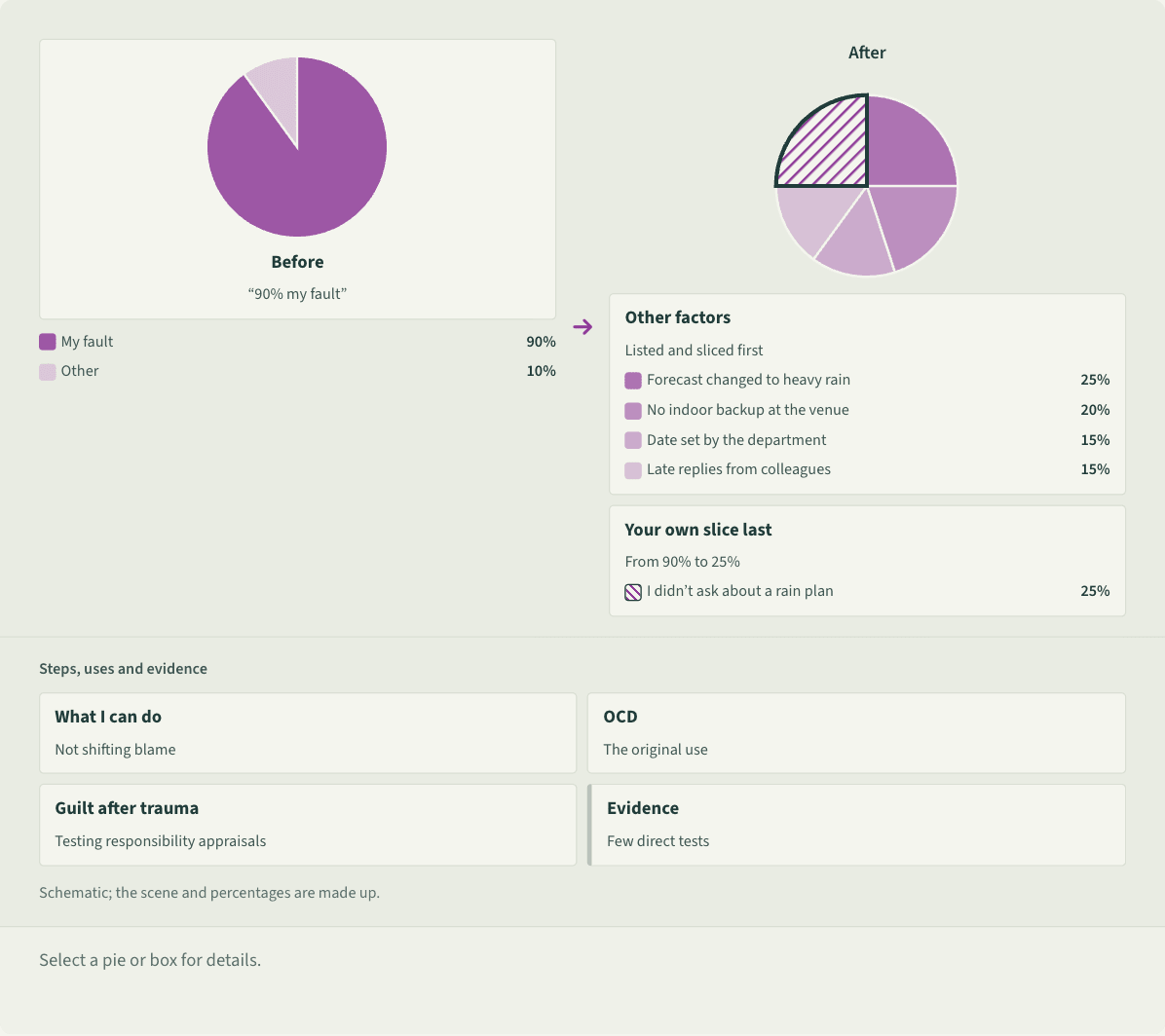
A responsibility pie is a cognitive therapy exercise for testing excessive self-blame: the bad outcome is drawn as a whole pie, every person and circumstance that may have contributed is listed and given a slice by their share of responsibility, and the person’s own slice comes last.[1][2]
- My fault 90%
- Other 10%
After
Steps, uses and evidence
Schematic; the scene and percentages are made up.
Schematic. On the left, a pie labeled before: my fault 90%, other 10%. On the right, a pie labeled after, in five slices: forecast changed to heavy rain 25%, no indoor backup at the venue 20%, date set by the department 15%, late replies from colleagues 15%, and a last, hatched slice, I didn’t ask about a rain plan, 25%. An arrow leads from the first pie to the second. Below, labeled steps, uses and evidence, four cards: what I can do, OCD, guilt after trauma, and evidence.
 Save as image (PNG)
This figure image is licensed CC BY 4.0: reuse it with credit and a link back to this page. How to reuse
Key points
- The pie technique was first designed to counter overestimated responsibility for a bad outcome (van Oppen and Arntz, 1994) and was later adapted to estimate how likely a feared event is.[3]
- An OCD self-help book sets out five steps: name the feared event, rate your responsibility (0–100%), list every factor, divide the pie with yourself last, then re-rate.[2]
- For guilt or shame, the finished pie comes with three questions: whether you are 100% responsible, how the pie changes your guilt, and whether you can make amends for your part.[1]
- Cognitive approaches to guilt after trauma use it to test appraisals such as “I could have prevented it,” but survivor guilt often involves no sense of responsibility and needs other methods.[4]
An example
Ms. Wang’s team outing is rained out, and she feels 90% to blame. She first lists other factors: a forecast that changed the day before, no indoor backup at the venue, a date the department chose, late replies that delayed the booking. Last comes her own slice, for not asking about a rain plan: 25%. Next time, she’ll ask.
Misreadings and limits
It is not a way to shift blame: your own slice still goes in, along with the question of amends.[1] Direct tests are scarce. What its authors call the first prospective test of such techniques involved 319 non-clinical adults and the pie’s probability version, and they caution against generalizing to anxious patients.[3]
Sources
- 1 Greenberger, D., & Padesky, C. A. (2016). Worksheet 15.7: Using a responsibility pie for guilt or shame. Mind over mood: Change how you feel by changing the way you think (2nd ed.), Guilford Press. View source
- 2 Veale, D., & Willson, R. (2021). Dividing up your responsibility pie (exercise, pp. 225–226). Overcoming obsessive compulsive disorder (2nd ed.), Robinson. View source
- 3 Gangemi, A., Gragnani, A., Dahò, M., & Buonanno, C. (2019). Reducing probability overestimation of threatening events: An Italian study on the efficacy of cognitive techniques in non-clinical subjects. Clinical Neuropsychiatry, 16(3), 149–155. View source
- 4 Murray, H., Pethania, Y., & Medin, E. (2021). Survivor guilt: A cognitive approach. The Cognitive Behaviour Therapist, 14, e28. doi:10.1017/S1754470X21000246
Last checked against sources: October 28, 2026