Self-harm
自伤
If you need help now
If you’re struggling to cope or having thoughts of harming yourself:
- US and Canada: call or text 988 (24/7)
- UK and Ireland: Samaritans, 116 123 (free, 24/7)
- Australia: Lifeline, 13 11 14 (24/7)
- Elsewhere: findahelpline.com
If you’re in immediate danger, call your local emergency number.
Psyfield is not a crisis service. Numbers checked October 2026.
What is self-harm?
Self-harm is intentionally hurting oneself, whatever the person’s purpose.[1] When there is no intent to die, it is called non-suicidal self-injury (NSSI); the reason people give most often is to escape overwhelming emotions.[2][3]
Reasons people give (often more than one)
When someone tells you they self-harm
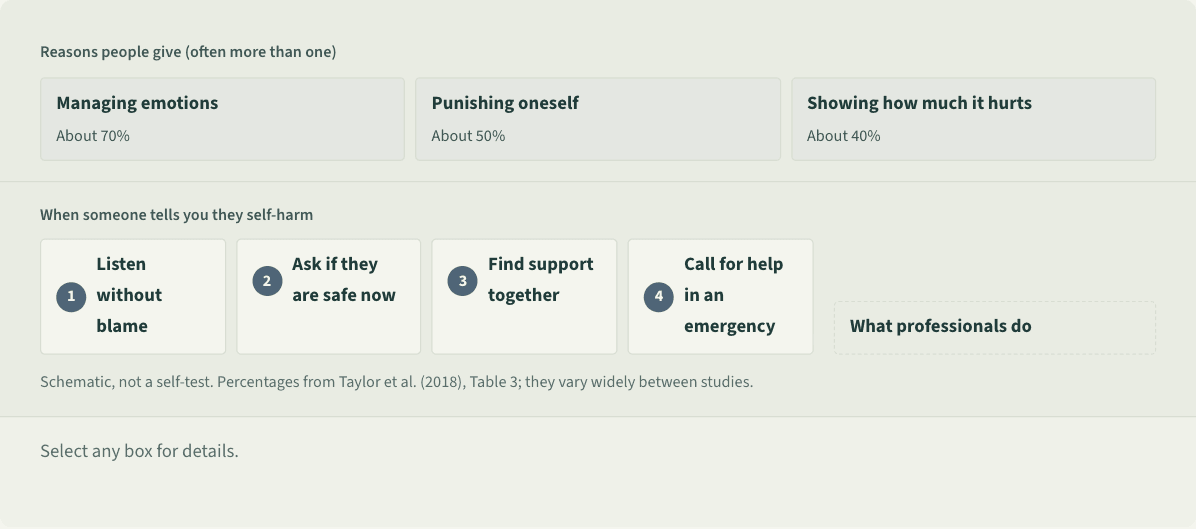
Schematic, not a self-test. Percentages from Taylor et al. (2018), Table 3; they vary widely between studies.
Schematic. Three boxes at the top show the reasons people give: managing emotions, about 70%, such as escaping painful feelings; punishing oneself, about 50%; and letting others know how much they are hurting, about 40%. Below are four steps in order: listen without blame; ask whether the person is safe right now; find professional support together; call emergency services if there is immediate danger. A box beside them explains professional assessment: a psychosocial assessment after every episode, no risk scales to decide who gets treatment, and a care plan made with the person. A note says the figure is schematic, not a self-test, and that percentages vary widely between studies.
 Save as image (PNG)
This figure image is licensed CC BY 4.0: reuse it with credit and a link back to this page. How to reuse
Key points
- A meta-analysis of community studies covering nearly 600,000 adolescents aged 12–18 in 41 countries found about 17% had self-harmed, starting at 13 on average; nearly half reported one or two episodes.[4]
- Among people who self-injure, about 70% say they do it to manage emotions, such as escaping painful feelings; about 40% also want others to know how much they are hurting.[3]
- People who self-harm face much higher suicide risk, especially in the year after a hospital visit. NICE asks for a psychosocial assessment every time and says risk scales must not decide care.[1]
- About half of adolescents who self-harm seek help, mostly from a friend.[4] NICE asks teachers and other non-health staff to respond with respect and compassion and help the person reach support.[1]
An example
Lin tells Jay that when stress gets unbearable, she hurts herself. Jay doesn’t scold her or ask for details. He thanks her for telling him, asks whether she is safe right now, listens, and then goes with her to see the school counselor.[1]
Misreadings and limits
Non-suicidal self-injury is not an attempt to die, but that does not make it minor: self-harm is linked to later suicide risk.[1] DSM-5-TR still lists non-suicidal self-injury disorder as a condition for further study, not an official diagnosis.[2]
Sources
- 1 National Institute for Health and Care Excellence (2022). Self-harm: Assessment, management and preventing recurrence (NG225). NICE guideline (presentational update August 2024). View source
- 2 Oliogu, E., & Ruocco, A. C. (2024). DSM-5 suicidal behavior disorder: A systematic review of research on clinical utility, diagnostic boundaries, measures, pathophysiology and interventions. Frontiers in Psychiatry, 15, 1278230. doi:10.3389/fpsyt.2024.1278230
- 3 Taylor, P. J., Jomar, K., Dhingra, K., Forrester, R., Shahmalak, U., & Dickson, J. M. (2018). A meta-analysis of the prevalence of different functions of non-suicidal self-injury. Journal of Affective Disorders, 227, 759–769. doi:10.1016/j.jad.2017.11.073
- 4 Gillies, D., Christou, M. A., Dixon, A. C., Featherston, O. J., Rapti, I., Garcia-Anguita, A., Villasis-Keever, M., Reebye, P., Christou, E., Al Kabir, N., & Christou, P. A. (2018). Prevalence and characteristics of self-harm in adolescents: Meta-analyses of community-based studies 1990–2015. Journal of the American Academy of Child & Adolescent Psychiatry, 57(10), 733–741. doi:10.1016/j.jaac.2018.06.018
Last checked against sources: October 28, 2026