Orientations to happiness
幸福取向
What are orientations to happiness?
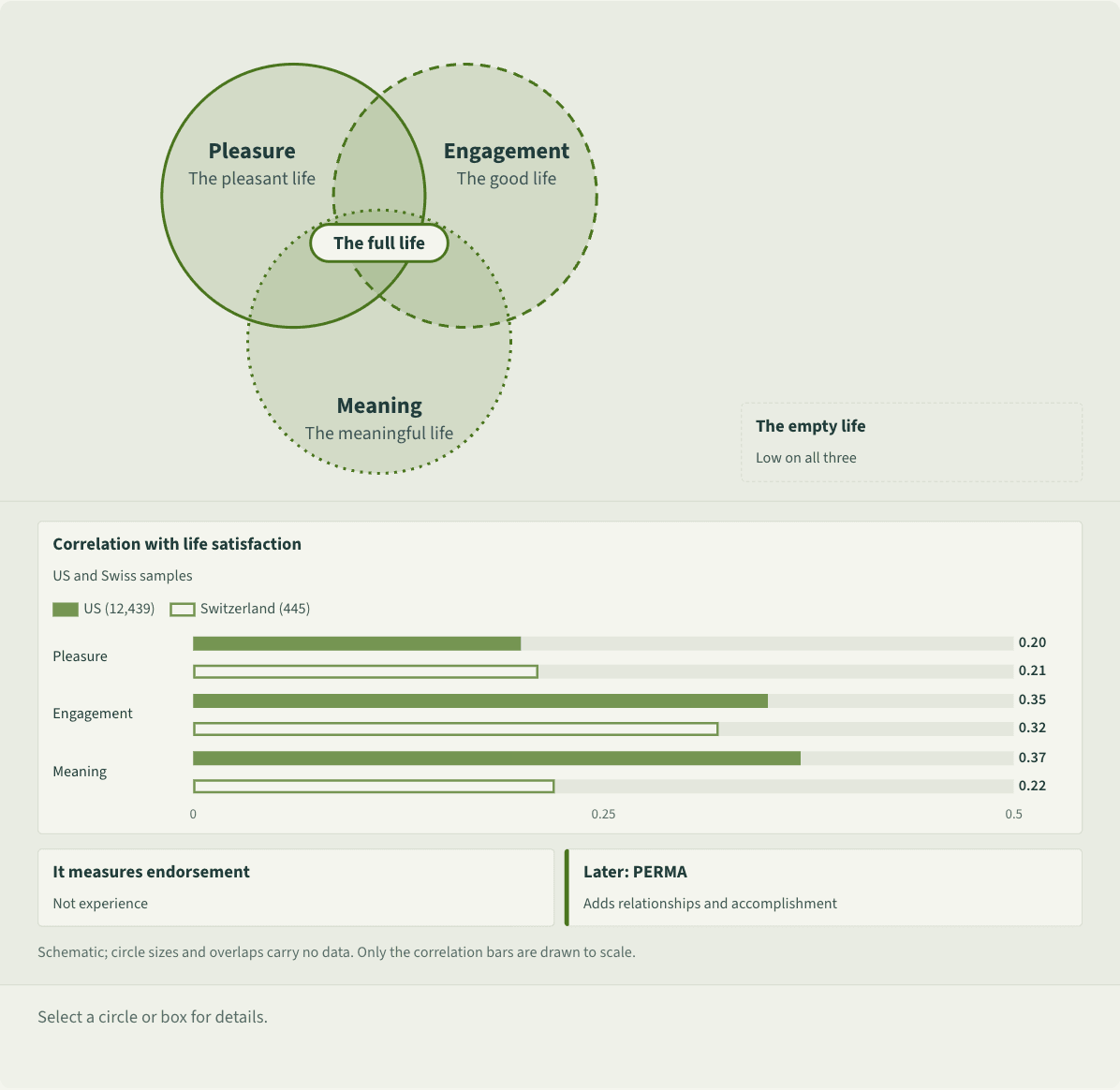
Orientations to happiness are the routes a person endorses for becoming happy: pleasure, engagement or meaning.[2][3] The three come from the core thesis of Martin Seligman’s Authentic Happiness: the pleasant life, the good life and the meaningful life.[1]
Schematic; circle sizes and overlaps carry no data. Only the correlation bars are drawn to scale.
Schematic. At the top, three partly overlapping circles labeled pleasure, the pleasant life; engagement, the good life; and meaning, the meaningful life. Where all three overlap, the center reads the full life. Outside the circles, a dashed card reads the empty life, low on all three. Below, a card on correlations with life satisfaction shows two sets of bars drawn to scale on a 0 to 0.5 axis: in the US sample, pleasure 0.20, engagement 0.35 and meaning 0.37; in the Swiss sample, 0.21, 0.32 and 0.22. At the bottom, two cards side by side: it measures endorsement, not experience; and later PERMA, which adds relationships and accomplishment. The sizes and overlaps of the circles carry no data.
 Save as image (PNG)
This figure image is licensed CC BY 4.0: reuse it with credit and a link back to this page. How to reuse
Key points
- The routes echo hedonism, flow and Aristotle’s eudaimonia. The scale has 18 items, six per route, each rated 1–5.[3]
- In the 2005 study of 845 adults, each orientation predicted life satisfaction on its own; people low on all three were especially dissatisfied, which the authors called the empty life.[2]
- Among 12,439 US adults answering online, partial correlations with life satisfaction were 0.20 for pleasure, 0.35 for engagement and 0.37 for meaning.[3]
- Reporting an early study of 150 people, Seligman wrote that pleasure did not add to life satisfaction.[1] In larger samples it did correlate positively, though usually less than the other two.[3]
An example
On an orientations-to-happiness questionnaire, Lin strongly agrees with items like “Life is too short to postpone its pleasures,” and scores highest on pleasure. Yet for six months she has been caring for a newborn and has had almost no time for things she enjoys. Her score shows which route she values, not how she is living now.
Misreadings and limits
A common misreading treats the three routes as Seligman’s current theory. In 2011 he wrote that reported life satisfaction depends heavily on mood at the moment of asking and that the three elements were “not enough,” so he added relationships and accomplishment in the PERMA model.[4]
Sources
- 1 Seligman, M. E. P. (n.d.). Pleasure, meaning & eudaimonia. Authentic Happiness newsletter archive, University of Pennsylvania. View source
- 2 Peterson, C., Park, N., & Seligman, M. E. P. (2005). Orientations to happiness and life satisfaction: The full life versus the empty life. Journal of Happiness Studies, 6(1), 25–41. doi:10.1007/s10902-004-1278-z
- 3 Peterson, C., Ruch, W., Beermann, U., Park, N., & Seligman, M. E. P. (2007). Strengths of character, orientations to happiness, and life satisfaction. The Journal of Positive Psychology, 2(3), 149–156. doi:10.1080/17439760701228938
- 4 Seligman, M. E. P. (2011). Flourish: A new theory of positive psychology (archived newsletter). Authentic Happiness newsletter archive, University of Pennsylvania (edited from chapter 1 of Flourish, Simon & Schuster, 2011). View source
Last checked against sources: October 28, 2026