Eudaimonia
实现论幸福感
What is eudaimonia?
Eudaimonia is Aristotle’s term for the highest human good, living well, which he located in virtuous activity over a whole life.[1] The eudaimonic approach in psychology defines well-being by meaning, self-realization and full functioning, in contrast to the hedonic approach of seeking pleasure and avoiding pain.[2]
Eudaimonic: Ryff’s six dimensions
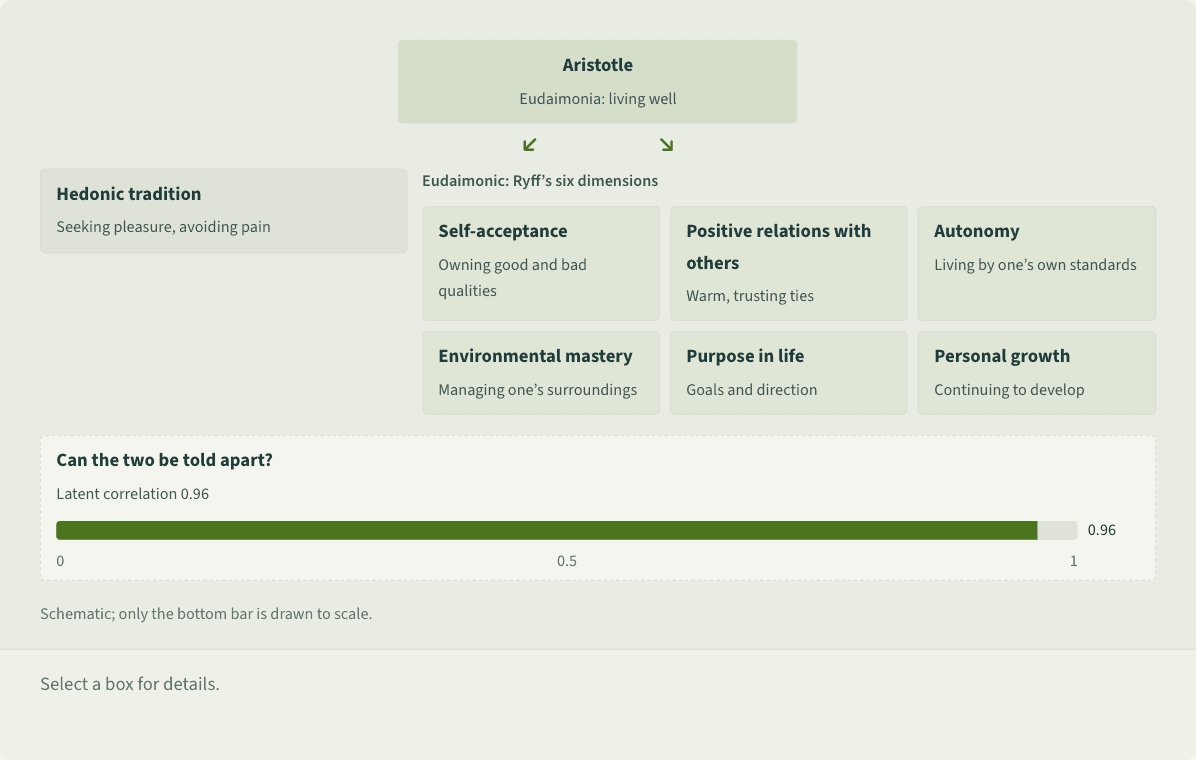
Schematic; only the bottom bar is drawn to scale.
Schematic. At the top, a card: Aristotle, eudaimonia, living well. It branches into two columns. Left, a card: the hedonic tradition, seeking pleasure and avoiding pain, usually measured as subjective well-being. Right, headed eudaimonic tradition, Ryff’s six dimensions, six small cards in two columns and three rows: self-acceptance, positive relations with others, autonomy, environmental mastery, purpose in life and personal growth. Spanning both columns below, a card: can the two be told apart, latent correlation 0.96, with a bar drawn to scale on a 0 to 1 axis reaching 0.96.
 Save as image (PNG)
This figure image is licensed CC BY 4.0: reuse it with credit and a link back to this page. How to reuse
Key points
- The Greek joins eu (“well”) and daimon (“spirit”), but Aristotle used the word simply to mean living well: an evaluation of a life, not a description of a state of mind.[1]
- Happiness, he argued, is not virtue but virtuous activity, and it also needs outside goods such as friends and some wealth; severe misfortune can rob even good people of it.[1]
- Drawing on humanistic, developmental and other theories, Carol Ryff proposed six dimensions: self-acceptance, positive relations with others, autonomy, environmental mastery, purpose in life and personal growth.[3]
- Older adults tend to score lower on purpose and personal growth. In epidemiological studies, more purpose in life predicted lower later risk of Alzheimer’s disease and stroke.[3]
An example
Lin works by day and studies nursing at night, often too tired to enjoy much, and spends weekends reviewing. She says it is what she has always wanted to do; she can feel herself learning, and her days have direction. In Ryff’s terms, she has few pleasant moods right now but may score high on purpose and personal growth.
Misreadings and limits
A common misreading treats eudaimonic well-being and pleasure as clearly separate kinds of happiness. In a large international sample, self-reported psychological well-being and subjective well-being correlated at 0.96 at the latent level; what is unique may be limited to things like meaningful goal-directedness.[4]
Sources
- 1 Kraut, R. (2026). Aristotle’s ethics. The Stanford Encyclopedia of Philosophy (Fall 2026 Edition; first published 1 May 2001, substantive revision 11 August 2026). View source
- 2 Ryan, R. M., & Deci, E. L. (2001). On happiness and human potentials: A review of research on hedonic and eudaimonic well-being. Annual Review of Psychology, 52, 141–166. doi:10.1146/annurev.psych.52.1.141
- 3 Ryff, C. D. (2014). Psychological well-being revisited: Advances in the science and practice of eudaimonia. Psychotherapy and Psychosomatics, 83(1), 10–28. doi:10.1159/000353263
- 4 Disabato, D. J., Goodman, F. R., Kashdan, T. B., Short, J. L., & Jarden, A. (2016). Different types of well-being? A cross-cultural examination of hedonic and eudaimonic well-being. Psychological Assessment, 28(5), 471–482. doi:10.1037/pas0000209
Last checked against sources: October 28, 2026