Job, career and calling orientations
工作价值取向
What are job, career and calling orientations?
Work orientation is how a person relates to their work. Wrzesniewski and colleagues (1997) distinguished three: a job, valued for pay and necessity; a career, valued for advancement; and a calling, work that is an end in itself, fulfilling, socially useful and inseparable from life.[1]
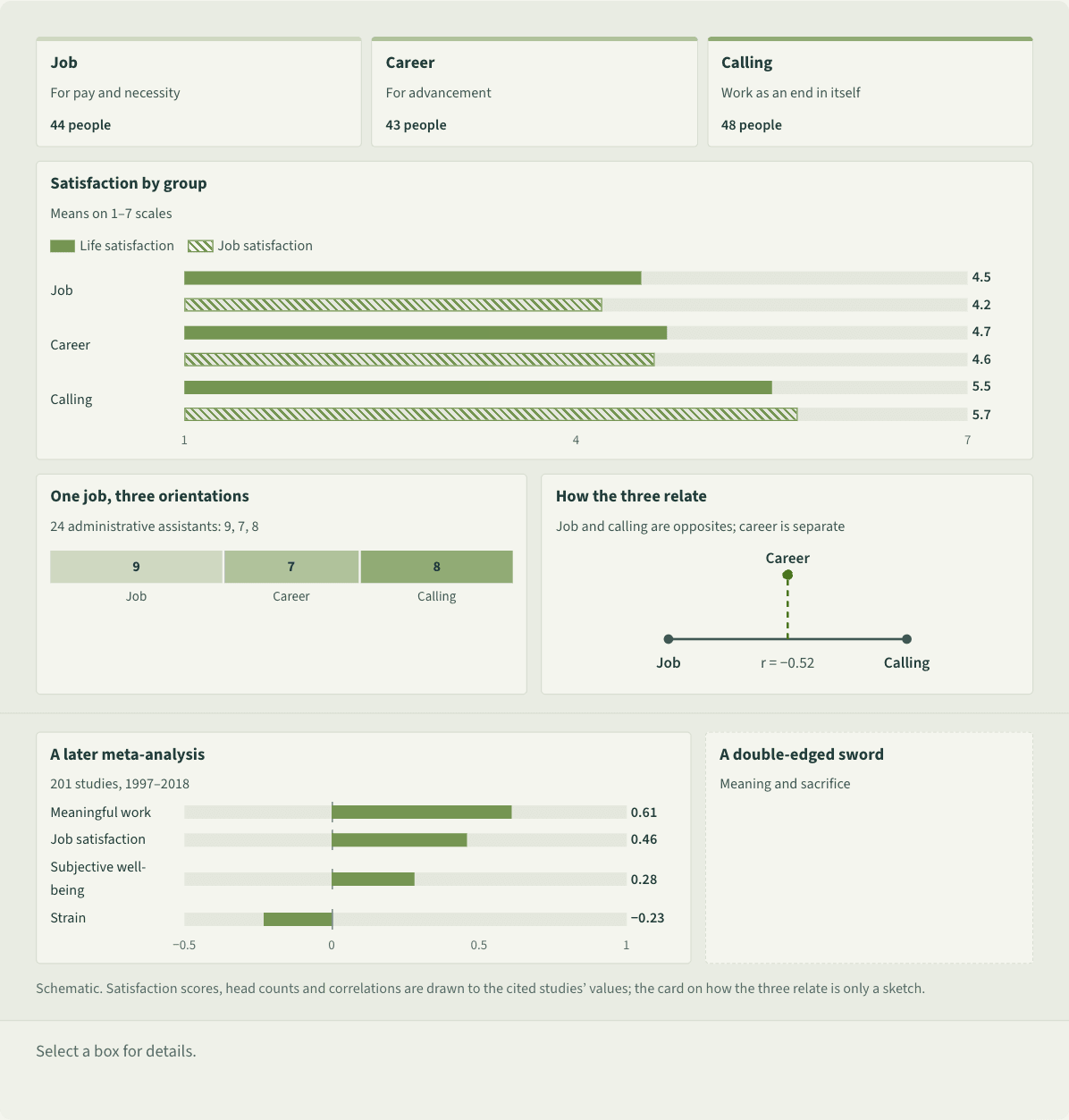
Schematic. Satisfaction scores, head counts and correlations are drawn to the cited studies’ values; the card on how the three relate is only a sketch.
Schematic. At the top, three cards side by side: job, for pay and necessity, 44 people; career, for advancement, 43 people; calling, work as an end in itself, 48 people. Below, a card on the groups’ satisfaction with two sets of bars drawn to scale on a 1 to 7 range: life satisfaction 4.5, 4.7 and 5.5, job satisfaction 4.2, 4.6 and 5.7. Next, a card on one job, three orientations, with a bar divided to scale into 9, 7 and 8 of 24 administrative assistants. Then a schematic card on how the three relate: a horizontal line with job and calling at its ends, marked r = −0.52, crossed at right angles by a vertical line for career. At the bottom, two cards side by side: a later meta-analysis, with four bars drawn to scale for meaningful work 0.61, job satisfaction 0.46, subjective well-being 0.28 and strain −0.23; and a dashed card, a double-edged sword, noting that a calling can also lead people to give up pay and personal time for their work.
 Save as image (PNG)
This figure image is licensed CC BY 4.0: reuse it with credit and a link back to this page. How to reuse
Key points
- The questionnaire never named the categories. People read short portraits of Mr. A, B and C, rated how much each was like them (0–3) and were sorted by the closest match.[1]
- Of 135 clearly sorted employees, 44 saw their work as a job, 43 as a career and 48 as a calling; 24 administrative assistants at one college split 9, 7 and 8.[1]
- Calling-oriented employees reported significantly higher life and job satisfaction (means 5.5 and 5.7 on 1–7 scales) and missed fewer workdays; the job and career groups differed little.[1]
- A meta-analysis of 201 studies linked callings to meaningful work (r = 0.61), job satisfaction (0.46) and subjective well-being (0.28).[2]
An example
Jay, Lin and Ms. Wang are administrative assistants at the same university, with similar pay and schooling. Jay works to support his family and lives for weekends. Lin treats the job as a stepping stone to promotion. Ms. Wang finds helping students meaningful and often talks about her work. Their views fit job, career and calling orientations.
Misreadings and limits
A common misreading is that a calling is always good for you. A study of US and Canadian zookeepers found that those with a calling identified more with their work but were also more likely to see it as a moral duty and to sacrifice pay, personal time and comfort.[3] A meta-analysis linked callings to less strain, including burnout, but most studies were cross-sectional self-reports.[2]
Sources
- 1 Wrzesniewski, A., McCauley, C., Rozin, P., & Schwartz, B. (1997). Jobs, careers, and callings: People’s relations to their work. Journal of Research in Personality, 31(1), 21–33. doi:10.1006/jrpe.1997.2162
- 2 Dobrow, S. R., Weisman, H., Heller, D., & Tosti-Kharas, J. (2023). Calling and the good life: A meta-analysis and theoretical extension. Administrative Science Quarterly, 68(2), 508–550. doi:10.1177/00018392231159641
- 3 Bunderson, J. S., & Thompson, J. A. (2009). The call of the wild: Zookeepers, callings, and the double-edged sword of deeply meaningful work. Administrative Science Quarterly, 54(1), 32–57. doi:10.2189/asqu.2009.54.1.32
Last checked against sources: October 28, 2026