Subjective well-being
主观幸福感
What is subjective well-being?
Subjective well-being is a person’s own evaluation of how life is going: a cognitive judgment such as life satisfaction, and feelings, with pleasant emotions outweighing unpleasant ones.[1] It is one facet of well-being; purpose in life and good relationships belong to eudaimonic well-being.[1]
What it goes with
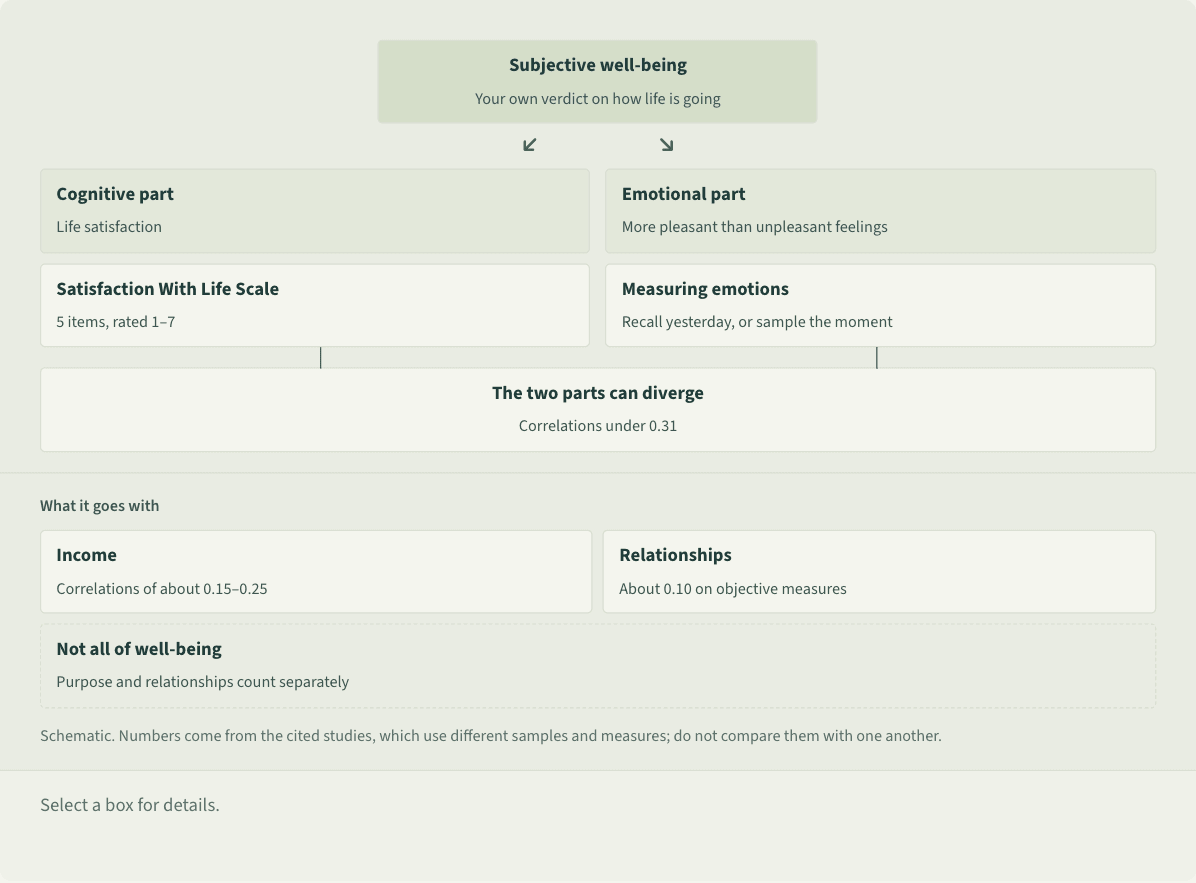
Schematic. Numbers come from the cited studies, which use different samples and measures; do not compare them with one another.
Schematic. At the top, a card: subjective well-being, your own verdict on how life is going. Below it, two columns side by side. Left: the cognitive part, life satisfaction, with a card beneath it for the Satisfaction With Life Scale, five items rated 1 to 7. Right: the emotional part, more pleasant than unpleasant feelings, with a card beneath it on measuring emotions by recalling yesterday or sampling the moment. Spanning both columns, a card: the two parts can diverge, with correlations under 0.31. Further down, labeled what it goes with, two cards: income, correlations of about 0.15 to 0.25, and relationships, about 0.10 on objective measures. At the bottom, a dashed card: not all of well-being, since purpose and relationships are counted separately. The numbers come from different studies and should not be compared with one another.
 Save as image (PNG)
This figure image is licensed CC BY 4.0: reuse it with credit and a link back to this page. How to reuse
Key points
- The most widely used measure, the Satisfaction With Life Scale, has five items such as “I am satisfied with my life,” each rated 1–7, for totals of 5–35.[2]
- The two parts do not always move together. In more than 450,000 US survey responses, yesterday’s emotions correlated with life evaluations at under 0.31.[3]
- Income tracks life evaluation more closely than daily emotion, and evaluations rise steadily with log income.[3] In large samples, income correlates with subjective well-being at about 0.15–0.25.[1]
- Relationships are often called the strongest correlate, mostly on self-report. With objective measures, correlations are often near 0.10; an early meta-analysis put marital status at 0.14.[1]
An example
After a promotion and a raise, Ms. Wang gives “I am satisfied with my life” a 6 out of 7. Yet this month she works late every night, and when she looks back on each day, her feelings are mostly fatigue and irritation. In subjective well-being terms, her life satisfaction is high while the emotional part lags.
Misreadings and limits
The popular claim that happiness stops rising above about $75,000 a year is too strong. A 2023 adversarial collaboration found the plateau only among the least happy 15–20% of people; for most, momentary happiness keeps rising with income, though the link is weak (r = 0.09).[4]
Sources
- 1 Diener, E., Lucas, R. E., & Oishi, S. (2018). Advances and open questions in the science of subjective well-being. Collabra: Psychology, 4(1), 15. doi:10.1525/collabra.115
- 2 Diener, E. (n.d.). Satisfaction With Life Scale (SWLS). Ed Diener’s lab website, University of Illinois (scale first published in Diener, Emmons, Larsen & Griffin, 1985, Journal of Personality Assessment, 49(1), 71–75). View source
- 3 Kahneman, D., & Deaton, A. (2010). High income improves evaluation of life but not emotional well-being. Proceedings of the National Academy of Sciences, 107(38), 16489–16493. doi:10.1073/pnas.1011492107
- 4 Killingsworth, M. A., Kahneman, D., & Mellers, B. (2023). Income and emotional well-being: A conflict resolved. Proceedings of the National Academy of Sciences, 120(10), e2208661120. doi:10.1073/pnas.2208661120
Last checked against sources: October 28, 2026