Triangulation (family systems)
家庭三角关系
What is triangulation in family systems theory?
Triangulation, a concept from Bowen family systems theory, is how a strained two-person relationship draws in a third person, so tension shifts around three relationships: things steady, but nothing is resolved.[1] A common case is parents in conflict each pulling a child to their side.[2]
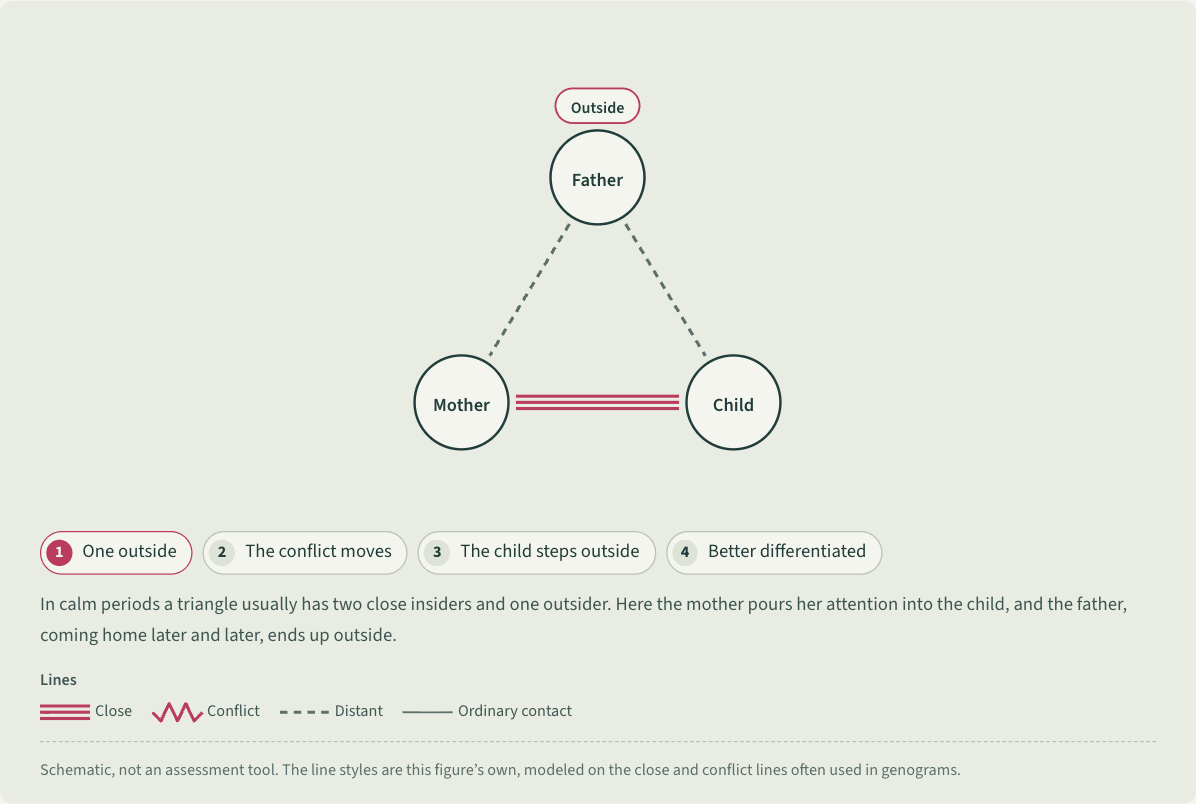
Schematic. Three circles form a triangle: father at the top, mother at lower left, child at lower right. Lines between them show the relationship: three parallel lines mean close, a zigzag means conflict, a dashed line means distant, and a thin solid line means ordinary contact. Step 1, one person outside: mother and child are joined by a close line, the father has dashed lines to both, and he is tagged outside. Step 2, the conflict moves: father and mother are close, father and child are in conflict, and mother and child have a thin line. Step 3, the child steps outside: father and mother are in conflict, the child has thin lines to both and is tagged outside. Step 4, better differentiation: all three sides are thin solid lines, with no conflict and no one tagged outside.
 Save as image (PNG)
This figure image is licensed CC BY 4.0: reuse it with credit and a link back to this page. How to reuse
Key points
- Bowen theory treats the triangle as the basic unit of emotional systems: a pair tolerates little tension, three people can hold more, and any overflow spreads to interlocking triangles.[1]
- Positions shift with tension: when calm, two insiders are close and one is outside; under high tension the outside spot is most comfortable, and an insider may set the other two fighting.[1]
- In Bowen theory, better-differentiated families triangle less: when parents relate comfortably with each other, the child is not drawn into their tensions.[1]
- A study following 416 two-parent families for three years found that the more a child was drawn into marital conflict, the more the child’s anxiety and low mood rose later.[3]
An example
Ms. Wang and her husband Jay have barely spoken for a week over a renovation. Ms. Wang keeps telling their daughter Lin, a middle schooler, to “go ask your dad,” and at dinner Jay complains to Lin about her mother. The couple seems calmer, but Lin now carries the messages, and nobody returns to the renovation itself.
Misreadings and limits
This is not the drama triangle: Bowen describes tension moving among three relationships, not fixed roles, and which side is in conflict reflects the whole triangle.[1] In research, triangulation means confirming a finding from several sources.[2] A 2004 review found little empirical support for Bowen’s specific theory of triangles.[4]
Sources
- 1 Kerr, M. E. (n.d.). Triangles; Differentiation of self. The eight concepts of Bowen theory, The Bowen Center for the Study of the Family. View source
- 2 American Psychological Association (2018). Triangulation. APA Dictionary of Psychology (updated April 19, 2018). View source
- 3 Buehler, C., & Welsh, D. P. (2009). A process model of adolescents’ triangulation into parents’ marital conflict: The role of emotional reactivity. Journal of Family Psychology, 23(2), 167–180. doi:10.1037/a0014976
- 4 Miller, R. B., Anderson, S., & Keala, D. K. (2004). Is Bowen theory valid? A review of basic research. Journal of Marital and Family Therapy, 30(4), 453–466. doi:10.1111/j.1752-0606.2004.tb01255.x
Last checked against sources: October 28, 2026