Parasocial relationships
准社会关系
What is a parasocial relationship?
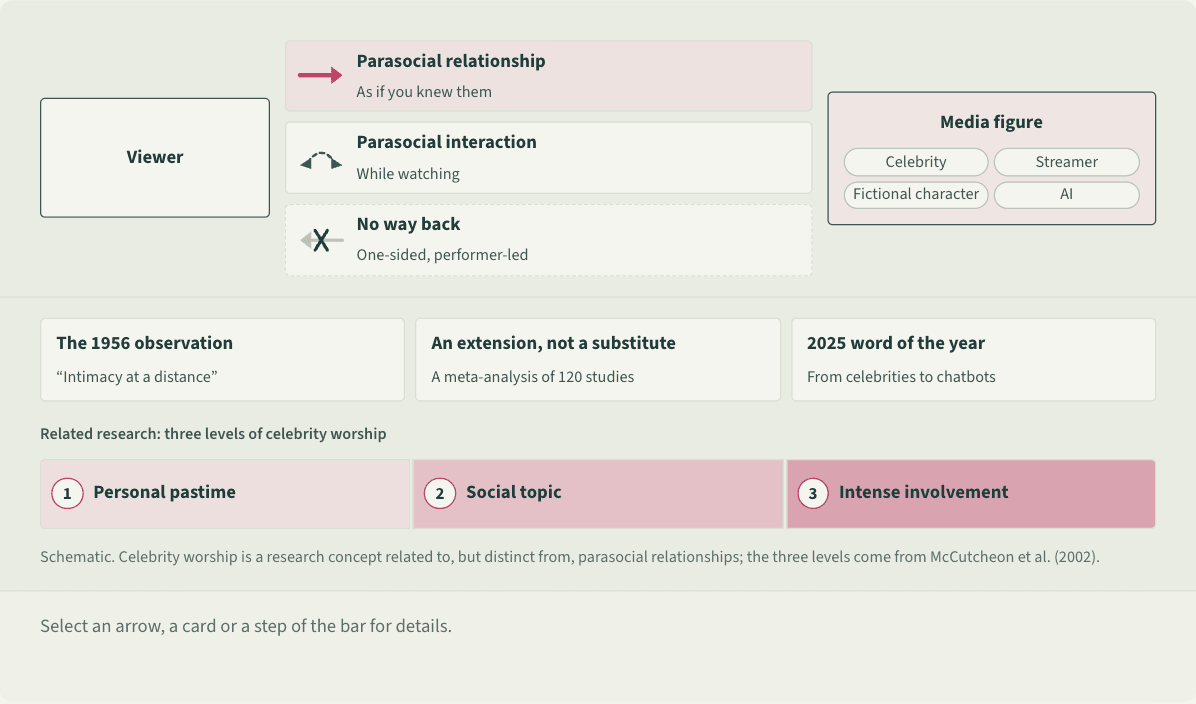
A parasocial relationship is the sense of connection someone feels with a famous person they have never met, a fictional character or an AI, as if they knew them, though the bond runs one way.[1][2] Horton and Wohl coined the term in 1956; Cambridge Dictionary made “parasocial” its 2025 word of the year.[2]
- Celebrity
- Streamer
- Fictional character
- AI
Related research: three levels of celebrity worship
Schematic. Celebrity worship is a research concept related to, but distinct from, parasocial relationships; the three levels come from McCutcheon et al. (2002).
 Save as image (PNG)
This figure image is licensed CC BY 4.0: reuse it with credit and a link back to this page. How to reuse
Key points
- Horton and Wohl saw that radio, television and film gave audiences the illusion of a face-to-face relationship with performers, one the performer controls and that cannot develop mutually.[1]
- They called the conversational give-and-take felt while watching parasocial interaction. A meta-analysis found it only moderately correlated with parasocial relationships, so the two are distinct.[1][3]
- These bonds are often assumed to replace real relationships. A meta-analysis of 120 studies found no significant link with social deficiencies, supporting a view of them as an extension instead.[3]
- Cambridge Dictionary’s definition includes AI, and its publisher reported wide interest in 2025 in one-sided bonds with celebrities, influencers and AI chatbots.[2]
An example
Every night Jay watches the same streamer. He knows the streamer’s catchphrases and cat’s name, and says “good night” back at the end. Jay knows the streamer has no idea who he is, and he still goes to work and meets friends. This is a typical parasocial bond: one-sided, but no substitute for real relationships.[3]
Misreadings and limits
Parasocial bonds are often read as a sign of loneliness or of something wrong. They are widespread,[2] and Horton and Wohl saw them as differing from ordinary relationships in degree, not kind.[1] The concern lies at the intense end: in celebrity worship research, the highest level involves over-identification, compulsive behavior and obsession with a celebrity’s life.[4]
Sources
- 1 Horton, D., & Wohl, R. R. (1956). Mass communication and para-social interaction: Observations on intimacy at a distance. Psychiatry, 19(3), 215–229. doi:10.1080/00332747.1956.11023049
- 2 University of Cambridge (2025). Cambridge Dictionary reveals Word of the Year 2025. University of Cambridge news (November 18, 2025), adapted from Cambridge University Press & Assessment. View source
- 3 Tukachinsky, R., Walter, N., & Saucier, C. J. (2020). Antecedents and effects of parasocial relationships: A meta-analysis. Journal of Communication, 70(6), 868–894. doi:10.1093/joc/jqaa034
- 4 McCutcheon, L. E., Lange, R., & Houran, J. (2002). Conceptualization and measurement of celebrity worship. British Journal of Psychology, 93(1), 67–87. doi:10.1348/000712602162454
Last checked against sources: October 28, 2026