Family of origin
原生家庭
What is a family of origin?
A family of origin is the family in which a person was raised, which may or may not be their biological family.[1] In Bowen family systems theory, the level of differentiation of self and the ways of relating that people develop there pass down through parent–child relationships across generations.[2]
What passes down three generations (schematic)
Grandparents
Parents
Child
Dashed: theoretical claim Solid: meta-analytic finding
Behind the numbers
In adult life
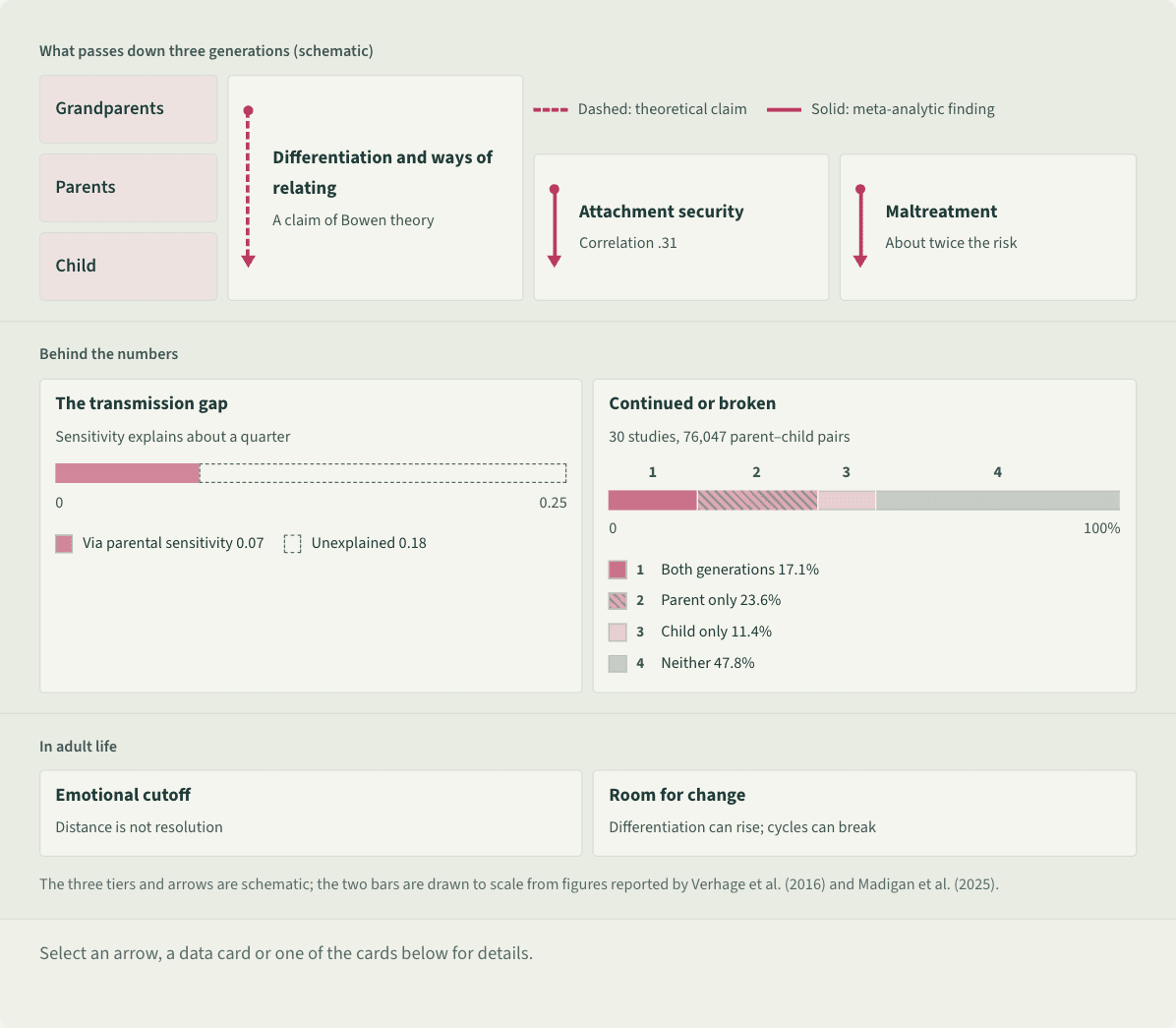
The three tiers and arrows are schematic; the two bars are drawn to scale from figures reported by Verhage et al. (2016) and Madigan et al. (2025).
Schematic. On the left, three stacked tiers: grandparents, parents, child. On the right, three arrows: a dashed arrow running from grandparents through parents to the child, labeled “differentiation and ways of relating, a claim of Bowen theory,” and two solid arrows from parents to child, labeled “attachment security, correlation .31” and “maltreatment, about twice the risk.” Two data cards in the middle: the “transmission gap” card has a bar in two segments, 0.07 running through parents’ sensitive responding and 0.18 unexplained; the “continued or broken” card has a bar in four proportional segments: maltreatment in both generations 17.1%, in the parent only 23.6%, in the child only 11.4%, in neither 47.8%. Two cards below: “emotional cutoff” and “room for change.”
 Save as image (PNG)
This figure image is licensed CC BY 4.0: reuse it with credit and a link back to this page. How to reuse
Key points
- In Bowen theory, transmission ranges from deliberate teaching to automatic emotional reactions. Children usually end up near their parents’ level of differentiation, and over generations family lines diverge.[2]
- In a meta-analysis of 95 samples, parents’ attachment representations correlated .31 with their children’s attachment security, about 10% of the variance and less than estimated 20 years earlier.[3]
- Maltreatment also links across generations: a meta-analysis of 142 studies found that parents maltreated as children were about twice as likely to have children who were maltreated.[4]
- Bowen theory holds that cutting off from family, by moving away or avoiding sensitive topics, leaves problems dormant; once set, differentiation rarely changes without a structured, long-term effort.[2]
An example
As a child, Lin watched her parents go silent for days after each fight. When she and her boyfriend Jay fall out, she too stops replying for days. Noticing the likeness, she now asks Jay to talk it through the same day, and at home she no longer slips off to her room when her mother complains about her father.
Misreadings and limits
Online, many adult problems get traced to the family of origin, but links across generations are not destiny: in 30 studies, 23.6% of pairs had a maltreated parent and a child who was not, more than the 17.1% where both were, which the authors read as resilience.[4] Bowen theory also ties unresolved family bonds to both generations, though people tend to blame themselves or others.[2]
Sources
- 1 American Psychological Association (2018). Family of origin. APA Dictionary of Psychology (updated April 19, 2018). View source
- 2 Kerr, M. E. (n.d.). Multigenerational transmission process; Emotional cutoff; Differentiation of self. The eight concepts of Bowen theory, The Bowen Center for the Study of the Family. View source
- 3 Verhage, M. L., Schuengel, C., Madigan, S., Fearon, R. M. P., Oosterman, M., Cassibba, R., Bakermans-Kranenburg, M. J., & van IJzendoorn, M. H. (2016). Narrowing the transmission gap: A synthesis of three decades of research on intergenerational transmission of attachment. Psychological Bulletin, 142(4), 337–366. doi:10.1037/bul0000038 The link is the authors’ accepted manuscript on UCL Discovery, the version this site read; page numbers cited by this site follow that manuscript, not the journal version.
- 4 Madigan, S., Turgeon, J., Racine, N., Zhu, J., Alink, L. R. A., Ereyi-Osas, W., Jang, G., & Fearon, R. M. P. (2025). Patterns of continuity and discontinuity of childhood maltreatment across generations: A meta-analysis. Development and Psychopathology, 37(5), 2590–2611. doi:10.1017/S0954579425000239
Last checked against sources: October 28, 2026