Separation of tasks
课题分离
What is the separation of tasks?
Separation of tasks is an interpersonal rule that Ichiro Kishimi and Fumitake Koga presented as Adlerian psychology in The Courage to Be Disliked (2013): whoever ultimately bears the consequences of something owns that task, and one stays out of others’ tasks.[1][3]
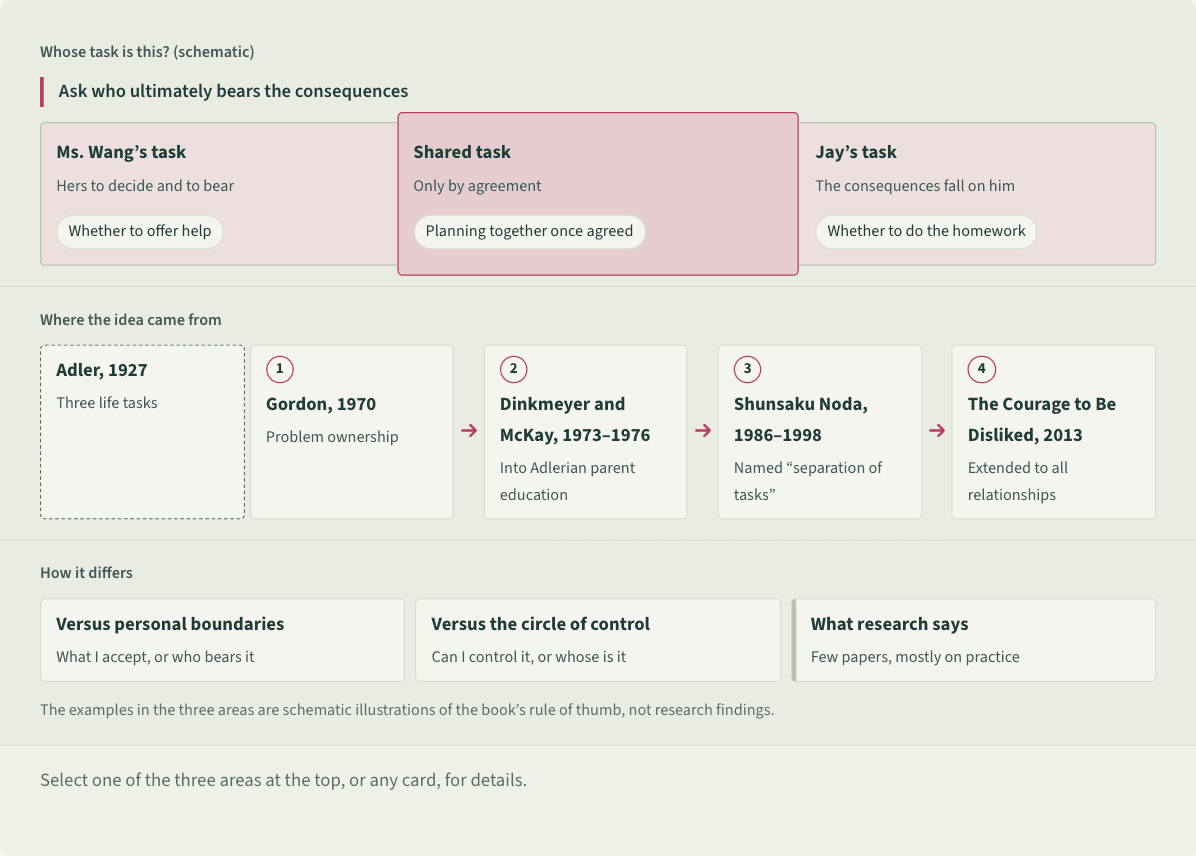
Whose task is this? (schematic)
Ask who ultimately bears the consequences
Where the idea came from
How it differs
The examples in the three areas are schematic illustrations of the book’s rule of thumb, not research findings.
Schematic. A heading reads “Whose task is this? Ask who ultimately bears the consequences,” above three areas side by side: on the left, “Ms. Wang’s task,” containing “whether to offer help”; on the right, “Jay’s task,” containing “whether to do the homework”; where the two overlap in the middle, “shared task,” containing “planning together once agreed.” A row of five cards in the middle: a dashed card, “Adler, 1927: three life tasks,” then four cards joined by arrows: “Gordon, 1970: problem ownership,” “Dinkmeyer and McKay, 1973–1976: into parent education,” “Shunsaku Noda, 1986–1998: named separation of tasks,” and “The Courage to Be Disliked, 2013: extended to all relationships.” Three cards below: “versus personal boundaries,” “versus the circle of control,” and “what research says.”
 Save as image (PNG)
This figure image is licensed CC BY 4.0: reuse it with credit and a link back to this page. How to reuse
Key points
- The idea first appeared as “problem ownership” in Thomas Gordon’s 1970 Parent Effectiveness Training: sort out whether a problem is the child’s or the parent’s, then choose listening or confronting.[3]
- Adlerians Don Dinkmeyer and Gary McKay brought it into parent education; in Japan, Shunsaku Noda used it in his parenting courses and named it “separation of tasks” only in 1998.[3]
- Adler wrote of three life tasks: social ties, occupation, and love and marriage.[2] The term appears neither in an Adlerian lexicon nor, in this sense, in the Ansbachers’ Adler anthology.[3]
- Research papers devoted to it are few, and they mostly discuss poor understanding of the concept and problems in applying it.[4]
An example
Ms. Wang’s son Jay, a high school junior, leaves homework until late at night. After reading The Courage to Be Disliked, she stops nagging him every evening. Weeks later, feeling that stepping back entirely is not right either, she asks Jay whether he wants help, and they agree to plan each coming week together on Sunday evenings.
Misreadings and limits
Online it gets boiled down to “let go of your savior complex and respect other people’s fate,” a license to say “not my problem.” Kishimi and Koga call it only a starting point: the goal is cooperation, and by agreement a task can become a “shared task”; Kishimi admits it often serves to dodge responsibility.[1] A Japanese Adlerian warns that rigid use can damage relationships.[4]
Sources
- 1 岸見一郎・古賀史健(Kishimi, I., & Koga, F.) (2025). 【岸見一郎×古賀史健対談】アドラー心理学の重要ポイントとして最も有名なのに、最も誤解されている「教え」とはなにか? [The most famous and most misunderstood teaching of Adlerian psychology: Kishimi and Koga in conversation]. ダイヤモンド・オンライン(2025 年 12 月 22 日). View source
- 2 Adler, A. (1927). Understanding human nature (W. B. Wolfe, Trans.). Greenberg (pp. 42, 240; Internet Archive scan). View source
- 3 向後千春(Kogo, C.) (2024). 「課題の分離」の出自と変遷について [On the origin and transformation of “separation of tasks”]. アドレリアン, 37(2), 9–12. doi:10.82700/adlerian.37.2_9
- 4 梅﨑一郎 (2026). 「課題の分離」の賞味期限は終わった [“Separation of tasks” is past its use-by date]. アドレリアン, 39(2), 3–13. doi:10.82700/adlerian.39.2_3
Last checked against sources: October 28, 2026