Socratic questioning
苏格拉底式提问
What is Socratic questioning?
Socratic questioning is a core strategy of cognitive therapy: rather than pointing out what is wrong with a thought, the therapist asks a graded series of questions that draw the client’s attention to overlooked information, so the client can re-evaluate an old conclusion or build a new one.[1][2]
Two aims of questioning
Four stages of guided discovery
Re-evaluate or form a new idea, then try it out in daily life
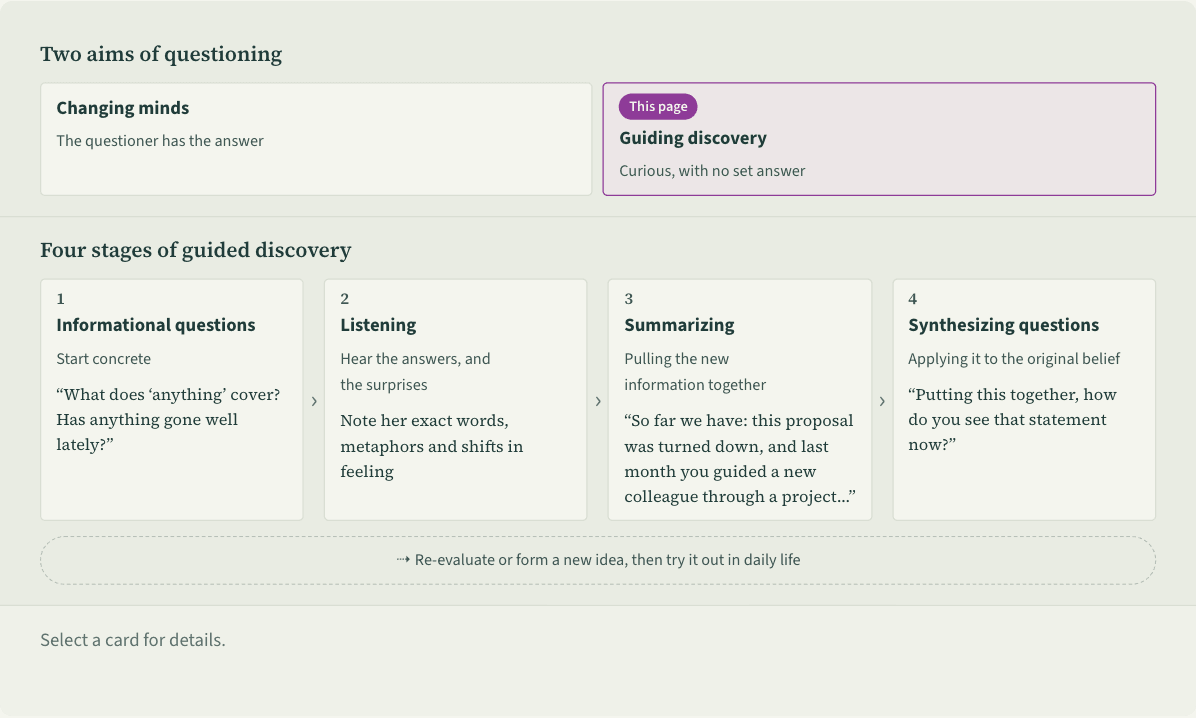
The figure has two parts. At the top, two cards side by side: on the left, changing minds, where the questioner already has the answer and steers the other person to it; on the right, guiding discovery, where the questioner is curious, has no set answer and the client reaches the conclusion; the right card is marked as the approach this page describes. Below, four stages from left to right joined by arrows: informational questions (sample: “What does ‘anything’ cover? Has anything gone well lately?”), listening (attending to the client’s own words, metaphors and feelings), summarizing (pulling the new information together) and synthesizing questions (sample: “Putting this together, how do you see that statement now?”). A dashed line from the last stage points to “re-evaluate or form a new idea, then try it out in daily life.”
 Save as image (PNG)
This figure image is licensed CC BY 4.0: reuse it with credit and a link back to this page. How to reuse
Key points
- Padesky distinguishes changing minds, where the questioner already has the answer, from guiding discovery, driven by genuine curiosity, where the client reaches the conclusion.[1]
- Questions may clarify (“What do you mean by ‘useless’?”), recall experience (“Has this happened before?”) or shift perspective (“What would you tell a friend who thought this?”).[1]
- Among 55 adults in cognitive therapy for depression, sessions in which a therapist used more Socratic questioning than usual were followed by larger symptom drops by the next session.[2]
- A 2022 study of 123 clients found evidence that the questioning works partly through cognitive change, with a stronger link to that change in clients who began with weaker CBT skills.[3]
An example
Ms. Wang’s proposal is turned down. “I can’t do anything right,” she says. Her therapist doesn’t argue but asks what “anything” covers, then whether anything went well lately. She recalls guiding a new colleague through a project last month. After a summary, the therapist asks how this fits her statement. “It’s this proposal that fell short,” she says.
Misreadings and limits
It is often mistaken for cross-examination: a chain of questions that corners the other person into admitting they were wrong. Padesky argues that good Socratic questioning guides discovery, and the questioner does not know the answer in advance.[1] Evidence is also thin: studies link it to change from one session to the next, but none has examined outcomes at the end of therapy.[4]
Sources
- 1 Padesky, C. A. (1993). Socratic questioning: Changing minds or guiding discovery?. Keynote address, European Congress of Behavioural and Cognitive Therapies, London. View source
- 2 Braun, J. D., Strunk, D. R., Sasso, K. E., & Cooper, A. A. (2015). Therapist use of Socratic questioning predicts session-to-session symptom change in cognitive therapy for depression. Behaviour Research and Therapy, 70, 32–37. doi:10.1016/j.brat.2015.05.004
- 3 Vittorio, L. N., Murphy, S. T., Braun, J. D., & Strunk, D. R. (2022). Using Socratic questioning to promote cognitive change and achieve depressive symptom reduction: Evidence of cognitive change as a mediator. Behaviour Research and Therapy, 150, 104035. doi:10.1016/j.brat.2022.104035
- 4 Overholser, J. C., & Beale, E. (2023). The art and science behind Socratic questioning and guided discovery: A research review. Psychotherapy Research, 33(7), 946–956. doi:10.1080/10503307.2023.2183154
Last checked against sources: October 28, 2026