Coping strategies
应对策略
What are coping strategies?
A coping strategy is an action or thought process used to meet a stressful or unpleasant situation or to change one’s reaction to it; unlike defense mechanisms, it is usually conscious and direct.[1] Lazarus and Folkman define coping as changing efforts to manage demands appraised as taxing or exceeding one’s resources.[2]
By goal (Lazarus and Folkman)
By control
Popular version: the 4 A’s (Mayo Clinic)
Measurement and evidence
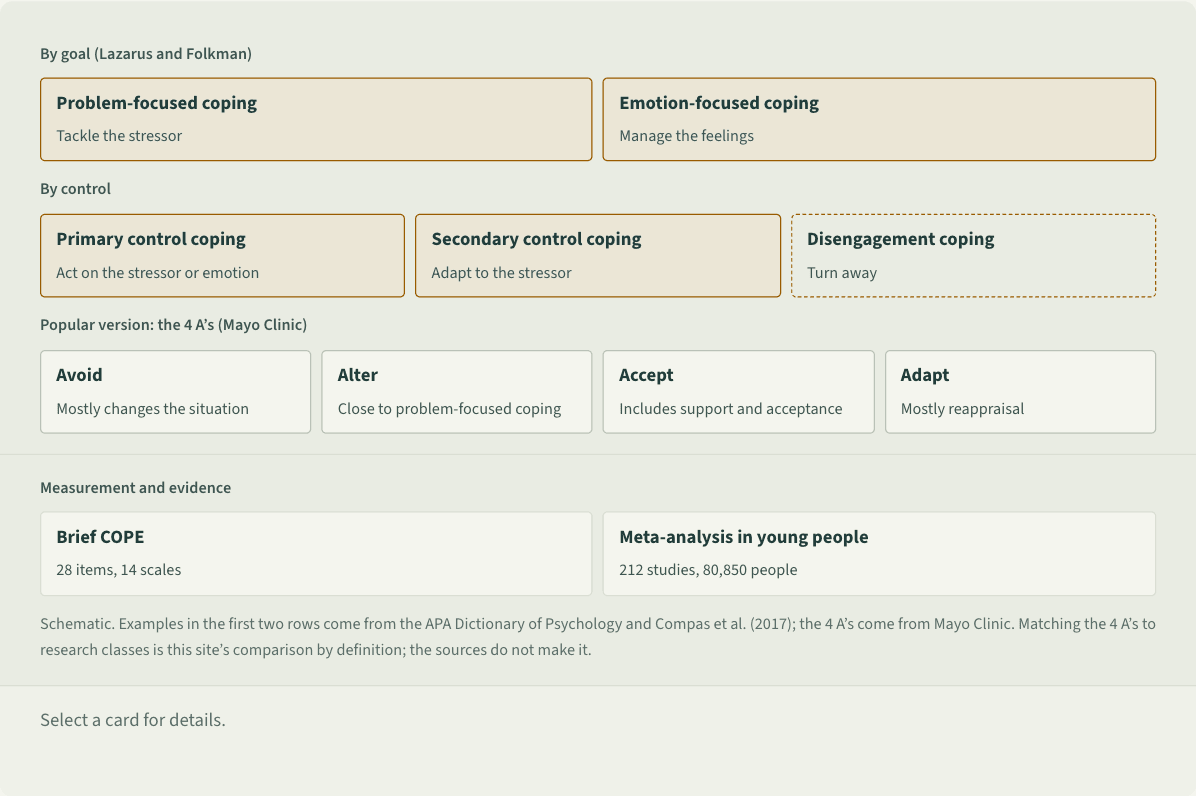
Schematic. Examples in the first two rows come from the APA Dictionary of Psychology and Compas et al. (2017); the 4 A’s come from Mayo Clinic. Matching the 4 A’s to research classes is this site’s comparison by definition; the sources do not make it.
The first row lists Lazarus and Folkman’s two classes: problem-focused coping, which tackles the stressor, and emotion-focused coping, which manages the feelings it causes, including relaxing, seeking support and avoidance. The second row shows a control-based scheme with three classes: primary control coping, which acts directly on the stressor or emotion, such as problem solving or expressing feelings; secondary control coping, which adapts to the stressor, such as acceptance, reappraisal or distraction; and disengagement coping, which turns away, such as avoidance, denial or wishful thinking. The third row shows Mayo Clinic’s 4 A’s of stress relief, avoid, alter, accept and adapt, each tagged with the closest research class in this site’s comparison: most avoid tips change the situation, alter is close to problem-focused or primary control coping, accept includes seeking support and acceptance, and adapt is mostly reappraisal, close to secondary control coping. Two final cards: the Brief COPE has 28 items in 14 scales and no total score; a meta-analysis of 212 studies with 80,850 children and adolescents linked primary and secondary control coping to fewer symptoms and disengagement coping to more.
 Save as image (PNG)
This figure image is licensed CC BY 4.0: reuse it with credit and a link back to this page. How to reuse
Key points
- They separated problem-focused coping, which tackles the stressor, from emotion-focused coping, which manages the feelings it causes, avoidance included; people are thought to favor the first when a stressor seems changeable.[1][2]
- A control-based scheme has three kinds. Primary control coping acts on the stressor or emotion, secondary control coping adapts through acceptance or reappraisal, and disengagement turns away, as in avoidance or denial.[2]
- Carver’s Brief COPE has 28 items in 14 scales, such as active coping, acceptance, venting and denial. Carver says it has no overall score and offers no “adaptive” or “maladaptive” composite.[3]
- A meta-analysis of 212 studies of children and adolescents linked primary and secondary control coping to fewer symptoms, and disengagement such as avoidance and denial to more.[2]
An example
Ms. Wang’s department is moving to an office much farther from home. She first asks her manager about working from home two days a week. The longer commute will not change, so she listens to audiobooks on the subway and calls it extra reading time. On the weekend she meets an old friend to vent.
Misreadings and limits
The popular “4 A’s” of stress relief (avoid, alter, accept, adapt) are health-education tips, such as Mayo Clinic’s, referenced to health agencies’ advice and stress-management textbooks.[4] Most “avoid” tips, such as leaving early, saying no or dropping tasks, change the situation; they differ from the avoidance coping that research links to more symptoms.[2][4]
Sources
- 1 American Psychological Association (2023). Coping strategy; Problem-focused coping; Emotion-focused coping. APA Dictionary of Psychology (coping strategy updated 19 April 2018; problem-focused and emotion-focused coping updated 15 November 2023). View source
- 2 Compas, B. E., Jaser, S. S., Bettis, A. H., Watson, K. H., Gruhn, M. A., Dunbar, J. P., Williams, E., & Thigpen, J. C. (2017). Coping, emotion regulation, and psychopathology in childhood and adolescence: A meta-analysis and narrative review. Psychological Bulletin, 143(9), 939–991. doi:10.1037/bul0000110
- 3 Carver, C. S. (n.d.). Brief COPE. University of Miami, Department of Psychology (scale page for Carver, 1997, International Journal of Behavioral Medicine, 4(1), 92–100). View source
- 4 Mayo Clinic Staff (n.d.). Try the 4 A's for stress relief. Mayo Clinic. View source
Last checked against sources: October 28, 2026