Reframing
重构
What is reframing in psychology?
Reframing means looking at a problem from a different angle so it is understood in a new way; shifting its conceptual or emotional context often changes how hard it seems and opens up ways to solve it.[1] Emotion researchers study a close relative, cognitive reappraisal: reinterpreting a situation to change the emotion it produces.[3]
Origins, evidence and limits
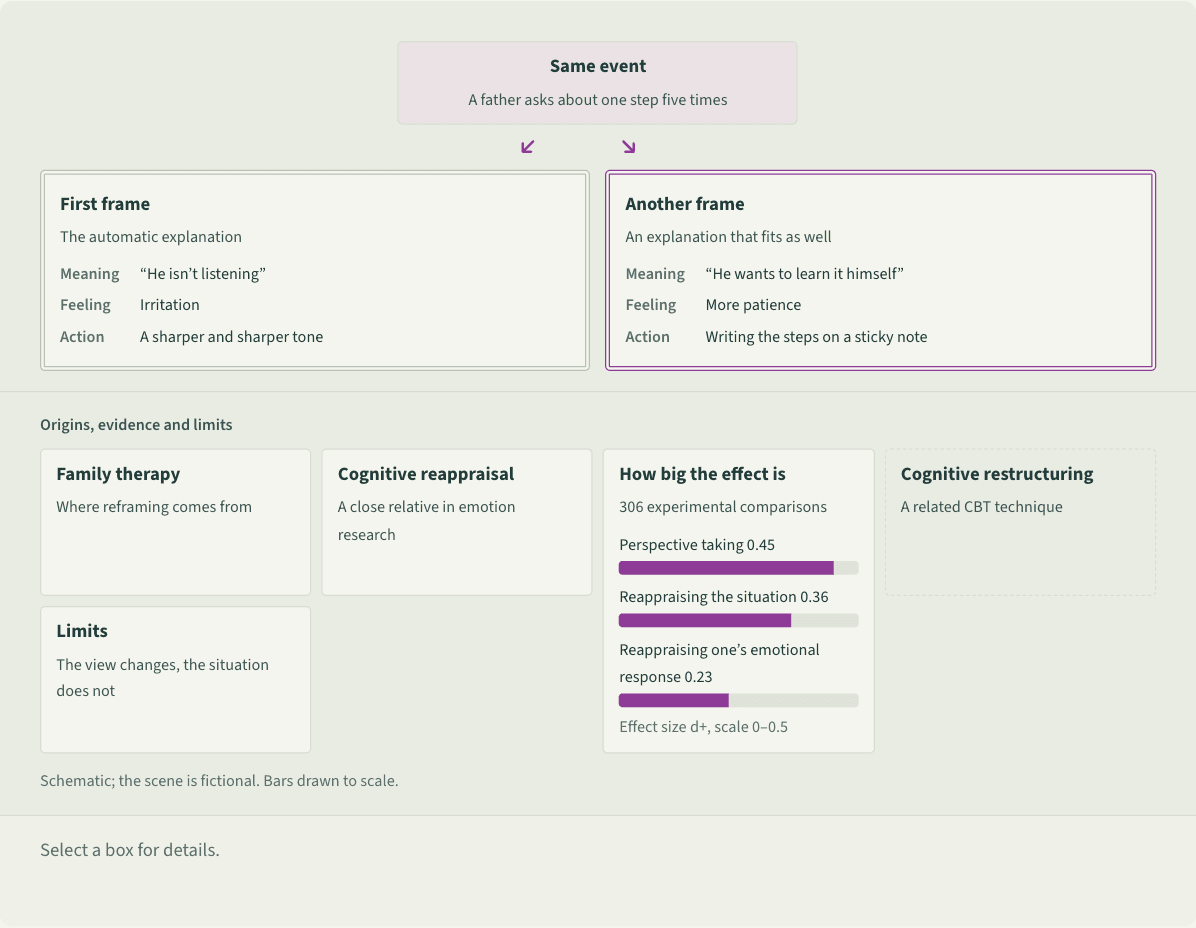
Schematic; the scene is fictional. Bars drawn to scale.
Schematic. At the top, a card titled same event: a father asks about the same step five times. Below it, two picture-frame cards side by side, each with three rows for meaning, feeling and action. Left, the first frame: the meaning is he isn’t listening, the feeling is irritation, the action is an increasingly sharp tone. Right, another frame: the meaning is he wants to learn it himself, the feeling is more patience, the action is writing the steps on a sticky note. Further down, labeled origins, evidence and limits, five cards: family therapy, cognitive reappraisal, how big the effect is, cognitive restructuring, and limits. The effect card holds three bars drawn to scale on an effect-size axis from 0 to 0.5: perspective taking 0.45, reappraising the situation 0.36, reappraising one’s emotional response 0.23.
 Save as image (PNG)
This figure image is licensed CC BY 4.0: reuse it with credit and a link back to this page. How to reuse
Key points
- Family therapy often reframes “the child is the problem” as “family relationships are the problem”; Watzlawick and colleagues (1974) saw reframing as changing how a situation is both understood and felt.[2]
- In Gross’s process model of emotion regulation, any situation can carry several meanings; cognitive change means selecting one, and reappraisal is a particularly well-studied form.[3]
- A meta-analysis of 306 experimental comparisons found a small-to-medium effect for cognitive change (d = 0.36); taking another perspective (0.45) worked better than reappraising one’s own emotional response (0.23).[4]
- A related technique in CBT is cognitive restructuring: identifying self-defeating beliefs or cognitive distortions, disputing them and revising them to be reasonable and adaptive.[1]
An example
Jay is teaching his father to book appointments by phone. After the fifth question about one step, Jay decides, “He isn’t listening,” and gets irritated. Then he tries a frame that fits just as well: his father keeps asking because he wants to manage alone. Jay writes the steps on a sticky note and teaches with more patience.
Misreadings and limits
Reframing changes how a situation is seen, not the situation itself. Gross notes that reappraisal helps less with stressors a person can change than with ones they cannot, and tends to break down when emotions run very high.[3] Family therapists also take care that a relational frame does not turn into blaming parents.[2]
Sources
- 1 American Psychological Association (2023). Reframing; Cognitive restructuring. APA Dictionary of Psychology (reframing updated 19 April 2018; cognitive restructuring updated 15 November 2023). View source
- 2 Santens, T., Chu-Chun, C., Levy, S., Diamond, G., & Bosmans, G. (2026). Anatomy of the relational reframe in attachment-based family therapy. Family Process, 65(2), e70155. doi:10.1111/famp.70155
- 3 Gross, J. J. (2015). Emotion regulation: Current status and future prospects. Psychological Inquiry, 26(1), 1–26. doi:10.1080/1047840X.2014.940781
- 4 Webb, T. L., Miles, E., & Sheeran, P. (2012). Dealing with feeling: A meta-analysis of the effectiveness of strategies derived from the process model of emotion regulation. Psychological Bulletin, 138(4), 775–808. doi:10.1037/a0027600
Last checked against sources: October 28, 2026