Defense cascade
防御级联
What is the defense cascade?
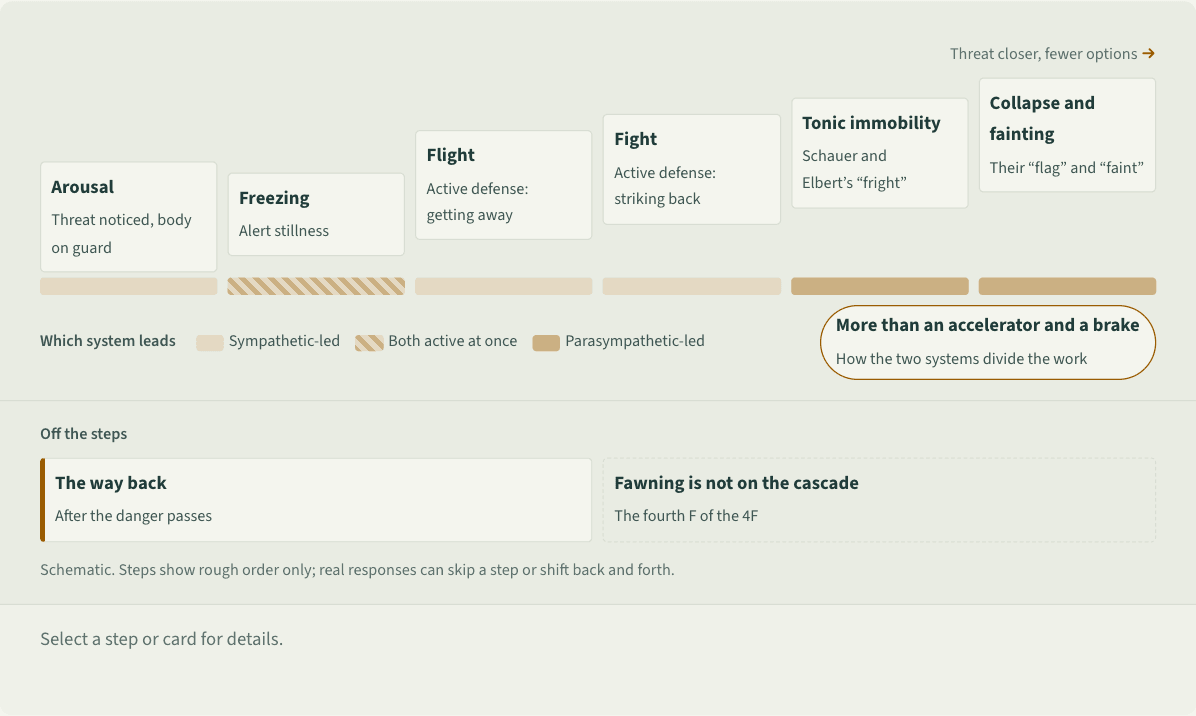
The defense cascade is the series of innate, automatically triggered responses that humans and animals show under threat: arousal, usually a brief freeze, then flight or fight and, if escape fails, tonic immobility or even a limp collapse into fainting.[1] Which step is reached depends on how close the danger is and what options remain.[2]
Off the steps
Schematic. Steps show rough order only; real responses can skip a step or shift back and forth.
Schematic. Six steps rise from left to right above an arrow labeled “threat closer, fewer options.” The steps are: arousal (threat noticed, body on guard); freezing (alert stillness); flight; fight; tonic immobility (Schauer and Elbert’s “fright”); and collapse and fainting (their “flag” and “faint”). A band under the steps uses three colors: arousal, flight and fight are marked sympathetic-led; freezing, both systems active at once; tonic immobility and collapse, parasympathetic-led. A small button beside the steps reads “More than an accelerator and a brake.” Below are two cards: “The way back” and, in a dashed outline, “Fawning is not on the cascade.”
 Save as image (PNG)
This figure image is licensed CC BY 4.0: reuse it with credit and a link back to this page. How to reuse
Key points
- Animal research showed defenses shift in order as a predator nears. Lang and colleagues applied “defense cascade” to humans in 1997–2000; Bracha added tonic immobility and fainting in 2004.[1]
- Freezing differs from tonic immobility: it comes early, alert and tense, with a slowing heart, primed to act. Tonic immobility comes later, once fight, flight and freezing no longer help.[3]
- In collapsed immobility, a variant, the heart slows sharply and the brain is starved of oxygen, so muscles go limp and fainting can follow; other causes of fainting need ruling out first.[1]
- Schauer and Elbert list six Fs: freeze, flight, fight, fright, flag, faint. The later ones form a parasympathetic shutdown, tied to dissociation, that can recur when trauma reminders return.[2]
An example
Lin is walking a hillside path when a snake slides out of the grass at her feet. She stops dead, holding her breath and staring at it; when it moves toward her, she turns and runs, and only far down the path notices her legs shaking. Freeze to flight took a second or two, with no time to think.
Misreadings and limits
The “4F” list adds fawning as a fourth response. Psychotherapist Pete Walker coined it in 2003 for the people-pleasing some survivors of childhood trauma rely on for safety;[4] it is absent from researchers’ accounts of the cascade.[1][2] His “freeze” also means numbing out, unlike the alert stillness researchers call freezing.[3][4]
Sources
- 1 Kozlowska, K., Walker, P., McLean, L., & Carrive, P. (2015). Fear and the defense cascade: Clinical implications and management. Harvard Review of Psychiatry, 23(4), 263–287. doi:10.1097/HRP.0000000000000065
- 2 Schauer, M., & Elbert, T. (2010). Dissociation following traumatic stress: Etiology and treatment. Zeitschrift für Psychologie / Journal of Psychology, 218(2), 109–127. doi:10.1027/0044-3409/a000018
- 3 Roelofs, K. (2017). Freeze for action: Neurobiological mechanisms in animal and human freezing. Philosophical Transactions of the Royal Society B: Biological Sciences, 372(1718), 20160206. doi:10.1098/rstb.2016.0206
- 4 Walker, P. (2003). Codependency, trauma and the fawn response. The East Bay Therapist (January/February 2003); reprinted on the author’s website. View source
Last checked against sources: October 28, 2026