Four components of the anxiety response
焦虑反应的四个成分
What are the components of the anxiety response?
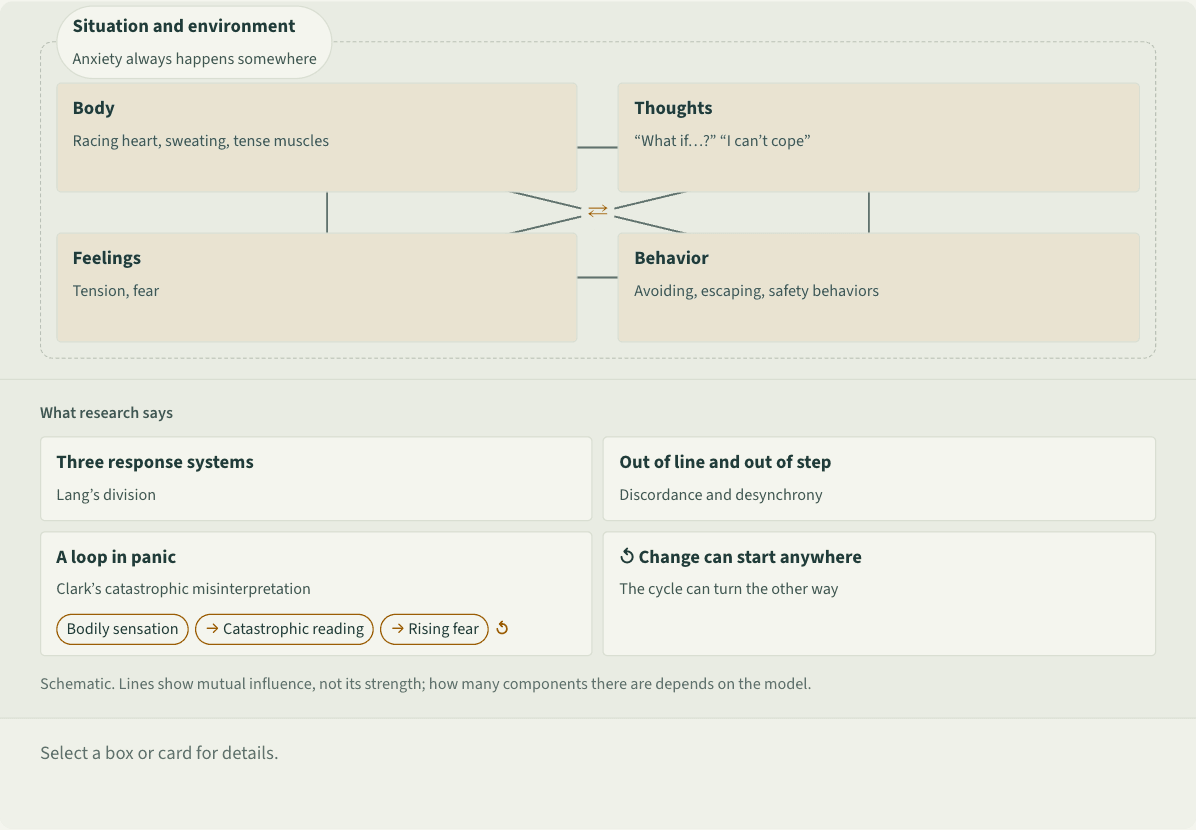
The four components of the anxiety response are the bodily reactions, thoughts, feelings and behaviors through which anxiety shows itself. Cognitive therapy treats them as linked, so a change in one moves the others;[1] earlier, Peter Lang divided fear into verbal (cognitive), overt motor and somatic response systems.[2]
What research says
Schematic. Lines show mutual influence, not its strength; how many components there are depends on the model.
Schematic. Inside an outer frame labeled situation and environment, four boxes sit in two rows: top left, body (racing heart, sweating, tense muscles); top right, thoughts (“What if…?”, “I can’t cope”); bottom left, feelings (tension, fear); bottom right, behavior (avoiding, escaping, safety behaviors). A two-way line joins every pair of boxes, six in all, including two diagonals. Below are four cards: three response systems (Lang); out of line and out of step; a loop in panic (bodily sensations misread as catastrophe, fear rises); and change can start anywhere.
 Save as image (PNG)
This figure image is licensed CC BY 4.0: reuse it with credit and a link back to this page. How to reuse
Key points
- Lang saw that reported fear often failed to match avoidance or bodily changes, so he proposed three response systems, each adding to fear’s intensity and each a target for therapy.[2]
- They diverge: intense reported fear can come with a normal heart rate; beta-blockers may calm the heart but not felt anxiety; in therapy, behavior and physiology often change before reported fear.[2]
- Clark’s model of panic: harmless sensations, such as a racing heart, misread as catastrophe (“a heart attack”) spark fear and panic. A seven-study meta-analysis found this misreading more common in panic disorder.[3]
- Behavior feeds back: avoidance and safety behaviors, such as keeping a phone at hand or planning an exit, bring relief now but leave fears untested, so anxiety and reliance on them grow.[4]
An example
Jay is waiting to hear about a job interview when an unknown number calls. His heart jumps, he thinks “What if it’s a no?”, dread builds, and he lets it ring. Then he worries he has missed the news, and his heart races again. Body, thoughts, feelings and behavior keep feeding one another.
Misreadings and limits
The four components are a teaching division, not four kinds of anxiety, and models split them differently. Reported fear overlaps only partly with behavioral and physiological measures, about 27–28% of shared variance at the most optimistic, so a racing heart does not always mean intense fear, or vice versa.[2]
Sources
- 1 Padesky, C. A., & Mooney, K. A. (1990). Presenting the cognitive model to clients. International Cognitive Therapy Newsletter, 6, 13–14. View source
- 2 Taschereau-Dumouchel, V., Michel, M., Lau, H., Hofmann, S. G., & LeDoux, J. E. (2022). Putting the “mental” back in “mental disorders”: A perspective from research on fear and anxiety. Molecular Psychiatry, 27(3), 1322–1330. doi:10.1038/s41380-021-01395-5
- 3 Ohst, B., & Tuschen-Caffier, B. (2018). Catastrophic misinterpretation of bodily sensations and external events in panic disorder, other anxiety disorders, and healthy subjects: A systematic review and meta-analysis. PLOS ONE, 13(3), e0194493. doi:10.1371/journal.pone.0194493
- 4 Centre for Clinical Interventions (n.d.). The vicious cycle of anxiety [Panic information sheet 3]. Centre for Clinical Interventions, Department of Health, Western Australia. View source
Last checked against sources: October 28, 2026