Gratitude
感恩
What is gratitude?
Gratitude is both the thankful feeling that follows a kindness from someone else and a broader tendency to notice and appreciate what is good in life.[1][2] Gratitude exercises, such as regular lists, reflection or thank-you letters, cultivate that focus on purpose.[2]
Three kinds of exercise
Well-being, by control condition (Davis et al. 2016)
Less depression and anxiety (Cregg & Cheavens 2021)
Effect sizes are real data; only point estimates are drawn, and confidence intervals are in each bar’s details.
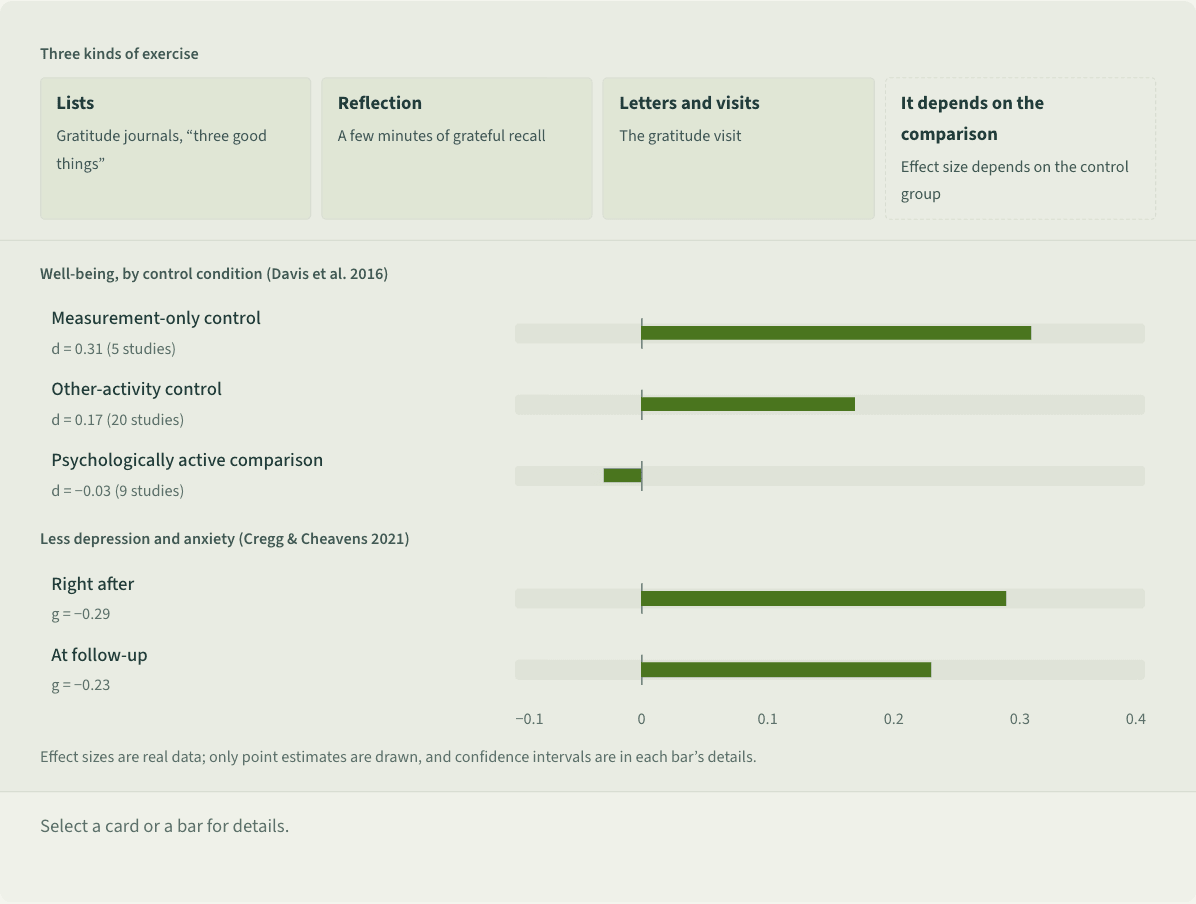
At the top, three cards: lists (gratitude journals, “three good things”); reflection (a few minutes of grateful recall); and letters and visits (the gratitude visit). Beside them, a card: it depends on the comparison. Below, a horizontal bar chart with a scale from −0.1 to 0.4 and a vertical line at 0. First group, “well-being, by control condition” (Davis et al. 2016): measurement-only control d = 0.31; other-activity control d = 0.17; psychologically active comparison d = −0.03, just below 0. Second group, “reduction in depression and anxiety symptoms” (Cregg and Cheavens 2021, 27 studies): right after the exercises 0.29; at follow-up 0.23, which the authors call small.
 Save as image (PNG)
This figure image is licensed CC BY 4.0: reuse it with credit and a link back to this page. How to reuse
Key points
- In a 2003 study, students who listed up to five things they were grateful for each week rated their lives and the coming week better than comparison groups; moods did not differ.[1]
- Exercises fall into three groups: regular lists, brief reflection, and thank-you letters or visits.[2] The idea is that keeping one’s blessings in view counters hedonic adaptation.[1]
- In a meta-analysis, well-being gains were d = 0.31 against measurement-only controls and 0.17 against other activities, with no advantage over psychologically active comparisons.[3]
- Another meta-analysis of 27 studies found small effects on depression and anxiety symptoms (g = −0.29), larger when the control group was a waitlist.[4]
An example
Every night before bed, Lin types three things she is thankful for into her phone: a coworker brought her lunch, she got a seat on the subway, her mother called. A month later she notices small kindnesses more often, though her mood has not changed much.
Misreadings and limits
Gratitude exercises are often promoted as positive psychology’s greatest success. A review found that many studies compared them with listing hassles; against more neutral controls the differences were often not significant.[2] For depression or anxiety, meta-analysts advise methods with stronger evidence.[4]
Sources
- 1 Emmons, R. A., & McCullough, M. E. (2003). Counting blessings versus burdens: An experimental investigation of gratitude and subjective well-being in daily life. Journal of Personality and Social Psychology, 84(2), 377–389. doi:10.1037/0022-3514.84.2.377
- 2 Wood, A. M., Froh, J. J., & Geraghty, A. W. A. (2010). Gratitude and well-being: A review and theoretical integration. Clinical Psychology Review, 30(7), 890–905. doi:10.1016/j.cpr.2010.03.005
- 3 Davis, D. E., Choe, E., Meyers, J., Wade, N., Varjas, K., Gifford, A., Quinn, A., Hook, J. N., Van Tongeren, D. R., Griffin, B. J., & Worthington, E. L., Jr. (2016). Thankful for the little things: A meta-analysis of gratitude interventions. Journal of Counseling Psychology, 63(1), 20–31. doi:10.1037/cou0000107
- 4 Cregg, D. R., & Cheavens, J. S. (2021). Gratitude interventions: Effective self-help? A meta-analysis of the impact on symptoms of depression and anxiety. Journal of Happiness Studies, 22(1), 413–445. doi:10.1007/s10902-020-00236-6
Last checked against sources: October 28, 2026