Resilience
心理韧性
What is resilience?
Resilience is the process of adapting well in the face of adversity, trauma, tragedy, threats or significant stress.[1] Longitudinal studies often define it as a stable trajectory of healthy functioning after a highly adverse event, with only brief disruption.[1][2]
More
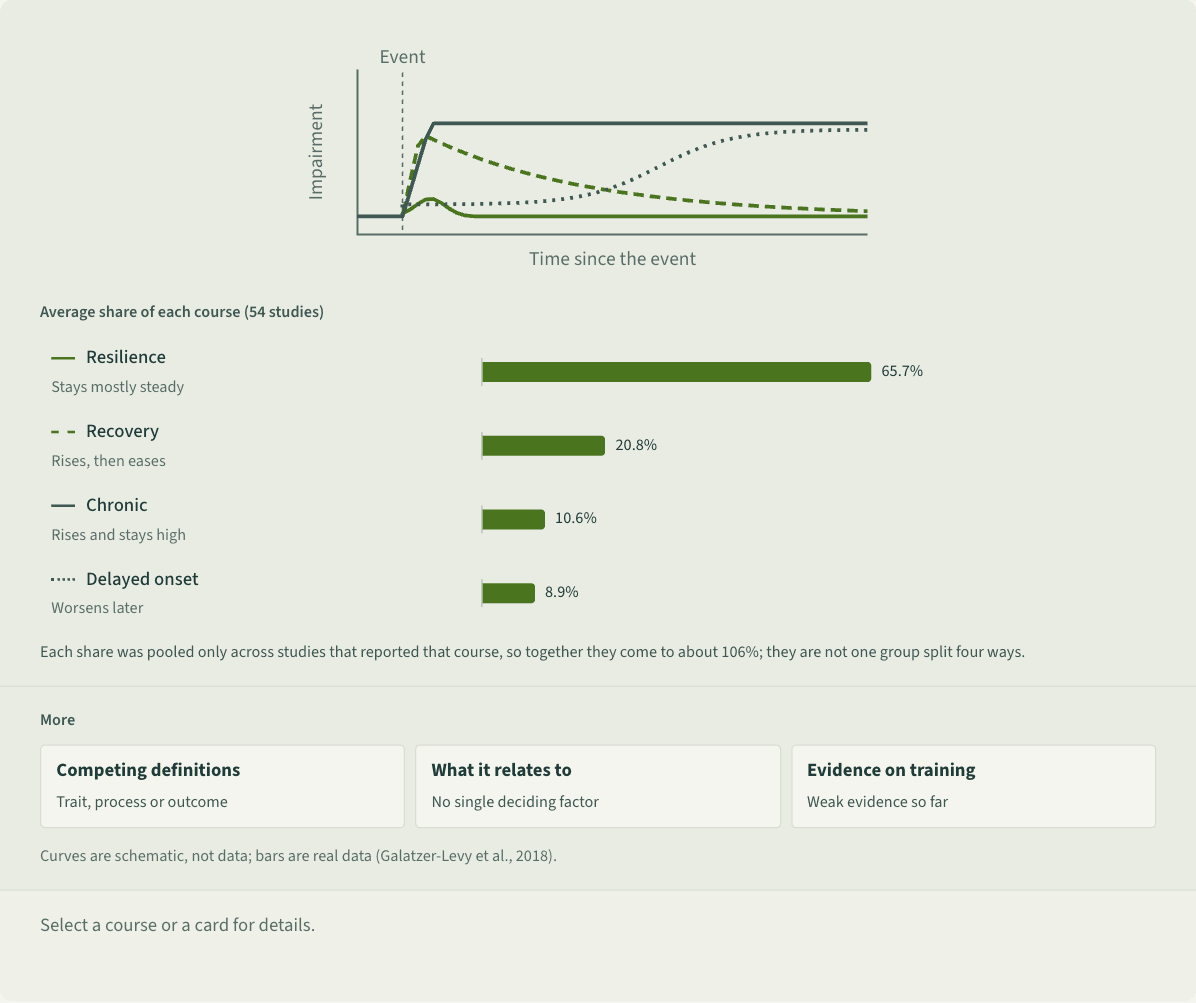
Curves are schematic, not data; bars are real data (Galatzer-Levy et al., 2018).
The upper half is a schematic line chart: time since the event runs along the bottom, impairment up the side, and the start is marked “event.” Four lines: resilience stays near the bottom with only a small bump after the event; recovery rises after the event and falls back over months to a year or two; chronic rises and stays high; delayed onset starts slightly raised and climbs only later. The lower half has four bars drawn to scale from 0 to 100%: resilience 65.7%, recovery 20.8%, chronic 10.6%, delayed onset 8.9%, with a note that each was pooled only across studies reporting that course, so they sum to about 106%. At the bottom, three cards: competing definitions (trait, process or outcome); what it relates to (no single deciding factor); and evidence on training (weak so far). A note says the curves are schematic.
 Save as image (PNG)
This figure image is licensed CC BY 4.0: reuse it with credit and a link back to this page. How to reuse
Key points
- A review pooling 54 studies found resilience the most common trajectory after potentially traumatic events, averaging 65.7%, followed by recovery, chronic distress and delayed onset.[3]
- Resilience is not recovery, in which symptoms last months or even a year or two before easing. Resilient people may sleep poorly or dwell on the event for weeks yet keep functioning.[2]
- Whether it is a trait, a process or an outcome is still debated; some argue that people with PTSD can be resilient too. Each known predictor explains little alone.[1]
- A Cochrane review of 44 randomized trials found that resilience training may raise health workers’ resilience and ease depression and stress, but the evidence is very uncertain.[4]
An example
After her father dies, Ms. Wang often wakes at night for the first few weeks and cries when she thinks of him. She keeps going to work and taking her children to school, and on weekends sorts his old photos with her sister. Two months later her sleep and mood are much as before.
Misreadings and limits
A common misreading treats resilience as a rare gift of people who never hurt. Research finds it common: resilient people still feel sadness and longing, but briefly and without derailing daily life.[2] Bereavement studies have found no clear evidence that grief held back now will erupt later.[2]
Sources
- 1 Southwick, S. M., Bonanno, G. A., Masten, A. S., Panter-Brick, C., & Yehuda, R. (2014). Resilience definitions, theory, and challenges: Interdisciplinary perspectives. European Journal of Psychotraumatology, 5(1), 25338. doi:10.3402/ejpt.v5.25338
- 2 Bonanno, G. A. (2004). Loss, trauma, and human resilience: Have we underestimated the human capacity to thrive after extremely aversive events?. American Psychologist, 59(1), 20–28. doi:10.1037/0003-066X.59.1.20
- 3 Galatzer-Levy, I. R., Huang, S. H., & Bonanno, G. A. (2018). Trajectories of resilience and dysfunction following potential trauma: A review and statistical evaluation. Clinical Psychology Review, 63, 41–55. doi:10.1016/j.cpr.2018.05.008
- 4 Kunzler, A. M., Helmreich, I., Chmitorz, A., König, J., Binder, H., Wessa, M., & Lieb, K. (2020). Psychological interventions to foster resilience in healthcare professionals. Cochrane Database of Systematic Reviews, 2020(7), CD012527. doi:10.1002/14651858.CD012527.pub2
Last checked against sources: October 28, 2026