Emotional blackmail
情绪勒索
What is emotional blackmail?
Emotional blackmail is a term from Susan Forward and Donna Frazier’s 1997 best seller: people close to us apply fear, obligation and guilt (FOG), implying we will suffer if we refuse, until we give in.[1] Academic research on it is scarce.[2]
One round (schematic)
FOG: three levers
In research
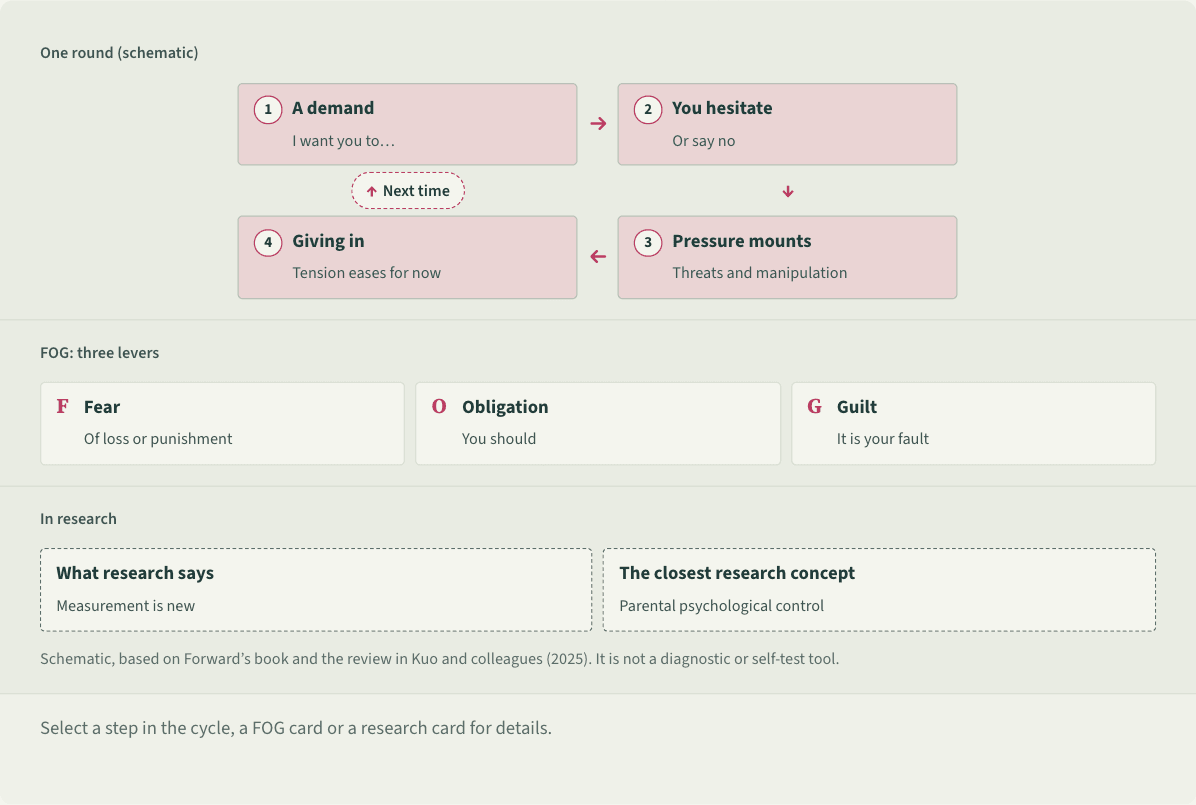
Schematic, based on Forward’s book and the review in Kuo and colleagues (2025). It is not a diagnostic or self-test tool.
Schematic. Four nodes in a ring at the top: making a demand, you are unwilling, pressure mounts, giving in; an arrow labeled “next time” runs from giving in back to the demand. Three cards in the middle: fear (of loss or punishment), obligation (you should), guilt (it is your fault). Two cards at the bottom: what research says (measurement is new) and the closest research concept (parental psychological control).
 Save as image (PNG)
This figure image is licensed CC BY 4.0: reuse it with credit and a link back to this page. How to reuse
Key points
- FOG names three levers: fear of being abandoned, raged at or frozen out; obligation, invoking the roles you are expected to fill; and guilt, blaming you for the other person’s unhappiness.[1][2]
- Forward frames it as a transaction: pressure mounts until you give in, and giving in teaches the other person that the tactic works, so it happens again.[1][2]
- Chou Mu-Tzu’s 2017 book of the same name was Taiwan’s best seller that year, selling over 110,000 copies. Drawing on filial piety and deference to authority, it urges self-worth and emotional boundaries.[3]
- Measurement is new: 25% of 199 partnered adults in Hong Kong reported it, and higher scores went with lower satisfaction; a Taiwanese parent–child version (356 adults) agreed. All rely on self-report.[2]
An example
Lin wants to take a job in another city. Her mother, Ms. Wang, says, “My health is poor. Who will look after me if you go? I raised you for nothing.” After a few days Lin turns the job down. Six months later she wants a weekend course; her mother says much the same, and Lin gives up again.
Misreadings and limits
The term comes from self-help.[1] Its closest research relative is parental psychological control, intruding on children’s thoughts and feelings through guilt induction or love withdrawal; it is linked to anxiety and depression, though its effects in Chinese families are debated.[4] The couple scale correlates .79 with a Four Horsemen scale.[2]
Sources
- 1 佛沃, S., & 費瑟, D.(Forward, S., & Frazier, D.) (2017). 《情緒勒索:遇到利用恐懼、責任與罪惡感控制你的人,該怎麼辦?》書摘(杜玉蓉 譯). 關鍵評論網,2017 年 9 月 30 日(摘自究竟出版中譯本;原著 1997 年由 HarperCollins 出版). View source
- 2 郭郡羽, 黃子格, & 張仁和 (2025). 「情緒勒索量表」中文化之信效度分析. 教育科學研究期刊, 70(1), 223–253. doi:10.6209/JORIES.202503_70(1).0007
- 3 Books From Taiwan (Ministry of Culture, Taiwan) (2018). Emotional blackmail (情緒勒索) by Chou Mu-Tzu: Book information and sample translation (H. Treadway, Trans.). Books From Taiwan. View source
- 4 高鑫, 邢淑芬, & 赵军燕 (2016). 父母的心理控制与儿童心理社会功能的关系. 心理科学进展, 24(11), 1792–1801. doi:10.3724/SP.J.1042.2016.01792
Last checked against sources: October 28, 2026