Coercive control
胁迫控制
What is coercive control?
Coercive control, a concept set out by Evan Stark, is a pattern in which one partner combines violence or threats with isolation, exploitation and control of daily life, leaving the other in a condition of unfreedom.[1] In perhaps a third of cases there is no notable physical violence.[1]
Common tactics
Law and research
Online terms
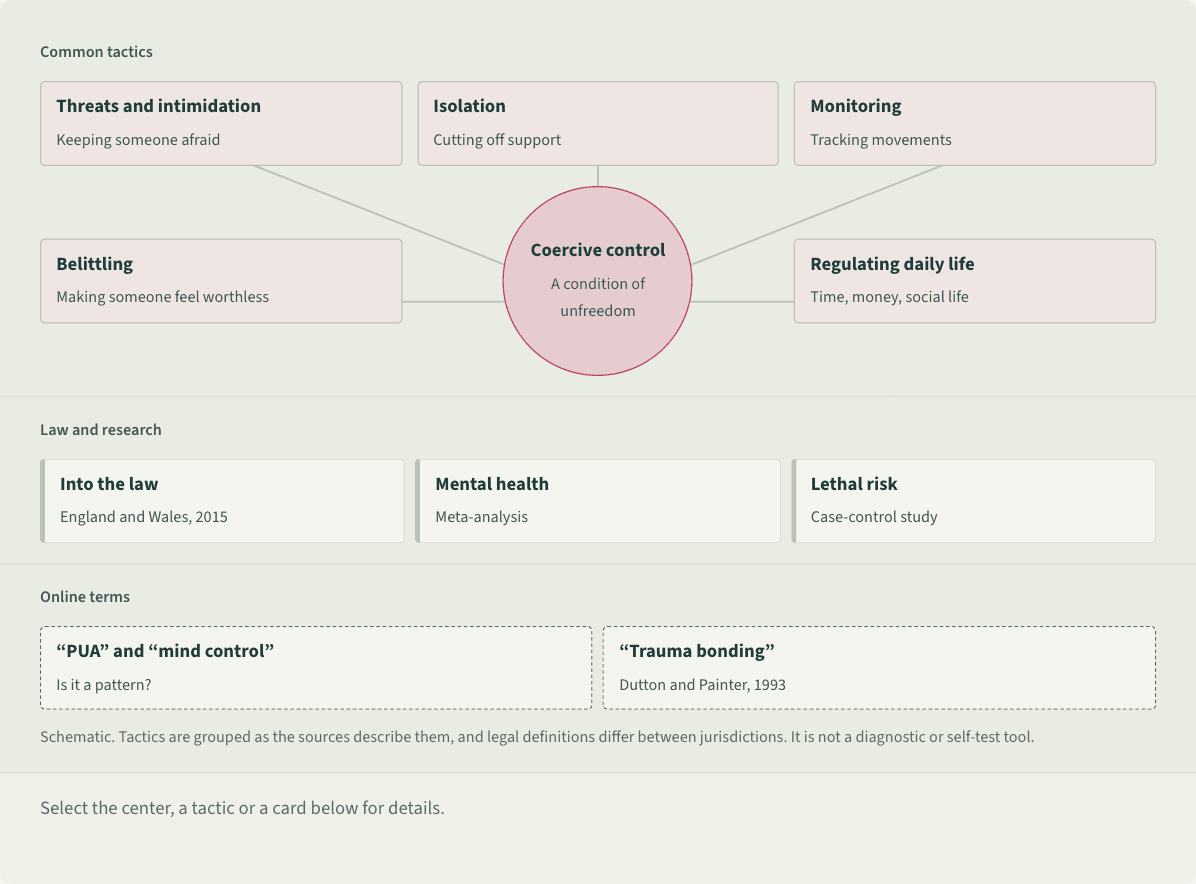
Schematic. Tactics are grouped as the sources describe them, and legal definitions differ between jurisdictions. It is not a diagnostic or self-test tool.
Schematic. A circle in the centre reads “Coercive control: a condition of unfreedom.” Five cards around it: threats and intimidation, isolation, monitoring, belittling, and regulating daily life. A row of three cards below: into the law (England and Wales, 2015), mental health (meta-analysis) and lethal risk (case-control study). Two cards at the bottom: “PUA” and “mind control,” and “trauma bonding.”
 Save as image (PNG)
This figure image is licensed CC BY 4.0: reuse it with credit and a link back to this page. How to reuse
Key points
- Common tactics include threats, isolation, monitoring and belittling, policing a partner’s time, spending, social life and eating, and gaslighting that makes someone feel “crazy.”[1][3]
- England and Wales made “controlling or coercive behaviour” in family relationships an offense in 2015, punishable by up to five years in prison; Scotland legislated in 2018.[1]
- It is moderately linked with PTSD and depression symptoms.[3] Where an abuser was highly controlling and the couple had separated after living together, the risk of femicide rose about ninefold.[2]
- Dutton and Painter tested “trauma bonding” theory: in 75 women who had left abusive partners, more intermittent abuse and wider power gaps went with stronger attachment.[4]
An example
Since Ms. Wang married, her husband has had her report where she goes each day; he often checks her phone and has taken over her bank card. When she arranges to see friends, he goes silent for days. Over the years she has nearly stopped seeing friends and asks him before buying so much as a shirt.
Misreadings and limits
Online labels such as “PUA” or “mind control” match coercive control only when they mean a lasting pattern of threats, isolation and control that forces compliance.[1] Researchers separate situational couple conflict from ongoing domination; a threat in one argument may not qualify, and common scales struggle to tell the two apart.[3] If you feel unsafe, contact the police or a domestic abuse service.
Sources
- 1 Stark, E., & Hester, M. (2019). Coercive control: Update and review. Violence Against Women, 25(1), 81–104. doi:10.1177/1077801218816191
- 2 Campbell, J. C., Webster, D., Koziol-McLain, J., Block, C., Campbell, D., Curry, M. A., Gary, F., Glass, N., McFarlane, J., Sachs, C., Sharps, P., Ulrich, Y., Wilt, S. A., Manganello, J., Xu, X., Schollenberger, J., Frye, V., & Laughon, K. (2003). Risk factors for femicide in abusive relationships: Results from a multisite case control study. American Journal of Public Health, 93(7), 1089–1097. doi:10.2105/AJPH.93.7.1089
- 3 Lohmann, S., Cowlishaw, S., Ney, L., O’Donnell, M., & Felmingham, K. (2024). The trauma and mental health impacts of coercive control: A systematic review and meta-analysis. Trauma, Violence, & Abuse, 25(1), 630–647. doi:10.1177/15248380231162972
- 4 Dutton, D. G., & Painter, S. (1993). Emotional attachments in abusive relationships: A test of traumatic bonding theory. Violence and Victims, 8(2), 105–120. doi:10.1891/0886-6708.8.2.105
Last checked against sources: October 28, 2026