Logotherapy
意义疗法
What is logotherapy?
Logotherapy is the approach to psychotherapy founded by the Austrian psychiatrist Viktor Frankl, who held that the search for meaning is the primary human motivation.[1] It helps clients through crises of meaning, looking at what they create, what they experience and the attitude they take to suffering, so they reach their own answers.[2]
Where meaning comes from
Breaking the vicious circle
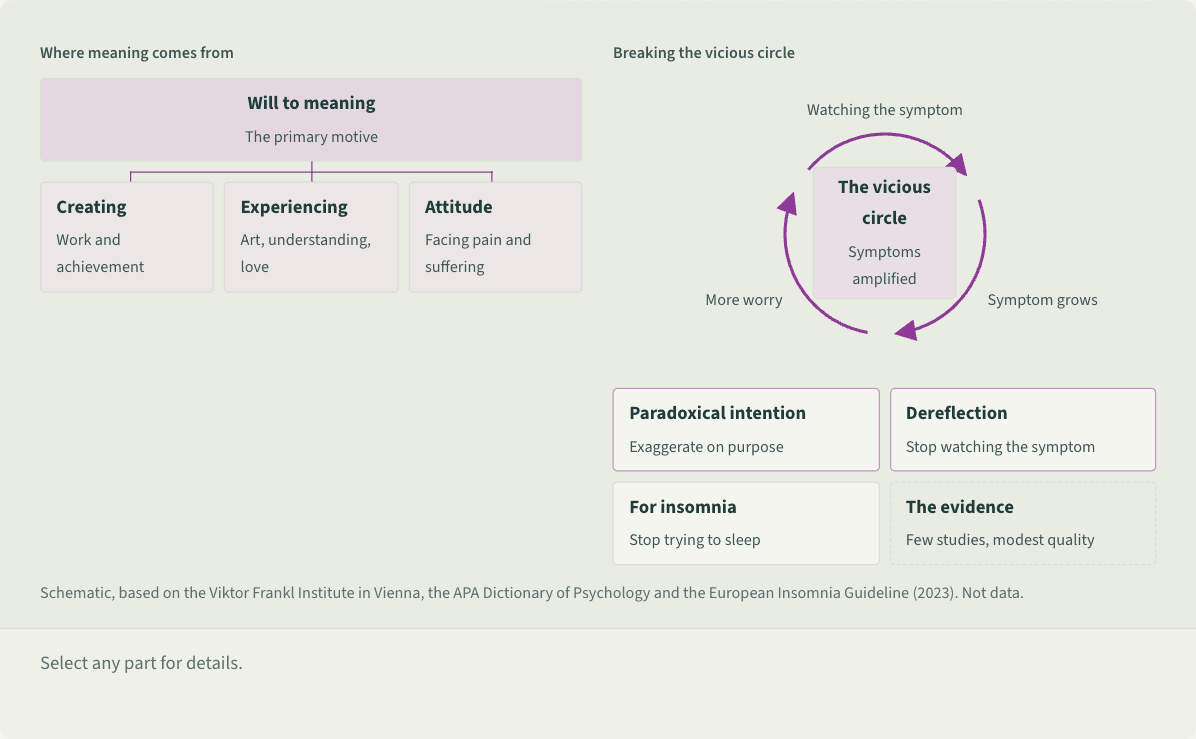
Schematic, based on the Viktor Frankl Institute in Vienna, the APA Dictionary of Psychology and the European Insomnia Guideline (2023). Not data.
Schematic in two columns. The left column, labeled where meaning comes from, has a card at the top, will to meaning (the primary motive), and three cards side by side below it: creating (work and achievement), experiencing (art, understanding, love) and attitude (facing pain and suffering). The right column, labeled breaking the vicious circle, shows a ring of arrows through three small labels, watching the symptom, symptom grows and more worry, around a selectable center, the vicious circle. Beside the ring are two cards for techniques that break it: paradoxical intention (exaggerate on purpose) and dereflection (stop watching the symptom). Below are two more cards: for insomnia (stop trying to sleep) and, with a dashed border, the evidence (few studies, modest quality). A note says the figure is a schematic, not data.
 Save as image (PNG)
This figure image is licensed CC BY 4.0: reuse it with credit and a link back to this page. How to reuse
Key points
- Frankl built on Freud’s psychoanalysis and Adler’s individual psychology, first publishing the approach in 1938. It is sometimes called the third Viennese school of psychotherapy.[1]
- It rests on three ideas: freedom to take a stance toward any condition, the will to meaning as the main drive, and meaning found in each situation, not assigned by the therapist.[1]
- Paradoxical intention has people deliberately exaggerate a feared symptom and use humor to gain distance.[1][2] For insomnia it means giving up trying to sleep; a European guideline lists it among cognitive techniques.[3]
- Evidence is thin. A meta-analysis pooled 15 randomized trials of existential therapies; six of meaning therapy raised sense of meaning, but the authors note the studies were few and of low quality.[4]
An example
Since retiring, Ms. Wang feels her days are empty. Her logotherapy-oriented counselor does not tell her what her life should mean. Instead he asks what has felt worthwhile lately. She recalls how absorbed she gets tutoring a neighbor’s child each week, and they start from there: what else could she create or experience?
Misreadings and limits
Logotherapy is often taken as feel-good advice to look on the bright side and find meaning in every hardship. It offers no general meaning of life, and therapists must not impose their own values.[1] Nor is paradoxical intention a life rule that doing the opposite brings success; it is a technique for specific symptoms, used under a therapist’s guidance.[1][2]
Sources
- 1 Batthyány, A. (n.d.). What is logotherapy/existential analysis?. Viktor Frankl Institut Wien. View source
- 2 American Psychological Association (2023). Logotherapy; Paradoxical intention. APA dictionary of psychology (entries updated November 15, 2023, and April 19, 2018). View source
- 3 Riemann, D., Espie, C. A., Altena, E., Arnardottir, E. S., Baglioni, C., Bassetti, C. L. A., Bastien, C., Berzina, N., Bjorvatn, B., Dikeos, D., Dolenc Groselj, L., Ellis, J. G., Garcia-Borreguero, D., Geoffroy, P. A., Gjerstad, M., Gonçalves, M., Hertenstein, E., Hoedlmoser, K., Hion, T., … Spiegelhalder, K. (2023). The European Insomnia Guideline: An update on the diagnosis and treatment of insomnia 2023. Journal of Sleep Research, 32(6), e14035. doi:10.1111/jsr.14035
- 4 Vos, J., Craig, M., & Cooper, M. (2015). Existential therapies: A meta-analysis of their effects on psychological outcomes. Journal of Consulting and Clinical Psychology, 83(1), 115–128. doi:10.1037/a0037167
Last checked against sources: October 28, 2026