Narrative therapy
叙事疗法
What is narrative therapy?
Narrative therapy holds that people make sense of their lives through stories; it treats problems as separate from people and clients as experts in their own lives.[1] Externalizing conversations put distance between person and problem, and the therapist builds on times when the problem had less hold to help clients author a preferred story.[1][2]
Separating person and problem
Events in a life
Practices, limits and evidence
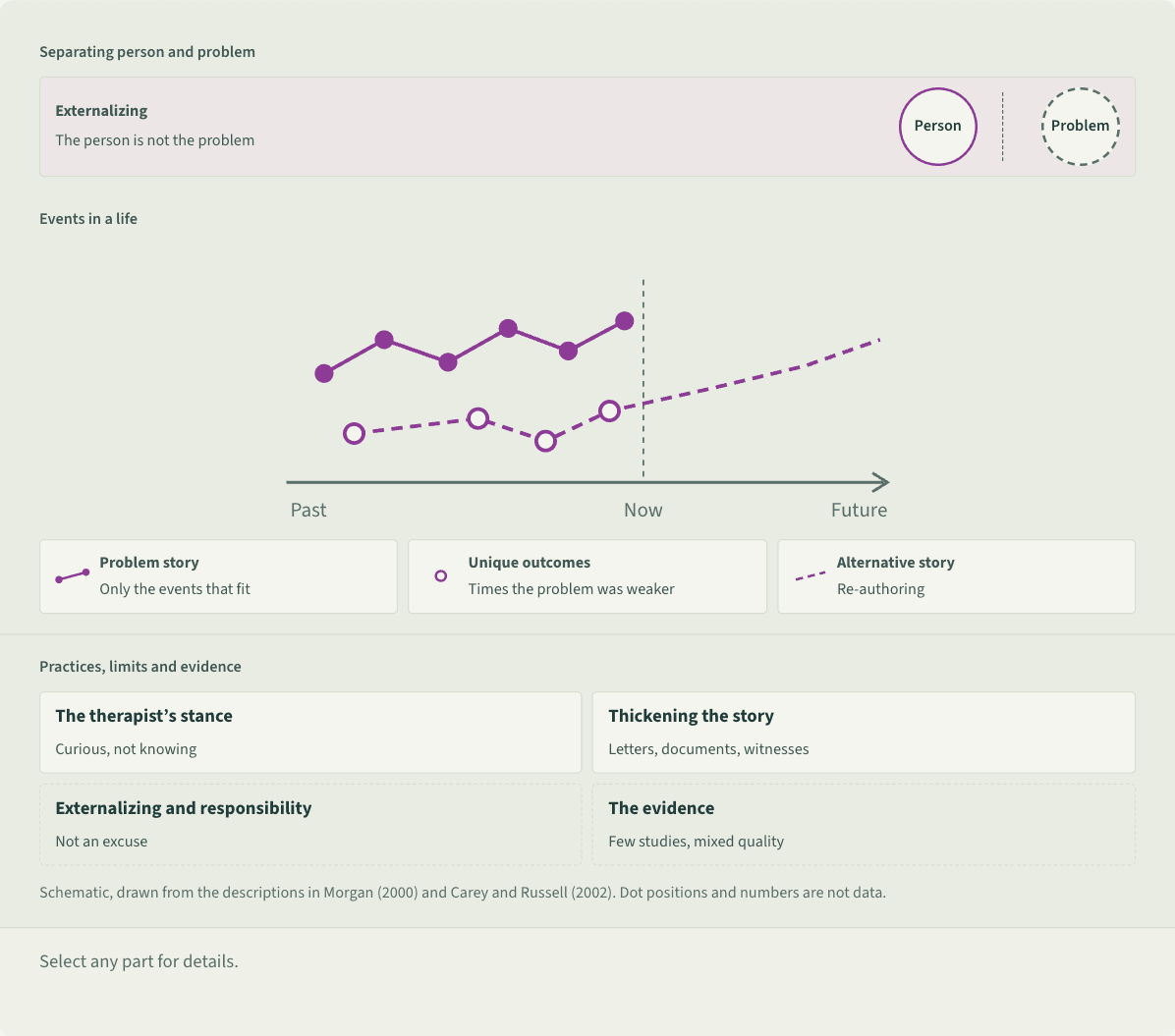
Schematic, drawn from the descriptions in Morgan (2000) and Carey and Russell (2002). Dot positions and numbers are not data.
Schematic in three rows. The top row, labeled separating person and problem, has one card, externalizing, with a circle for the person on the left and a circle for the problem on the right, a gap between them. The middle row, labeled events in a life, is a timeline running left to right from past through now to future. About a dozen dots sit above it: six solid dots joined by a solid line form the problem story; four hollow dots, the unique outcomes, are joined by a dashed line that runs on into the future, the alternative story. Each of these three has its own button. The bottom row, labeled practices, limits and evidence, has four cards: the therapist’s stance (curious, not knowing), thickening the story (letters, documents, witnesses), externalizing and responsibility (not an excuse), and the evidence (few studies, mixed quality); the last two have dashed borders. A note says the figure is a schematic and the dot positions are not data.
 Save as image (PNG)
This figure image is licensed CC BY 4.0: reuse it with credit and a link back to this page. How to reuse
Key points
- Michael White and David Epston developed it in the 1980s; their 1990 book, Narrative Means to Therapeutic Ends, is its founding text.[1][4]
- Externalizing, first developed with children, is summed up as “the person is not the problem; the problem is the problem.” “I’m a depressed person” becomes “How long has the depression influenced you?”[2]
- Therapists look for “unique outcomes,” moments when the problem had less influence, link them into an alternative storyline, and thicken it with letters, documents and outsider witnesses.[2]
- Research is thin: a 2023 scoping review found only 18 reports of narrative-based therapies for depression and other mood disorders; comparisons tentatively suggest results similar to other therapies.[3]
An example
Lin keeps calling herself “a procrastinator.” Her counselor asks instead, “When does procrastination tend to show up? What does it tell you about yourself?” Lin recalls the week last month when she handed in a report early. They follow that exception: what was different that week, and who helped her?
Misreadings and limits
Externalizing does not excuse harm: with people who have used violence, therapists trace the real effects on others to help them take responsibility.[2] A 2024 meta-analysis reported large effects, but most participants had physical illnesses, 52 of its 54 trials were from China, it included narrative nursing, and the evidence was rated very low quality.[4]
Sources
- 1 Morgan, A. (2000). What is narrative therapy? An easy-to-read introduction (extract: introduction and chapters 1–2). Dulwich Centre Publications. View source
- 2 Carey, M., & Russell, S. (2002). Externalising: Commonly asked questions. International Journal of Narrative Therapy and Community Work, 2002(2). View source
- 3 Hawke, L. D., Nguyen, A. T. P., Rodak, T., Yanos, P. T., & Castle, D. J. (2023). Narrative-based psychotherapies for mood disorders: A scoping review of the literature. SSM – Mental Health, 3, 100224. doi:10.1016/j.ssmmh.2023.100224
- 4 Hu, G., Han, B., Gains, H., & Jia, Y. (2024). Effectiveness of narrative therapy for depressive symptoms in adults with somatic disorders: A systematic review and meta-analysis. International Journal of Clinical and Health Psychology, 24(4), 100520. doi:10.1016/j.ijchp.2024.100520
Last checked against sources: October 28, 2026