Safe place exercise
安全岛技术
What is the safe place exercise?
The safe place exercise is a stabilizing imagery exercise used in trauma therapy: guided, the person imagines a real or invented place where they feel safe and comfortable, using different senses to make it vivid, to strengthen feelings of safety and the ability to self-soothe.[1]
Evidence and debate
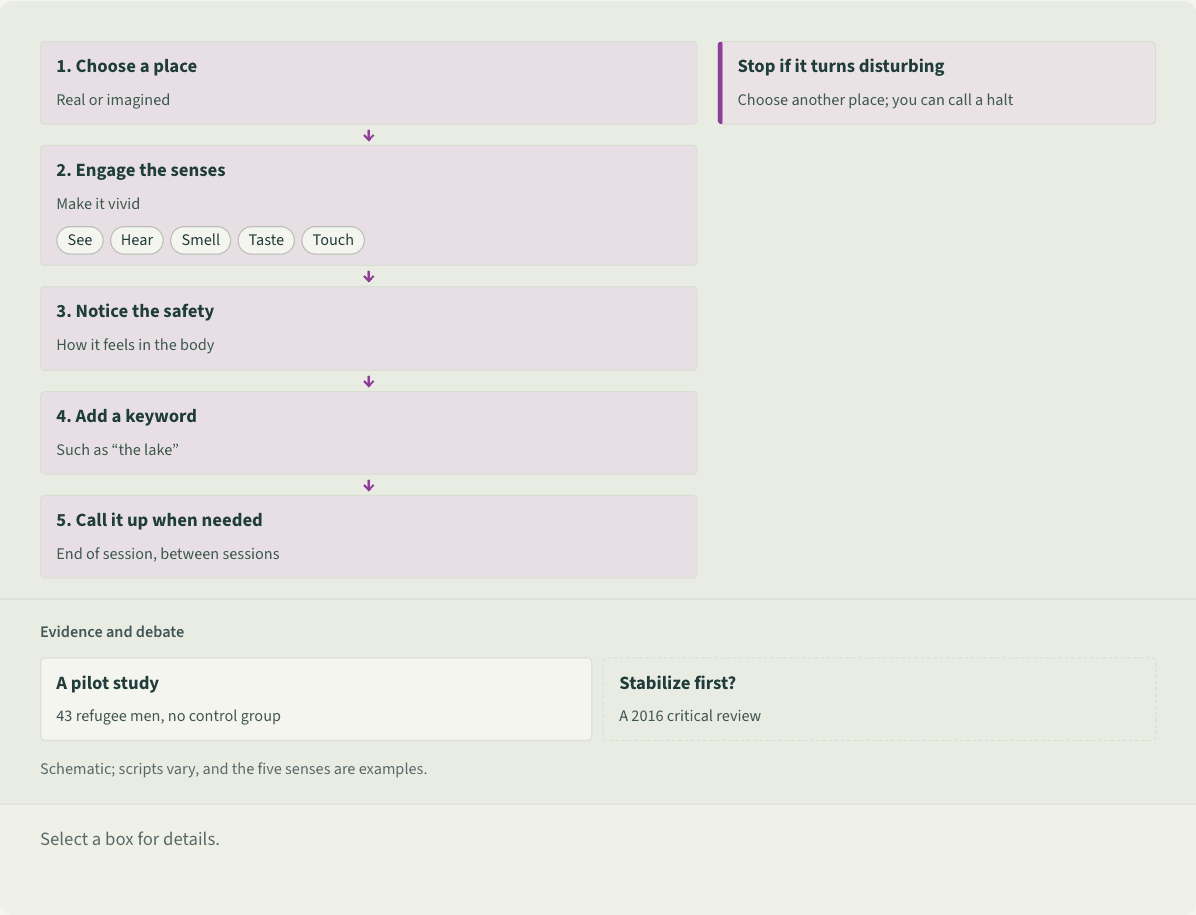
Schematic; scripts vary, and the five senses are examples.
Schematic. Five step cards from top to bottom, joined by downward arrows: one, choose a place, real or imagined; two, engage the senses, with five small tags: see, hear, smell, taste, touch; three, notice the feeling of safety in the body; four, add a keyword such as “the lake,” with a few sets of slow eye movements in EMDR; five, call it up when needed, such as at the end of a session or when anxious between sessions. Beside the steps, a reminder card: stop if anything disturbing appears, choose another place, and you can call a halt at any time. Below, two cards: a pilot study, and the debate over stabilizing first.
 Save as image (PNG)
This figure image is licensed CC BY 4.0: reuse it with credit and a link back to this page. How to reuse
Key points
- In EMDR preparation, the person picks a real or imagined place, the therapist checks it holds nothing disturbing, and slow, brief eye movements strengthen it along with a keyword.[2]
- The place is then revisited at the end of each session to settle emotions, and the person can call it up between sessions when distressed.[2]
- In a pilot study, refugee men practiced breathing, a body scan and imagery such as the safe place in groups; distress and anxiety fell, but PTSD and depression scores did not.[1]
- A guideline urged stabilization before processing traumatic memories in complex PTSD; a 2016 critical review found its evidence methodologically weak, with no rigorous research showing stabilization must come first.[4]
An example
Lin keeps waking to work messages at night, heart racing. Her therapist asks her to close her eyes and picture a place where she feels at ease. She chooses a childhood lake: light on the water, rustling reeds, the smell of grass, warm stones underfoot. She names it “the lake.” On anxious nights she now repeats the word and calms.
Misreadings and limits
It does not always bring a sense of safety: in interviews, some refugees struggled to picture a place, one said theirs had shattered, some could not keep out recurring thoughts, and some felt sad returning to reality.[3] As of 2018, the specific effect of such imagery techniques on PTSD had not been studied, and the pilot above had no control group.[1]
Sources
- 1 Zehetmair, C., Kaufmann, C., Tegeler, I., Kindermann, D., Junne, F., Zipfel, S., Herpertz, S. C., Herzog, W., & Nikendei, C. (2018). Psychotherapeutic group intervention for traumatized male refugees using imaginative stabilization techniques—A pilot study in a German reception center. Frontiers in Psychiatry, 9, 533. doi:10.3389/fpsyt.2018.00533
- 2 Russo, S., Fiani, F., & Napoli, C. (2024). Remote eye movement desensitization and reprocessing treatment of long-COVID- and post-COVID-related traumatic disorders: An innovative approach. Brain Sciences, 14(12), 1212. doi:10.3390/brainsci14121212
- 3 Zehetmair, C., Nagy, E., Leetz, C., Cranz, A., Kindermann, D., Reddemann, L., & Nikendei, C. (2020). Self-practice of stabilizing and guided imagery techniques for traumatized refugees via digital audio files: Qualitative study. Journal of Medical Internet Research, 22(9), e17906. doi:10.2196/17906
- 4 De Jongh, A., Resick, P. A., Zoellner, L. A., van Minnen, A., Lee, C. W., Monson, C. M., Foa, E. B., Wheeler, K., ten Broeke, E., Feeny, N., Rauch, S. A. M., Chard, K. M., Mueser, K. T., Sloan, D. M., van der Gaag, M., Rothbaum, B. O., Neuner, F., de Roos, C., Hehenkamp, L. M. J., Rosner, R., & Bicanic, I. A. E. (2016). Critical analysis of the current treatment guidelines for complex PTSD in adults. Depression and Anxiety, 33(5), 359–369. doi:10.1002/da.22469
Last checked against sources: October 28, 2026